
diff options
Diffstat (limited to 'README.md')
| -rw-r--r-- | README.md | 153 |
1 files changed, 73 insertions, 80 deletions
@@ -1,80 +1,73 @@ -# SADDNS2.0: DNS Cache Poisoning Attack: Resurrections with Side Channels
-
-## Introduction
-**SADDNS2.0** is a tool for launching the **DNS cache poisoning attack**. It infers the ephemeral port number and brute forces the TxID by exploiting ***F**orwarding Information Base(FIB) **N**ext **H**op **E**xception(FNHE)* cache as a side channel.
-
-This is a different side channel cache poisoning attack derived from [SADDNS](https://github.com/seclab-ucr/SADDNS). Most code usage may remain the same.
-
-## How it works
-1. Scan ephemeral ports opened by the resolver.
-2. Brute force TxID.
-
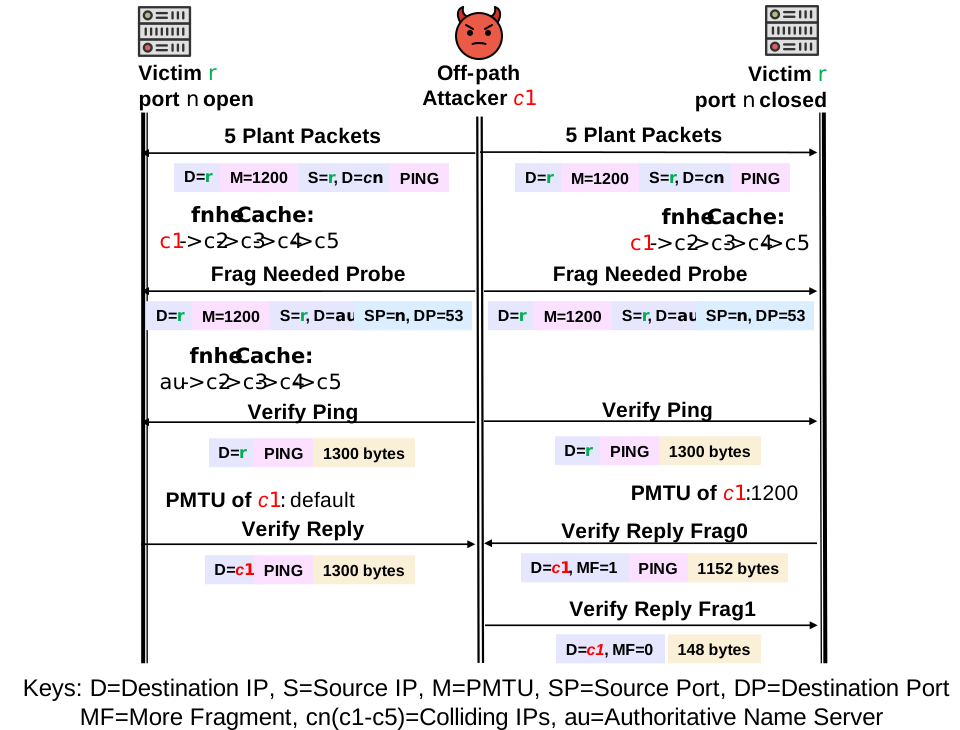
-The side channel leverages the hash table storing fnhe entry as a shared resource (between the **spoofed** and non-spoofed IPs), which controls whether an IP packet should be fragmented or not. This gives the off-path attacker the ability to identify whether previous **spoofed** ICMP fragment needed packets were accepted or not, which further indicates whether the guessed port is correct or not.
-
-The following figure shows the detail of inferring ephemeral ports.
-
-
-
-### Why spoofed IP is still necessary?
-- Compared with [SADDNS](https://github.com/seclab-ucr/SADDNS), SADDNS2.0 uses embedded UDP packet to scan open port and therefore no IP spoofing is needed during the scanning phase.
-- IP spoofing is still required for injecting rogue responses.
-
-## Additional resources
-
-### Publication
-
-[**DNS Cache Poisoning Attack: Resurrections with Side Channels**](https://doi.org/10.1145/3460120.3486219)
-
-Keyu Man, Xin'an Zhou, Zhiyun Qian
-
-*In Proceedings of ACM Conference on Computer and Communications Security (CCS`21), November 15-19, 2021, Virtual Event, Republic of Korea.*
-
-### Website
-
-[**SADDNS**](https://www.saddns.net)
-
-## How to run
-
-### Requirements
-
-- An IP-spoofing-capable host (preferably Linux. Windows is ok but suffers from low performance.).
-- A domain (attacker-controlled name server)
-- Other things needed to make clear:
- - The resolver to poison (victim resolver)
- - The domain to poison (victim domain)
- - *The **victim domain**'s record will be poisoned on the **victim resolver**.*
-
-### Overview
-
-- Determine the attack type (e.g., public or private port, fragment needed or redirect packet as the payload).
-- Guess the seed/key of FNHE hsah table if private port is used.
-- Flood query traffic to mute the name server of the victim domain (see [SADDNS](https://github.com/seclab-ucr/SADDNS) repo for flooding scripts).
-- Run attack program to guess the port number and TxID automatically.
-
-### Steps
-
-1. Compile
-
- ```go build ucr.edu/SADDNS2.0```(requires ```gopacket``` and ```libpcap```)
-
-2. Seed guessing (only required when probing private ports)
-
- See the paper for details. ```GuessSeed.go``` provides methods to send out seed guessing packets. ```guessSeed4.c``` implements hash guessing functions to guess the seed.
-
-4. Start flooding
-
- ```./dns_query.sh &```(requires ```hping3```)
-
- Please see the comment in the file for usage.
-
-5. Start attacking (flooding is still in progress)
-
- ```sudo ./saddns [args]```
-
- Run ```./saddns -h``` for usage.
-
-
-## Questions and issues
-
-Please submit them by opening a new issue.
-
+# SADDNS2.0: DNS Cache Poisoning Attack: Resurrections with Side Channels + +## Introduction +**SADDNS2.0** is a tool for launching the **DNS cache poisoning attack**. It infers the ephemeral port number and brute forces the TxID by exploiting ***F**orwarding Information Base(FIB) **N**ext **H**op **E**xception(FNHE)* cache as a side channel. + +This is a different side channel cache poisoning attack derived from [SADDNS](https://github.com/seclab-ucr/SADDNS). Most code usage may remain the same. + +## How it works +1. Scan ephemeral ports opened by the resolver. +2. Brute force TxID. + +The side channel leverages the hash table storing fnhe entry as a shared resource (between the **spoofed** and non-spoofed IPs), which controls whether an IP packet should be fragmented or not. This gives the off-path attacker the ability to identify whether previous **spoofed** ICMP fragment needed packets were accepted or not, which further indicates whether the guessed port is correct or not. + +The following figure shows the detail of inferring ephemeral ports. + + + +### Why spoofed IP is still necessary? +- Compared with [SADDNS](https://github.com/seclab-ucr/SADDNS), SADDNS2.0 uses embedded UDP packet to scan open port and therefore no IP spoofing is needed during the scanning phase. +- IP spoofing is still required for injecting rogue responses. + +## Additional resources + + +### Website + +[**SADDNS**](https://www.saddns.net) + +## How to run + +### Requirements + +- An IP-spoofing-capable host (preferably Linux. Windows is ok but suffers from low performance.). +- A domain (attacker-controlled name server) +- Other things needed to make clear: + - The resolver to poison (victim resolver) + - The domain to poison (victim domain) + - *The **victim domain**'s record will be poisoned on the **victim resolver**.* + +### Overview + +- Determine the attack type (e.g., public or private port, fragment needed or redirect packet as the payload). +- Guess the seed/key of FNHE hsah table if private port is used. +- Flood query traffic to mute the name server of the victim domain (see [SADDNS](https://github.com/seclab-ucr/SADDNS) repo for flooding scripts). +- Run attack program to guess the port number and TxID automatically. + +### Steps + +1. Compile + + ```go build ucr.edu/SADDNS2.0```(requires ```gopacket``` and ```libpcap```) + +2. Seed guessing (only required when probing private ports) + + See the paper for details. ```GuessSeed.go``` provides methods to send out seed guessing packets. ```guessSeed4.c``` implements hash guessing functions to guess the seed. + +4. Start flooding + + ```./dns_query.sh &```(requires ```hping3```) + + Please see the comment in the file for usage. + +5. Start attacking (flooding is still in progress) + + ```sudo ./saddns [args]``` + + Run ```./saddns -h``` for usage. + + +## Questions and issues + +Please submit them by opening a new issue. + |