
diff options
| author | yangwei <[email protected]> | 2024-04-01 18:02:33 +0800 |
|---|---|---|
| committer | yangwei <[email protected]> | 2024-04-03 15:43:47 +0800 |
| commit | 61ced1df7e02f9022a0f18ddb0515a0e7193a3a0 (patch) | |
| tree | 244e916f4642f150ff46011dba2ad96270d8e15f | |
| parent | 132e9473ff47e8d4f37479b6231fd2ec5948753a (diff) | |
✨ feat(ap_bloom): 使用ap_bloom替代dabloom
27 files changed, 11632 insertions, 31 deletions
diff --git a/.gitlab-ci.yml b/.gitlab-ci.yml index 7837140..456338c 100644 --- a/.gitlab-ci.yml +++ b/.gitlab-ci.yml @@ -56,6 +56,8 @@ stages: --suppress=uselessAssignmentArg --suppress=uninitvar --suppress=unusedStructMember + --suppress=preprocessorErrorDirective + --suppress=syntaxError tags: - share diff --git a/CMakeLists.txt b/CMakeLists.txt index 0e17282..7233696 100644 --- a/CMakeLists.txt +++ b/CMakeLists.txt @@ -49,6 +49,8 @@ if (CMAKE_CXX_CPPCHECK) "--suppress=uselessAssignmentArg" "--suppress=uninitvar" "--suppress=unusedStructMember" + "--suppress=preprocessorErrorDirective" + "--suppress=syntaxError" ) set(CMAKE_C_CPPCHECK ${CMAKE_CXX_CPPCHECK}) else() @@ -201,7 +203,7 @@ set(SAPP_DEPEND_DYN_LIB MESA_handle_logger MESA_prof_load MESA_htable MESA_fiel set(SAPP_INNER_STATIC_LIB sapp_dev dealpkt packet_io packet_io_pcap packet_io_marsio common config inline_keepalive gdev_assistant sapp_assistant sapp_metrics plugctrl project timer md5 symbol_check tomlc99_wrap MESA_socket_wrap timestamp_record - MESA_sleep dpdk_ip_hash cpu_limit timeout libdabloom token_bucket) + MESA_sleep dpdk_ip_hash cpu_limit timeout ap_bloom token_bucket) if(LIBEVENT_ENABLED) set(SAPP_INNER_STATIC_LIB ${SAPP_INNER_STATIC_LIB} libevent-static) diff --git a/bin/etc/sapp.toml b/bin/etc/sapp.toml index dee3978..2be5600 100644 --- a/bin/etc/sapp.toml +++ b/bin/etc/sapp.toml @@ -213,7 +213,7 @@ [TOOLS] [tools.pkt_dump] - enabled=1 + enabled=0 ### note, mode options value:[storage, udp_socket] mode="udp_socket" BSD_packet_filter="" diff --git a/include/private/sapp_global_val.h b/include/private/sapp_global_val.h index 911330e..5e6013f 100644 --- a/include/private/sapp_global_val.h +++ b/include/private/sapp_global_val.h @@ -213,6 +213,7 @@ typedef struct{ int bloom_capacity; double bloom_error_rate; int bloom_timeout; + int bloom_slice_num; }sapp_dup_pkt_t; typedef struct{ diff --git a/src/config/config_parse.cpp b/src/config/config_parse.cpp index bb4493a..97f5dee 100644 --- a/src/config/config_parse.cpp +++ b/src/config/config_parse.cpp @@ -1736,6 +1736,7 @@ int sapp_parse_config(void) tomlc99_wrap_load_int_def(ABBR_CFG_FILE_MAIN_ENTRY, (char *)"dup_pkt.parameter", (char *)"bloom_capacity", &pconfig->packet_io.dup_pkt_para.bloom_capacity, 1000000); tomlc99_wrap_load_int_def(ABBR_CFG_FILE_MAIN_ENTRY, (char *)"dup_pkt.parameter", (char *)"bloom_timeout", &pconfig->packet_io.dup_pkt_para.bloom_timeout, 10); + tomlc99_wrap_load_int_def(ABBR_CFG_FILE_MAIN_ENTRY, (char *)"dup_pkt.parameter", (char *)"bloom_slice_num", &pconfig->packet_io.dup_pkt_para.bloom_slice_num, 10); tomlc99_wrap_load_string_def(ABBR_CFG_FILE_MAIN_ENTRY, (char *)"dup_pkt.parameter", (char *)"bloom_error_rate", str_tmp, sizeof(str_tmp), "0.00001"); pconfig->packet_io.dup_pkt_para.bloom_error_rate = strtod(str_tmp, NULL); diff --git a/src/dealpkt/CMakeLists.txt b/src/dealpkt/CMakeLists.txt index aa61abe..1215798 100644 --- a/src/dealpkt/CMakeLists.txt +++ b/src/dealpkt/CMakeLists.txt @@ -7,7 +7,7 @@ include_directories(${CMAKE_SOURCE_DIR}/include/support) include_directories(${CMAKE_SOURCE_DIR}/src/support/dablooms/src) include_directories(${MESA_SDK_PREFIX}/include) include_directories(${MESA_SDK_PREFIX}/include/MESA) - +include_directories(${CMAKE_SOURCE_DIR}/src/support/ap_bloom/src) if(OPT_IOMODE_MARSIO) include_directories(${MARSIO_SDK_PREFIX}/include) diff --git a/src/dealpkt/duplicate_pkt_distinguish.c b/src/dealpkt/duplicate_pkt_distinguish.c index ef154e8..75e12ba 100644 --- a/src/dealpkt/duplicate_pkt_distinguish.c +++ b/src/dealpkt/duplicate_pkt_distinguish.c @@ -4,8 +4,8 @@ extern "C" { #include "sapp_api.h" #include "sapp_private_api.h" #include "sapp_declaration.h" -#include "dablooms.h" +#include "ap_bloom.h" /* 识别因路由策略导致的重复流量, 首次收到数据包加入bloom filter, @@ -41,8 +41,12 @@ int sapp_dup_stream_search(struct streaminfo *a_stream) key = (void *)a_stream->addr.tuple4_v6; key_len=sizeof(struct stream_tuple4_v6); } - return expiry_dablooms_search((struct expiry_dablooms_handle *)sapp_global_val->mthread_volatile[a_stream->threadnum]->dup_pkt_distinguish_handle, - (const char *)key, key_len, (time_t)g_CurrentTime); + + struct timeval now; + now.tv_sec = g_CurrentTime; + now.tv_usec=0; + return AP_bloom_check((const struct AP_bloom *)sapp_global_val->mthread_volatile[a_stream->threadnum]->dup_pkt_distinguish_handle, + now, (const char *)key, key_len); } void sapp_dup_stream_add(struct streaminfo *a_stream) @@ -59,13 +63,13 @@ void sapp_dup_stream_add(struct streaminfo *a_stream) key = (void *)a_stream->addr.tuple4_v6; key_len=sizeof(struct stream_tuple4_v6); } - int ret = expiry_dablooms_add( - (struct expiry_dablooms_handle *)sapp_global_val->mthread_volatile[a_stream->threadnum]->dup_pkt_distinguish_handle, - (const char *)key, key_len, (time_t)g_CurrentTime); - if (ret < 0) - { - sapp_global_val->mthread_volatile[a_stream->threadnum]->sys_stat.count[SAPP_STAT_DUP_IDENTIFY_ERR]++; - } + struct timeval now; + now.tv_sec = g_CurrentTime; + now.tv_usec=0; + AP_bloom_add( + (struct AP_bloom *)sapp_global_val->mthread_volatile[a_stream->threadnum]->dup_pkt_distinguish_handle, + now, + (const char *)key, key_len); } static inline int sapp_set_dup_pkt_key(enum addr_type_t addr_type, enum stream_type_t stream_type, const void *iphdr, @@ -123,19 +127,19 @@ int sapp_dup_pkt_identify(int tid, struct streaminfo_private *pstream_pr, { int is_dup_pkt = 0; union sapp_dup_pkt_key dup_bloom_key; - + struct timeval now; + now.tv_sec = g_CurrentTime; + now.tv_usec=0; + size_t key_len = sapp_set_dup_pkt_key((enum addr_type_t)pstream_pr->stream_public.addr.addrtype, (enum stream_type_t)pstream_pr->stream_public.type, ip_hdr, (void *)l4_hdr, &dup_bloom_key); - is_dup_pkt= expiry_dablooms_search((struct expiry_dablooms_handle *)sapp_global_val->mthread_volatile[tid]->dup_pkt_distinguish_handle, - (const char *)&dup_bloom_key, key_len, (time_t)g_CurrentTime); + is_dup_pkt= AP_bloom_check((const struct AP_bloom *)sapp_global_val->mthread_volatile[tid]->dup_pkt_distinguish_handle, + now, (const char *)&dup_bloom_key, key_len); if(is_dup_pkt != 0){ pstream_pr->has_duplicate_pkt = 1; }else{ if(need_add_bloom_filter){ - int ret = expiry_dablooms_add((struct expiry_dablooms_handle *)sapp_global_val->mthread_volatile[tid]->dup_pkt_distinguish_handle, - (const char *)&dup_bloom_key, key_len, (time_t)g_CurrentTime); - if(ret < 0){ - sapp_global_val->mthread_volatile[tid]->sys_stat.count[SAPP_STAT_DUP_IDENTIFY_ERR]++; - } + AP_bloom_add((struct AP_bloom *)sapp_global_val->mthread_volatile[tid]->dup_pkt_distinguish_handle, + now, (const char *)&dup_bloom_key, key_len); } } return is_dup_pkt; @@ -146,15 +150,14 @@ void sapp_dup_pkt_mark_l4(struct streaminfo *a_stream, const void *ip_hdr, const union sapp_dup_pkt_key dup_bloom_key; size_t key_len = 0; int ret = 0; + struct timeval now; + now.tv_sec = g_CurrentTime; + now.tv_usec=0; key_len = sapp_set_dup_pkt_key((enum addr_type_t)a_stream->addr.addrtype, (enum stream_type_t)a_stream->type, ip_hdr, l4_hdr, &dup_bloom_key); - ret = expiry_dablooms_add( - (struct expiry_dablooms_handle *)sapp_global_val->mthread_volatile[tid]->dup_pkt_distinguish_handle, - (const char *)&dup_bloom_key, key_len, (time_t)g_CurrentTime); + AP_bloom_add( + (struct AP_bloom *)sapp_global_val->mthread_volatile[tid]->dup_pkt_distinguish_handle, + now, (const char *)&dup_bloom_key, key_len); - if (ret < 0) - { - sapp_global_val->mthread_volatile[tid]->sys_stat.count[SAPP_STAT_DUP_IDENTIFY_ERR]++; - } return; } @@ -173,8 +176,11 @@ int sapp_dup_pkt_init(void) /* 流量入口有三个开关, 识别句柄只有一个, 拆分句柄多耗费内存, 且判断时每个包需要扫描多个句柄, 可能好处只是准确率高了一点点而已 */ + struct timeval now; + now.tv_sec = time(NULL); + now.tv_usec=0; for(i = 0; i < sapp_global_val->config.cpu.worker_threads; i++){ - sapp_global_val->mthread_volatile[i]->dup_pkt_distinguish_handle = (void *)expiry_dablooms_init(p_dup_conf->bloom_capacity, p_dup_conf->bloom_error_rate, time(NULL), p_dup_conf->bloom_timeout); + sapp_global_val->mthread_volatile[i]->dup_pkt_distinguish_handle = (void *)AP_bloom_new(now, p_dup_conf->bloom_error_rate, p_dup_conf->bloom_capacity, p_dup_conf->bloom_timeout*1000, p_dup_conf->bloom_slice_num); if(NULL == sapp_global_val->mthread_volatile[i]->dup_pkt_distinguish_handle){ sapp_log(RLOG_LV_FATAL, 1, 1, "dup_pkt_distinguish init error!"); return -1; @@ -192,7 +198,7 @@ void sapp_dup_pkt_destroy(void) for(i = 0; i < sapp_global_val->config.cpu.worker_threads; i++){ if(sapp_global_val->mthread_volatile[i]->dup_pkt_distinguish_handle){ - expiry_dablooms_destroy(sapp_global_val->mthread_volatile[i]->dup_pkt_distinguish_handle); + AP_bloom_free(sapp_global_val->mthread_volatile[i]->dup_pkt_distinguish_handle); } } diff --git a/src/entry/CMakeLists.txt b/src/entry/CMakeLists.txt index 3cfef40..16cf2cc 100644 --- a/src/entry/CMakeLists.txt +++ b/src/entry/CMakeLists.txt @@ -38,7 +38,7 @@ set(SAPP_MODULES timestamp_record md5 symbol_check MESA_sleep MESA_socket_wrap packet_io dealpkt project plugctrl common config timer tomlc99_wrap dpdk_ip_hash - gdev_assistant inline_keepalive libdabloom + gdev_assistant inline_keepalive ap_bloom sapp_dev sapp_assistant sapp_metrics platform_support cpu_limit timeout token_bucket) diff --git a/src/support/CMakeLists.txt b/src/support/CMakeLists.txt index 291c15f..469ea38 100644 --- a/src/support/CMakeLists.txt +++ b/src/support/CMakeLists.txt @@ -11,3 +11,4 @@ add_subdirectory(cpu_limit) add_subdirectory(dablooms) add_subdirectory(timeout) add_subdirectory(token_bucket) +add_subdirectory(ap_bloom) diff --git a/src/support/ap_bloom/CMakeLists.txt b/src/support/ap_bloom/CMakeLists.txt new file mode 100644 index 0000000..e89f0ff --- /dev/null +++ b/src/support/ap_bloom/CMakeLists.txt @@ -0,0 +1,6 @@ +cmake_minimum_required(VERSION 2.8...3.10) + + +add_definitions(-fPIC) +include_directories(${CMAKE_SOURCE_DIR}/src/support/ap_bloom/deps) +add_library(ap_bloom STATIC deps/xxhash.c deps/crdt_utils.c src/ap_bloom.c)
\ No newline at end of file diff --git a/src/support/ap_bloom/deps/LICENSE b/src/support/ap_bloom/deps/LICENSE new file mode 100644 index 0000000..6bc30a1 --- /dev/null +++ b/src/support/ap_bloom/deps/LICENSE @@ -0,0 +1,26 @@ +xxHash Library +Copyright (c) 2012-2020 Yann Collet +All rights reserved. + +BSD 2-Clause License (https://www.opensource.org/licenses/bsd-license.php) + +Redistribution and use in source and binary forms, with or without modification, +are permitted provided that the following conditions are met: + +* Redistributions of source code must retain the above copyright notice, this + list of conditions and the following disclaimer. + +* Redistributions in binary form must reproduce the above copyright notice, this + list of conditions and the following disclaimer in the documentation and/or + other materials provided with the distribution. + +THIS SOFTWARE IS PROVIDED BY THE COPYRIGHT HOLDERS AND CONTRIBUTORS "AS IS" AND +ANY EXPRESS OR IMPLIED WARRANTIES, INCLUDING, BUT NOT LIMITED TO, THE IMPLIED +WARRANTIES OF MERCHANTABILITY AND FITNESS FOR A PARTICULAR PURPOSE ARE +DISCLAIMED. IN NO EVENT SHALL THE COPYRIGHT HOLDER OR CONTRIBUTORS BE LIABLE FOR +ANY DIRECT, INDIRECT, INCIDENTAL, SPECIAL, EXEMPLARY, OR CONSEQUENTIAL DAMAGES +(INCLUDING, BUT NOT LIMITED TO, PROCUREMENT OF SUBSTITUTE GOODS OR SERVICES; +LOSS OF USE, DATA, OR PROFITS; OR BUSINESS INTERRUPTION) HOWEVER CAUSED AND ON +ANY THEORY OF LIABILITY, WHETHER IN CONTRACT, STRICT LIABILITY, OR TORT +(INCLUDING NEGLIGENCE OR OTHERWISE) ARISING IN ANY WAY OUT OF THE USE OF THIS +SOFTWARE, EVEN IF ADVISED OF THE POSSIBILITY OF SUCH DAMAGE. diff --git a/src/support/ap_bloom/deps/README.md b/src/support/ap_bloom/deps/README.md new file mode 100644 index 0000000..2406c8d --- /dev/null +++ b/src/support/ap_bloom/deps/README.md @@ -0,0 +1,236 @@ + +xxHash - Extremely fast hash algorithm +====================================== + +xxHash is an Extremely fast Hash algorithm, running at RAM speed limits. +It successfully completes the [SMHasher](https://code.google.com/p/smhasher/wiki/SMHasher) test suite +which evaluates collision, dispersion and randomness qualities of hash functions. +Code is highly portable, and hashes are identical across all platforms (little / big endian). + +|Branch |Status | +|------------|---------| +|dev | [](https://github.com/Cyan4973/xxHash/actions?query=branch%3Adev+) | + + +Benchmarks +------------------------- + +The reference system uses an Intel i7-9700K cpu, and runs Ubuntu x64 20.04. +The [open source benchmark program] is compiled with `clang` v10.0 using `-O3` flag. + +| Hash Name | Width | Bandwidth (GB/s) | Small Data Velocity | Quality | Comment | +| --------- | ----- | ---------------- | ----- | --- | --- | +| __XXH3__ (SSE2) | 64 | 31.5 GB/s | 133.1 | 10 +| __XXH128__ (SSE2) | 128 | 29.6 GB/s | 118.1 | 10 +| _RAM sequential read_ | N/A | 28.0 GB/s | N/A | N/A | _for reference_ +| City64 | 64 | 22.0 GB/s | 76.6 | 10 +| T1ha2 | 64 | 22.0 GB/s | 99.0 | 9 | Slightly worse [collisions] +| City128 | 128 | 21.7 GB/s | 57.7 | 10 +| __XXH64__ | 64 | 19.4 GB/s | 71.0 | 10 +| SpookyHash | 64 | 19.3 GB/s | 53.2 | 10 +| Mum | 64 | 18.0 GB/s | 67.0 | 9 | Slightly worse [collisions] +| __XXH32__ | 32 | 9.7 GB/s | 71.9 | 10 +| City32 | 32 | 9.1 GB/s | 66.0 | 10 +| Murmur3 | 32 | 3.9 GB/s | 56.1 | 10 +| SipHash | 64 | 3.0 GB/s | 43.2 | 10 +| FNV64 | 64 | 1.2 GB/s | 62.7 | 5 | Poor avalanche properties +| Blake2 | 256 | 1.1 GB/s | 5.1 | 10 | Cryptographic +| SHA1 | 160 | 0.8 GB/s | 5.6 | 10 | Cryptographic but broken +| MD5 | 128 | 0.6 GB/s | 7.8 | 10 | Cryptographic but broken + +[open source benchmark program]: https://github.com/Cyan4973/xxHash/tree/release/tests/bench +[collisions]: https://github.com/Cyan4973/xxHash/wiki/Collision-ratio-comparison#collision-study + +note 1: Small data velocity is a _rough_ evaluation of algorithm's efficiency on small data. For more detailed analysis, please refer to next paragraph. + +note 2: some algorithms feature _faster than RAM_ speed. In which case, they can only reach their full speed when input data is already in CPU cache (L3 or better). Otherwise, they max out on RAM speed limit. + +### Small data + +Performance on large data is only one part of the picture. +Hashing is also very useful in constructions like hash tables and bloom filters. +In these use cases, it's frequent to hash a lot of small data (starting at a few bytes). +Algorithm's performance can be very different for such scenarios, since parts of the algorithm, +such as initialization or finalization, become fixed cost. +The impact of branch mis-prediction also becomes much more present. + +XXH3 has been designed for excellent performance on both long and small inputs, +which can be observed in the following graph: + +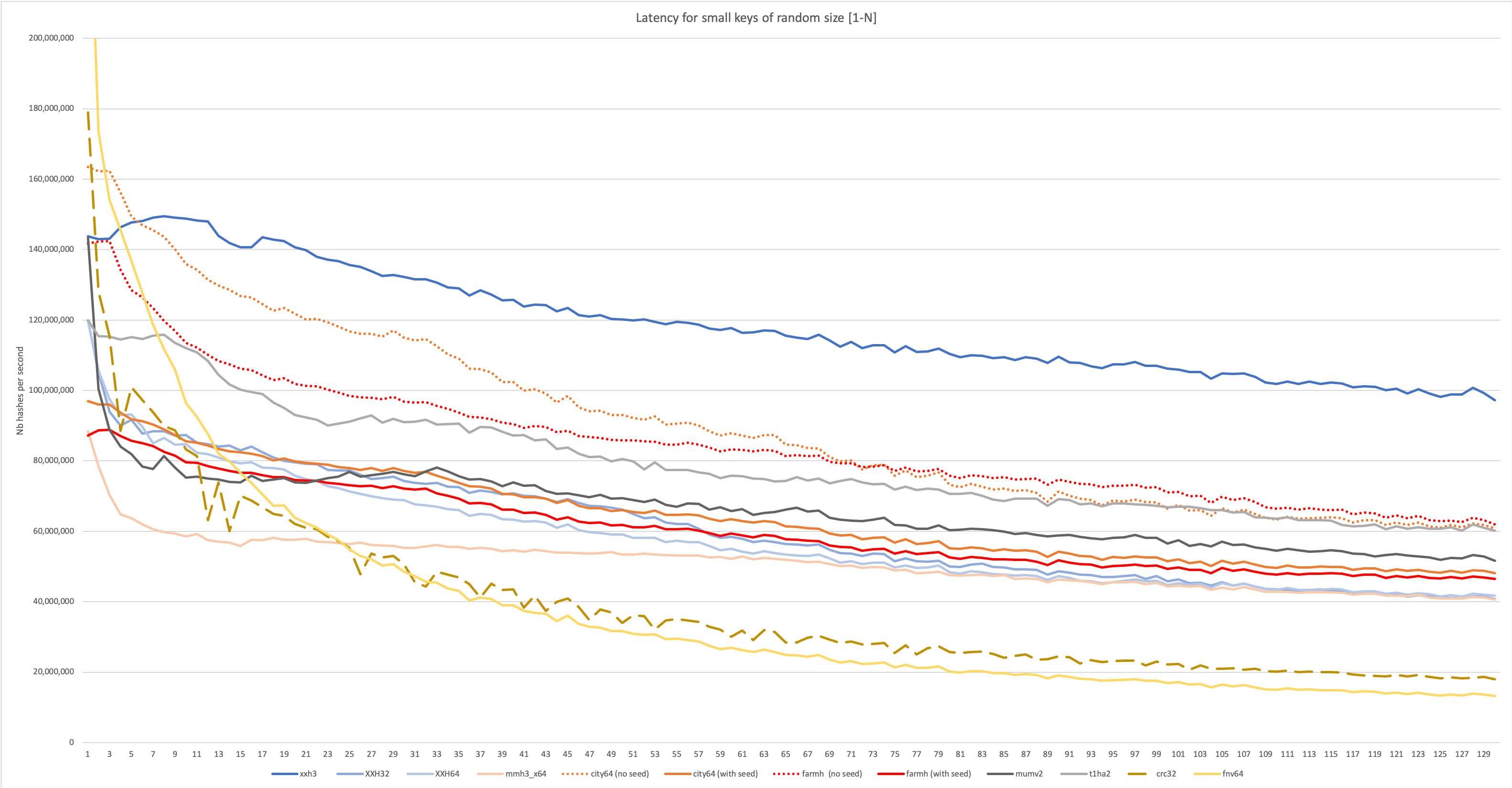 + +For a more detailed analysis, visit the wiki : +https://github.com/Cyan4973/xxHash/wiki/Performance-comparison#benchmarks-concentrating-on-small-data- + +Quality +------------------------- + +Speed is not the only property that matters. +Produced hash values must respect excellent dispersion and randomness properties, +so that any sub-section of it can be used to maximally spread out a table or index, +as well as reduce the amount of collisions to the minimal theoretical level, following the [birthday paradox]. + +`xxHash` has been tested with Austin Appleby's excellent SMHasher test suite, +and passes all tests, ensuring reasonable quality levels. +It also passes extended tests from [newer forks of SMHasher], featuring additional scenarios and conditions. + +Finally, xxHash provides its own [massive collision tester](https://github.com/Cyan4973/xxHash/tree/dev/tests/collisions), +able to generate and compare billions of hashes to test the limits of 64-bit hash algorithms. +On this front too, xxHash features good results, in line with the [birthday paradox]. +A more detailed analysis is documented [in the wiki](https://github.com/Cyan4973/xxHash/wiki/Collision-ratio-comparison). + +[birthday paradox]: https://en.wikipedia.org/wiki/Birthday_problem +[newer forks of SMHasher]: https://github.com/rurban/smhasher + + +### Build modifiers + +The following macros can be set at compilation time to modify libxxhash's behavior. They are generally disabled by default. + +- `XXH_INLINE_ALL`: Make all functions `inline`, with implementations being directly included within `xxhash.h`. + Inlining functions is beneficial for speed on small keys. + It's _extremely effective_ when key length is expressed as _a compile time constant_, + with performance improvements observed in the +200% range . + See [this article](https://fastcompression.blogspot.com/2018/03/xxhash-for-small-keys-impressive-power.html) for details. +- `XXH_PRIVATE_API`: same outcome as `XXH_INLINE_ALL`. Still available for legacy support. + The name underlines that `XXH_*` symbols will not be exported. +- `XXH_NAMESPACE`: Prefixes all symbols with the value of `XXH_NAMESPACE`. + This macro can only use compilable character set. + Useful to evade symbol naming collisions, + in case of multiple inclusions of xxHash's source code. + Client applications still use the regular function names, + as symbols are automatically translated through `xxhash.h`. +- `XXH_FORCE_MEMORY_ACCESS`: The default method `0` uses a portable `memcpy()` notation. + Method `1` uses a gcc-specific `packed` attribute, which can provide better performance for some targets. + Method `2` forces unaligned reads, which is not standards compliant, but might sometimes be the only way to extract better read performance. + Method `3` uses a byteshift operation, which is best for old compilers which don't inline `memcpy()` or big-endian systems without a byteswap instruction +- `XXH_FORCE_ALIGN_CHECK`: Use a faster direct read path when input is aligned. + This option can result in dramatic performance improvement when input to hash is aligned on 32 or 64-bit boundaries, + when running on architectures unable to load memory from unaligned addresses, or suffering a performance penalty from it. + It is (slightly) detrimental on platform with good unaligned memory access performance (same instruction for both aligned and unaligned accesses). + This option is automatically disabled on `x86`, `x64` and `aarch64`, and enabled on all other platforms. +- `XXH_VECTOR` : manually select a vector instruction set (default: auto-selected at compilation time). Available instruction sets are `XXH_SCALAR`, `XXH_SSE2`, `XXH_AVX2`, `XXH_AVX512`, `XXH_NEON` and `XXH_VSX`. Compiler may require additional flags to ensure proper support (for example, `gcc` on linux will require `-mavx2` for AVX2, and `-mavx512f` for AVX512). +- `XXH_NO_PREFETCH` : disable prefetching. Some platforms or situations may perform better without prefetching. XXH3 only. +- `XXH_PREFETCH_DIST` : select prefetching distance. For close-to-metal adaptation to specific hardware platforms. XXH3 only. +- `XXH_NO_INLINE_HINTS`: By default, xxHash uses `__attribute__((always_inline))` and `__forceinline` to improve performance at the cost of code size. + Defining this macro to 1 will mark all internal functions as `static`, allowing the compiler to decide whether to inline a function or not. + This is very useful when optimizing for smallest binary size, + and is automatically defined when compiling with `-O0`, `-Os`, `-Oz`, or `-fno-inline` on GCC and Clang. + This may also increase performance depending on compiler and architecture. +- `XXH32_ENDJMP`: Switch multi-branch finalization stage of XXH32 by a single jump. + This is generally undesirable for performance, especially when hashing inputs of random sizes. + But depending on exact architecture and compiler, a jump might provide slightly better performance on small inputs. Disabled by default. +- `XXH_STATIC_LINKING_ONLY`: gives access to internal state declaration, required for static allocation. + Incompatible with dynamic linking, due to risks of ABI changes. +- `XXH_NO_XXH3` : removes symbols related to `XXH3` (both 64 & 128 bits) from generated binary. + Useful to reduce binary size, notably for applications which do not use `XXH3`. +- `XXH_NO_LONG_LONG`: removes compilation of algorithms relying on 64-bit types (XXH3 and XXH64). Only XXH32 will be compiled. + Useful for targets (architectures and compilers) without 64-bit support. +- `XXH_IMPORT`: MSVC specific: should only be defined for dynamic linking, as it prevents linkage errors. +- `XXH_CPU_LITTLE_ENDIAN`: By default, endianness is determined by a runtime test resolved at compile time. + If, for some reason, the compiler cannot simplify the runtime test, it can cost performance. + It's possible to skip auto-detection and simply state that the architecture is little-endian by setting this macro to 1. + Setting it to 0 states big-endian. +- `XXH_DEBUGLEVEL` : When set to any value >= 1, enables `assert()` statements. + This (slightly) slows down execution, but may help finding bugs during debugging sessions. + +When compiling the Command Line Interface `xxhsum` with `make`, the following environment variables can also be set : +- `DISPATCH=1` : use `xxh_x86dispatch.c`, to automatically select between `scalar`, `sse2`, `avx2` or `avx512` instruction set at runtime, depending on local host. This option is only valid for `x86`/`x64` systems. + + +### Building xxHash - Using vcpkg + +You can download and install xxHash using the [vcpkg](https://github.com/Microsoft/vcpkg) dependency manager: + + git clone https://github.com/Microsoft/vcpkg.git + cd vcpkg + ./bootstrap-vcpkg.sh + ./vcpkg integrate install + ./vcpkg install xxhash + +The xxHash port in vcpkg is kept up to date by Microsoft team members and community contributors. If the version is out of date, please [create an issue or pull request](https://github.com/Microsoft/vcpkg) on the vcpkg repository. + + +### Example + +The simplest example calls xxhash 64-bit variant as a one-shot function +generating a hash value from a single buffer, and invoked from a C/C++ program: + +```C +#include "xxhash.h" + + (...) + XXH64_hash_t hash = XXH64(buffer, size, seed); +} +``` + +Streaming variant is more involved, but makes it possible to provide data incrementally: + +```C +#include "stdlib.h" /* abort() */ +#include "xxhash.h" + + +XXH64_hash_t calcul_hash_streaming(FileHandler fh) +{ + /* create a hash state */ + XXH64_state_t* const state = XXH64_createState(); + if (state==NULL) abort(); + + size_t const bufferSize = SOME_SIZE; + void* const buffer = malloc(bufferSize); + if (buffer==NULL) abort(); + + /* Initialize state with selected seed */ + XXH64_hash_t const seed = 0; /* or any other value */ + if (XXH64_reset(state, seed) == XXH_ERROR) abort(); + + /* Feed the state with input data, any size, any number of times */ + (...) + while ( /* some data left */ ) { + size_t const length = get_more_data(buffer, bufferSize, fh); + if (XXH64_update(state, buffer, length) == XXH_ERROR) abort(); + (...) + } + (...) + + /* Produce the final hash value */ + XXH64_hash_t const hash = XXH64_digest(state); + + /* State could be re-used; but in this example, it is simply freed */ + free(buffer); + XXH64_freeState(state); + + return hash; +} +``` + + +### License + +The library files `xxhash.c` and `xxhash.h` are BSD licensed. +The utility `xxhsum` is GPL licensed. + + +### Other programming languages + +Beyond the C reference version, +xxHash is also available from many different programming languages, +thanks to great contributors. +They are [listed here](http://www.xxhash.com/#other-languages). + + +### Packaging status + +Many distributions bundle a package manager +which allows easy xxhash installation as both a `libxxhash` library +and `xxhsum` command line interface. + +[](https://repology.org/project/xxhash/versions) + + +### Special Thanks + +- Takayuki Matsuoka, aka @t-mat, for creating `xxhsum -c` and great support during early xxh releases +- Mathias Westerdahl, aka @JCash, for introducing the first version of `XXH64` +- Devin Hussey, aka @easyaspi314, for incredible low-level optimizations on `XXH3` and `XXH128` diff --git a/src/support/ap_bloom/deps/crdt_utils.c b/src/support/ap_bloom/deps/crdt_utils.c new file mode 100644 index 0000000..c796081 --- /dev/null +++ b/src/support/ap_bloom/deps/crdt_utils.c @@ -0,0 +1,13 @@ +#include "crdt_utils.h" +#include "xxhash.h" + +void double_hash_init(struct double_hash *rv, const void *buffer, int len) +{ + rv->a=XXH3_64bits_withSeed(buffer, len, 0x9747b28c); + rv->b=XXH3_64bits_withSeed(buffer, len, rv->a); + return; +} +int double_hash_generate(const struct double_hash *rv, int i, int m) +{ + return (rv->a + i * rv->b) % m; +}
\ No newline at end of file diff --git a/src/support/ap_bloom/deps/crdt_utils.h b/src/support/ap_bloom/deps/crdt_utils.h new file mode 100644 index 0000000..951e44b --- /dev/null +++ b/src/support/ap_bloom/deps/crdt_utils.h @@ -0,0 +1,48 @@ +#pragma once + +#include <stdlib.h> //calloc +#include <sys/time.h>//gettimeofday +#include <stdint.h> //uint64_t + +#define ALLOC(type, number) ((type *)calloc(sizeof(type), number)) +#define FREE(p) {free(*p);*p=NULL;} + +#define TRUE 1 +#define FALSE 0 + +#ifndef MAX +#define MAX(a, b) (((a) > (b)) ? (a) : (b)) +#endif + +#ifndef MIN +#define MIN(a, b) (((a) < (b)) ? (a) : (b)) +#endif + +#ifndef offsetof +#define offsetof(TYPE, MEMBER) ((size_t) &((TYPE *)0)->MEMBER) +#endif + +#ifndef container_of +#define container_of(ptr, type, member) ({ \ + const typeof( ((type *)0)->member ) *__mptr = (ptr); \ + (type *)( (char *)__mptr - offsetof(type,member) );}) +#endif +#define timeval_delta_ms(start, end) (((end).tv_sec-(start).tv_sec)*1000 + ((end).tv_usec-(start).tv_usec)/1000) +#define timeval_delta_us(start, end) (((end).tv_sec-(start).tv_sec)*1000*1000 + ((end).tv_usec-(start).tv_usec)) +#define timeval_to_ms(t) ((t).tv_sec*1000+(t).tv_usec/1000) +#define likely(x) __builtin_expect((x),1) +#define unlikely(x) __builtin_expect((x),0) + + + +// Double hashing for fast hashing, +// reference: Kirsch, Adam, and Michael Mitzenmacher. "Less hashing, same performance: Building a better bloom filter." +// Algorithms–ESA 2006: 14th Annual European Symposium, Zurich, Switzerland, September 11-13, 2006. Proceedings 14. Springer Berlin Heidelberg, 2006. +// https://www.eecs.harvard.edu/~michaelm/postscripts/rsa2008.pdf +struct double_hash +{ + uint64_t a; + uint64_t b; +}; +void double_hash_init(struct double_hash *rv, const void *buffer, int len); +int double_hash_generate(const struct double_hash *rv, int i, int m);
\ No newline at end of file diff --git a/src/support/ap_bloom/deps/utarray.h b/src/support/ap_bloom/deps/utarray.h new file mode 100644 index 0000000..6b62018 --- /dev/null +++ b/src/support/ap_bloom/deps/utarray.h @@ -0,0 +1,247 @@ +/* +Copyright (c) 2008-2018, Troy D. Hanson http://troydhanson.github.com/uthash/ +All rights reserved. + +Redistribution and use in source and binary forms, with or without +modification, are permitted provided that the following conditions are met: + + * Redistributions of source code must retain the above copyright + notice, this list of conditions and the following disclaimer. + +THIS SOFTWARE IS PROVIDED BY THE COPYRIGHT HOLDERS AND CONTRIBUTORS "AS +IS" AND ANY EXPRESS OR IMPLIED WARRANTIES, INCLUDING, BUT NOT LIMITED +TO, THE IMPLIED WARRANTIES OF MERCHANTABILITY AND FITNESS FOR A +PARTICULAR PURPOSE ARE DISCLAIMED. IN NO EVENT SHALL THE COPYRIGHT OWNER +OR CONTRIBUTORS BE LIABLE FOR ANY DIRECT, INDIRECT, INCIDENTAL, SPECIAL, +EXEMPLARY, OR CONSEQUENTIAL DAMAGES (INCLUDING, BUT NOT LIMITED TO, +PROCUREMENT OF SUBSTITUTE GOODS OR SERVICES; LOSS OF USE, DATA, OR +PROFITS; OR BUSINESS INTERRUPTION) HOWEVER CAUSED AND ON ANY THEORY OF +LIABILITY, WHETHER IN CONTRACT, STRICT LIABILITY, OR TORT (INCLUDING +NEGLIGENCE OR OTHERWISE) ARISING IN ANY WAY OUT OF THE USE OF THIS +SOFTWARE, EVEN IF ADVISED OF THE POSSIBILITY OF SUCH DAMAGE. +*/ + +/* a dynamic array implementation using macros + */ +#ifndef UTARRAY_H +#define UTARRAY_H + +#define UTARRAY_VERSION 2.1.0 + +#include <stddef.h> /* size_t */ +#include <string.h> /* memset, etc */ +#include <stdlib.h> /* exit */ + +#ifdef __GNUC__ +#define UTARRAY_UNUSED __attribute__((__unused__)) +#else +#define UTARRAY_UNUSED +#endif + +#ifdef oom +#error "The name of macro 'oom' has been changed to 'utarray_oom'. Please update your code." +#define utarray_oom() oom() +#endif + +#ifndef utarray_oom +#define utarray_oom() exit(-1) +#endif + +typedef void (ctor_f)(void *dst, const void *src); +typedef void (dtor_f)(void *elt); +typedef void (init_f)(void *elt); +typedef struct { + size_t sz; + init_f *init; + ctor_f *copy; + dtor_f *dtor; +} UT_icd; + +typedef struct { + unsigned i,n;/* i: index of next available slot, n: num slots */ + UT_icd icd; /* initializer, copy and destructor functions */ + char *d; /* n slots of size icd->sz*/ +} UT_array; + +#define utarray_init(a,_icd) do { \ + memset(a,0,sizeof(UT_array)); \ + (a)->icd = *(_icd); \ +} while(0) + +#define utarray_done(a) do { \ + if ((a)->n) { \ + if ((a)->icd.dtor) { \ + unsigned _ut_i; \ + for(_ut_i=0; _ut_i < (a)->i; _ut_i++) { \ + (a)->icd.dtor(utarray_eltptr(a,_ut_i)); \ + } \ + } \ + free((a)->d); \ + } \ + (a)->n=0; \ +} while(0) + +#define utarray_new(a,_icd) do { \ + (a) = (UT_array*)malloc(sizeof(UT_array)); \ + if ((a) == NULL) { \ + utarray_oom(); \ + } \ + utarray_init(a,_icd); \ +} while(0) + +#define utarray_free(a) do { \ + utarray_done(a); \ + free(a); \ +} while(0) + +#define utarray_reserve(a,by) do { \ + if (((a)->i+(by)) > (a)->n) { \ + char *utarray_tmp; \ + while (((a)->i+(by)) > (a)->n) { (a)->n = ((a)->n ? (2*(a)->n) : 8); } \ + utarray_tmp=(char*)realloc((a)->d, (a)->n*(a)->icd.sz); \ + if (utarray_tmp == NULL) { \ + utarray_oom(); \ + } \ + (a)->d=utarray_tmp; \ + } \ +} while(0) + +#define utarray_push_back(a,p) do { \ + utarray_reserve(a,1); \ + if ((a)->icd.copy) { (a)->icd.copy( _utarray_eltptr(a,(a)->i++), p); } \ + else { memcpy(_utarray_eltptr(a,(a)->i++), p, (a)->icd.sz); }; \ +} while(0) + +#define utarray_pop_back(a) do { \ + if ((a)->icd.dtor) { (a)->icd.dtor( _utarray_eltptr(a,--((a)->i))); } \ + else { (a)->i--; } \ +} while(0) + +#define utarray_extend_back(a) do { \ + utarray_reserve(a,1); \ + if ((a)->icd.init) { (a)->icd.init(_utarray_eltptr(a,(a)->i)); } \ + else { memset(_utarray_eltptr(a,(a)->i),0,(a)->icd.sz); } \ + (a)->i++; \ +} while(0) + +#define utarray_len(a) ((a)->i) + +#define utarray_eltptr(a,j) (((j) < (a)->i) ? _utarray_eltptr(a,j) : NULL) +#define _utarray_eltptr(a,j) ((void*)((a)->d + ((a)->icd.sz * (j)))) + +#define utarray_insert(a,p,j) do { \ + if ((j) > (a)->i) utarray_resize(a,j); \ + utarray_reserve(a,1); \ + if ((j) < (a)->i) { \ + memmove( _utarray_eltptr(a,(j)+1), _utarray_eltptr(a,j), \ + ((a)->i - (j))*((a)->icd.sz)); \ + } \ + if ((a)->icd.copy) { (a)->icd.copy( _utarray_eltptr(a,j), p); } \ + else { memcpy(_utarray_eltptr(a,j), p, (a)->icd.sz); }; \ + (a)->i++; \ +} while(0) + +#define utarray_inserta(a,w,j) do { \ + if (utarray_len(w) == 0) break; \ + if ((j) > (a)->i) utarray_resize(a,j); \ + utarray_reserve(a,utarray_len(w)); \ + if ((j) < (a)->i) { \ + memmove(_utarray_eltptr(a,(j)+utarray_len(w)), \ + _utarray_eltptr(a,j), \ + ((a)->i - (j))*((a)->icd.sz)); \ + } \ + if ((a)->icd.copy) { \ + unsigned _ut_i; \ + for(_ut_i=0;_ut_i<(w)->i;_ut_i++) { \ + (a)->icd.copy(_utarray_eltptr(a, (j) + _ut_i), _utarray_eltptr(w, _ut_i)); \ + } \ + } else { \ + memcpy(_utarray_eltptr(a,j), _utarray_eltptr(w,0), \ + utarray_len(w)*((a)->icd.sz)); \ + } \ + (a)->i += utarray_len(w); \ +} while(0) + +#define utarray_resize(dst,num) do { \ + unsigned _ut_i; \ + if ((dst)->i > (unsigned)(num)) { \ + if ((dst)->icd.dtor) { \ + for (_ut_i = (num); _ut_i < (dst)->i; ++_ut_i) { \ + (dst)->icd.dtor(_utarray_eltptr(dst, _ut_i)); \ + } \ + } \ + } else if ((dst)->i < (unsigned)(num)) { \ + utarray_reserve(dst, (num) - (dst)->i); \ + if ((dst)->icd.init) { \ + for (_ut_i = (dst)->i; _ut_i < (unsigned)(num); ++_ut_i) { \ + (dst)->icd.init(_utarray_eltptr(dst, _ut_i)); \ + } \ + } else { \ + memset(_utarray_eltptr(dst, (dst)->i), 0, (dst)->icd.sz*((num) - (dst)->i)); \ + } \ + } \ + (dst)->i = (num); \ +} while(0) + +#define utarray_concat(dst,src) do { \ + utarray_inserta(dst, src, utarray_len(dst)); \ +} while(0) + +#define utarray_erase(a,pos,len) do { \ + if ((a)->icd.dtor) { \ + unsigned _ut_i; \ + for (_ut_i = 0; _ut_i < (len); _ut_i++) { \ + (a)->icd.dtor(utarray_eltptr(a, (pos) + _ut_i)); \ + } \ + } \ + if ((a)->i > ((pos) + (len))) { \ + memmove(_utarray_eltptr(a, pos), _utarray_eltptr(a, (pos) + (len)), \ + ((a)->i - ((pos) + (len))) * (a)->icd.sz); \ + } \ + (a)->i -= (len); \ +} while(0) + +#define utarray_renew(a,u) do { \ + if (a) utarray_clear(a); \ + else utarray_new(a, u); \ +} while(0) + +#define utarray_clear(a) do { \ + if ((a)->i > 0) { \ + if ((a)->icd.dtor) { \ + unsigned _ut_i; \ + for(_ut_i=0; _ut_i < (a)->i; _ut_i++) { \ + (a)->icd.dtor(_utarray_eltptr(a, _ut_i)); \ + } \ + } \ + (a)->i = 0; \ + } \ +} while(0) + +#define utarray_sort(a,cmp) do { \ + qsort((a)->d, (a)->i, (a)->icd.sz, cmp); \ +} while(0) + +#define utarray_find(a,v,cmp) bsearch((v),(a)->d,(a)->i,(a)->icd.sz,cmp) + +#define utarray_front(a) (((a)->i) ? (_utarray_eltptr(a,0)) : NULL) +#define utarray_next(a,e) (((e)==NULL) ? utarray_front(a) : (((a)->i != utarray_eltidx(a,e)+1) ? _utarray_eltptr(a,utarray_eltidx(a,e)+1) : NULL)) +#define utarray_prev(a,e) (((e)==NULL) ? utarray_back(a) : ((utarray_eltidx(a,e) != 0) ? _utarray_eltptr(a,utarray_eltidx(a,e)-1) : NULL)) +#define utarray_back(a) (((a)->i) ? (_utarray_eltptr(a,(a)->i-1)) : NULL) +#define utarray_eltidx(a,e) (((char*)(e) - (a)->d) / (a)->icd.sz) + +/* last we pre-define a few icd for common utarrays of ints and strings */ +static void utarray_str_cpy(void *dst, const void *src) { + char **_src = (char**)src, **_dst = (char**)dst; + *_dst = (*_src == NULL) ? NULL : strdup(*_src); +} +static void utarray_str_dtor(void *elt) { + char **eltc = (char**)elt; + if (*eltc != NULL) free(*eltc); +} +static const UT_icd ut_str_icd UTARRAY_UNUSED = {sizeof(char*),NULL,utarray_str_cpy,utarray_str_dtor}; +static const UT_icd ut_int_icd UTARRAY_UNUSED = {sizeof(int),NULL,NULL,NULL}; +static const UT_icd ut_ptr_icd UTARRAY_UNUSED = {sizeof(void*),NULL,NULL,NULL}; + + +#endif /* UTARRAY_H */ diff --git a/src/support/ap_bloom/deps/uthash.h b/src/support/ap_bloom/deps/uthash.h new file mode 100644 index 0000000..5e5866a --- /dev/null +++ b/src/support/ap_bloom/deps/uthash.h @@ -0,0 +1,1150 @@ +/* +Copyright (c) 2003-2018, Troy D. Hanson http://troydhanson.github.com/uthash/ +All rights reserved. + +Redistribution and use in source and binary forms, with or without +modification, are permitted provided that the following conditions are met: + + * Redistributions of source code must retain the above copyright + notice, this list of conditions and the following disclaimer. + +THIS SOFTWARE IS PROVIDED BY THE COPYRIGHT HOLDERS AND CONTRIBUTORS "AS +IS" AND ANY EXPRESS OR IMPLIED WARRANTIES, INCLUDING, BUT NOT LIMITED +TO, THE IMPLIED WARRANTIES OF MERCHANTABILITY AND FITNESS FOR A +PARTICULAR PURPOSE ARE DISCLAIMED. IN NO EVENT SHALL THE COPYRIGHT OWNER +OR CONTRIBUTORS BE LIABLE FOR ANY DIRECT, INDIRECT, INCIDENTAL, SPECIAL, +EXEMPLARY, OR CONSEQUENTIAL DAMAGES (INCLUDING, BUT NOT LIMITED TO, +PROCUREMENT OF SUBSTITUTE GOODS OR SERVICES; LOSS OF USE, DATA, OR +PROFITS; OR BUSINESS INTERRUPTION) HOWEVER CAUSED AND ON ANY THEORY OF +LIABILITY, WHETHER IN CONTRACT, STRICT LIABILITY, OR TORT (INCLUDING +NEGLIGENCE OR OTHERWISE) ARISING IN ANY WAY OUT OF THE USE OF THIS +SOFTWARE, EVEN IF ADVISED OF THE POSSIBILITY OF SUCH DAMAGE. +*/ + +#ifndef UTHASH_H +#define UTHASH_H + +#define UTHASH_VERSION 2.1.0 + +#include <string.h> /* memcmp, memset, strlen */ +#include <stddef.h> /* ptrdiff_t */ +#include <stdlib.h> /* exit */ + +/* These macros use decltype or the earlier __typeof GNU extension. + As decltype is only available in newer compilers (VS2010 or gcc 4.3+ + when compiling c++ source) this code uses whatever method is needed + or, for VS2008 where neither is available, uses casting workarounds. */ +#if !defined(DECLTYPE) && !defined(NO_DECLTYPE) +#if defined(_MSC_VER) /* MS compiler */ +#if _MSC_VER >= 1600 && defined(__cplusplus) /* VS2010 or newer in C++ mode */ +#define DECLTYPE(x) (decltype(x)) +#else /* VS2008 or older (or VS2010 in C mode) */ +#define NO_DECLTYPE +#endif +#elif defined(__BORLANDC__) || defined(__ICCARM__) || defined(__LCC__) || defined(__WATCOMC__) +#define NO_DECLTYPE +#else /* GNU, Sun and other compilers */ +#define DECLTYPE(x) (__typeof(x)) +#endif +#endif + +#ifdef NO_DECLTYPE +#define DECLTYPE(x) +#define DECLTYPE_ASSIGN(dst,src) \ +do { \ + char **_da_dst = (char**)(&(dst)); \ + *_da_dst = (char*)(src); \ +} while (0) +#else +#define DECLTYPE_ASSIGN(dst,src) \ +do { \ + (dst) = DECLTYPE(dst)(src); \ +} while (0) +#endif + +/* a number of the hash function use uint32_t which isn't defined on Pre VS2010 */ +#if defined(_WIN32) +#if defined(_MSC_VER) && _MSC_VER >= 1600 +#include <stdint.h> +#elif defined(__WATCOMC__) || defined(__MINGW32__) || defined(__CYGWIN__) +#include <stdint.h> +#else +typedef unsigned int uint32_t; +typedef unsigned char uint8_t; +#endif +#elif defined(__GNUC__) && !defined(__VXWORKS__) +#include <stdint.h> +#else +typedef unsigned int uint32_t; +typedef unsigned char uint8_t; +#endif + +#ifndef uthash_malloc +#define uthash_malloc(sz) malloc(sz) /* malloc fcn */ +#endif +#ifndef uthash_free +#define uthash_free(ptr,sz) free(ptr) /* free fcn */ +#endif +#ifndef uthash_bzero +#define uthash_bzero(a,n) memset(a,'\0',n) +#endif +#ifndef uthash_strlen +#define uthash_strlen(s) strlen(s) +#endif + +#ifdef uthash_memcmp +/* This warning will not catch programs that define uthash_memcmp AFTER including uthash.h. */ +#warning "uthash_memcmp is deprecated; please use HASH_KEYCMP instead" +#else +#define uthash_memcmp(a,b,n) memcmp(a,b,n) +#endif + +#ifndef HASH_KEYCMP +#define HASH_KEYCMP(a,b,n) uthash_memcmp(a,b,n) +#endif + +#ifndef uthash_noexpand_fyi +#define uthash_noexpand_fyi(tbl) /* can be defined to log noexpand */ +#endif +#ifndef uthash_expand_fyi +#define uthash_expand_fyi(tbl) /* can be defined to log expands */ +#endif + +#ifndef HASH_NONFATAL_OOM +#define HASH_NONFATAL_OOM 0 +#endif + +#if HASH_NONFATAL_OOM +/* malloc failures can be recovered from */ + +#ifndef uthash_nonfatal_oom +#define uthash_nonfatal_oom(obj) do {} while (0) /* non-fatal OOM error */ +#endif + +#define HASH_RECORD_OOM(oomed) do { (oomed) = 1; } while (0) +#define IF_HASH_NONFATAL_OOM(x) x + +#else +/* malloc failures result in lost memory, hash tables are unusable */ + +#ifndef uthash_fatal +#define uthash_fatal(msg) exit(-1) /* fatal OOM error */ +#endif + +#define HASH_RECORD_OOM(oomed) uthash_fatal("out of memory") +#define IF_HASH_NONFATAL_OOM(x) + +#endif + +/* initial number of buckets */ +#define HASH_INITIAL_NUM_BUCKETS 32U /* initial number of buckets */ +#define HASH_INITIAL_NUM_BUCKETS_LOG2 5U /* lg2 of initial number of buckets */ +#define HASH_BKT_CAPACITY_THRESH 10U /* expand when bucket count reaches */ + +/* calculate the element whose hash handle address is hhp */ +#define ELMT_FROM_HH(tbl,hhp) ((void*)(((char*)(hhp)) - ((tbl)->hho))) +/* calculate the hash handle from element address elp */ +#define HH_FROM_ELMT(tbl,elp) ((UT_hash_handle*)(void*)(((char*)(elp)) + ((tbl)->hho))) + +#define HASH_ROLLBACK_BKT(hh, head, itemptrhh) \ +do { \ + struct UT_hash_handle *_hd_hh_item = (itemptrhh); \ + unsigned _hd_bkt; \ + HASH_TO_BKT(_hd_hh_item->hashv, (head)->hh.tbl->num_buckets, _hd_bkt); \ + (head)->hh.tbl->buckets[_hd_bkt].count++; \ + _hd_hh_item->hh_next = NULL; \ + _hd_hh_item->hh_prev = NULL; \ +} while (0) + +#define HASH_VALUE(keyptr,keylen,hashv) \ +do { \ + HASH_FCN(keyptr, keylen, hashv); \ +} while (0) + +#define HASH_FIND_BYHASHVALUE(hh,head,keyptr,keylen,hashval,out) \ +do { \ + (out) = NULL; \ + if (head) { \ + unsigned _hf_bkt; \ + HASH_TO_BKT(hashval, (head)->hh.tbl->num_buckets, _hf_bkt); \ + if (HASH_BLOOM_TEST((head)->hh.tbl, hashval) != 0) { \ + HASH_FIND_IN_BKT((head)->hh.tbl, hh, (head)->hh.tbl->buckets[ _hf_bkt ], keyptr, keylen, hashval, out); \ + } \ + } \ +} while (0) + +#define HASH_FIND(hh,head,keyptr,keylen,out) \ +do { \ + (out) = NULL; \ + if (head) { \ + unsigned _hf_hashv; \ + HASH_VALUE(keyptr, keylen, _hf_hashv); \ + HASH_FIND_BYHASHVALUE(hh, head, keyptr, keylen, _hf_hashv, out); \ + } \ +} while (0) + +#ifdef HASH_BLOOM +#define HASH_BLOOM_BITLEN (1UL << HASH_BLOOM) +#define HASH_BLOOM_BYTELEN (HASH_BLOOM_BITLEN/8UL) + (((HASH_BLOOM_BITLEN%8UL)!=0UL) ? 1UL : 0UL) +#define HASH_BLOOM_MAKE(tbl,oomed) \ +do { \ + (tbl)->bloom_nbits = HASH_BLOOM; \ + (tbl)->bloom_bv = (uint8_t*)uthash_malloc(HASH_BLOOM_BYTELEN); \ + if (!(tbl)->bloom_bv) { \ + HASH_RECORD_OOM(oomed); \ + } else { \ + uthash_bzero((tbl)->bloom_bv, HASH_BLOOM_BYTELEN); \ + (tbl)->bloom_sig = HASH_BLOOM_SIGNATURE; \ + } \ +} while (0) + +#define HASH_BLOOM_FREE(tbl) \ +do { \ + uthash_free((tbl)->bloom_bv, HASH_BLOOM_BYTELEN); \ +} while (0) + +#define HASH_BLOOM_BITSET(bv,idx) (bv[(idx)/8U] |= (1U << ((idx)%8U))) +#define HASH_BLOOM_BITTEST(bv,idx) (bv[(idx)/8U] & (1U << ((idx)%8U))) + +#define HASH_BLOOM_ADD(tbl,hashv) \ + HASH_BLOOM_BITSET((tbl)->bloom_bv, ((hashv) & (uint32_t)((1UL << (tbl)->bloom_nbits) - 1U))) + +#define HASH_BLOOM_TEST(tbl,hashv) \ + HASH_BLOOM_BITTEST((tbl)->bloom_bv, ((hashv) & (uint32_t)((1UL << (tbl)->bloom_nbits) - 1U))) + +#else +#define HASH_BLOOM_MAKE(tbl,oomed) +#define HASH_BLOOM_FREE(tbl) +#define HASH_BLOOM_ADD(tbl,hashv) +#define HASH_BLOOM_TEST(tbl,hashv) (1) +#define HASH_BLOOM_BYTELEN 0U +#endif + +#define HASH_MAKE_TABLE(hh,head,oomed) \ +do { \ + (head)->hh.tbl = (UT_hash_table*)uthash_malloc(sizeof(UT_hash_table)); \ + if (!(head)->hh.tbl) { \ + HASH_RECORD_OOM(oomed); \ + } else { \ + uthash_bzero((head)->hh.tbl, sizeof(UT_hash_table)); \ + (head)->hh.tbl->tail = &((head)->hh); \ + (head)->hh.tbl->num_buckets = HASH_INITIAL_NUM_BUCKETS; \ + (head)->hh.tbl->log2_num_buckets = HASH_INITIAL_NUM_BUCKETS_LOG2; \ + (head)->hh.tbl->hho = (char*)(&(head)->hh) - (char*)(head); \ + (head)->hh.tbl->buckets = (UT_hash_bucket*)uthash_malloc( \ + HASH_INITIAL_NUM_BUCKETS * sizeof(struct UT_hash_bucket)); \ + (head)->hh.tbl->signature = HASH_SIGNATURE; \ + if (!(head)->hh.tbl->buckets) { \ + HASH_RECORD_OOM(oomed); \ + uthash_free((head)->hh.tbl, sizeof(UT_hash_table)); \ + } else { \ + uthash_bzero((head)->hh.tbl->buckets, \ + HASH_INITIAL_NUM_BUCKETS * sizeof(struct UT_hash_bucket)); \ + HASH_BLOOM_MAKE((head)->hh.tbl, oomed); \ + IF_HASH_NONFATAL_OOM( \ + if (oomed) { \ + uthash_free((head)->hh.tbl->buckets, \ + HASH_INITIAL_NUM_BUCKETS*sizeof(struct UT_hash_bucket)); \ + uthash_free((head)->hh.tbl, sizeof(UT_hash_table)); \ + } \ + ) \ + } \ + } \ +} while (0) + +#define HASH_REPLACE_BYHASHVALUE_INORDER(hh,head,fieldname,keylen_in,hashval,add,replaced,cmpfcn) \ +do { \ + (replaced) = NULL; \ + HASH_FIND_BYHASHVALUE(hh, head, &((add)->fieldname), keylen_in, hashval, replaced); \ + if (replaced) { \ + HASH_DELETE(hh, head, replaced); \ + } \ + HASH_ADD_KEYPTR_BYHASHVALUE_INORDER(hh, head, &((add)->fieldname), keylen_in, hashval, add, cmpfcn); \ +} while (0) + +#define HASH_REPLACE_BYHASHVALUE(hh,head,fieldname,keylen_in,hashval,add,replaced) \ +do { \ + (replaced) = NULL; \ + HASH_FIND_BYHASHVALUE(hh, head, &((add)->fieldname), keylen_in, hashval, replaced); \ + if (replaced) { \ + HASH_DELETE(hh, head, replaced); \ + } \ + HASH_ADD_KEYPTR_BYHASHVALUE(hh, head, &((add)->fieldname), keylen_in, hashval, add); \ +} while (0) + +#define HASH_REPLACE(hh,head,fieldname,keylen_in,add,replaced) \ +do { \ + unsigned _hr_hashv; \ + HASH_VALUE(&((add)->fieldname), keylen_in, _hr_hashv); \ + HASH_REPLACE_BYHASHVALUE(hh, head, fieldname, keylen_in, _hr_hashv, add, replaced); \ +} while (0) + +#define HASH_REPLACE_INORDER(hh,head,fieldname,keylen_in,add,replaced,cmpfcn) \ +do { \ + unsigned _hr_hashv; \ + HASH_VALUE(&((add)->fieldname), keylen_in, _hr_hashv); \ + HASH_REPLACE_BYHASHVALUE_INORDER(hh, head, fieldname, keylen_in, _hr_hashv, add, replaced, cmpfcn); \ +} while (0) + +#define HASH_APPEND_LIST(hh, head, add) \ +do { \ + (add)->hh.next = NULL; \ + (add)->hh.prev = ELMT_FROM_HH((head)->hh.tbl, (head)->hh.tbl->tail); \ + (head)->hh.tbl->tail->next = (add); \ + (head)->hh.tbl->tail = &((add)->hh); \ +} while (0) + +#define HASH_AKBI_INNER_LOOP(hh,head,add,cmpfcn) \ +do { \ + do { \ + if (cmpfcn(DECLTYPE(head)(_hs_iter), add) > 0) { \ + break; \ + } \ + } while ((_hs_iter = HH_FROM_ELMT((head)->hh.tbl, _hs_iter)->next)); \ +} while (0) + +#ifdef NO_DECLTYPE +#undef HASH_AKBI_INNER_LOOP +#define HASH_AKBI_INNER_LOOP(hh,head,add,cmpfcn) \ +do { \ + char *_hs_saved_head = (char*)(head); \ + do { \ + DECLTYPE_ASSIGN(head, _hs_iter); \ + if (cmpfcn(head, add) > 0) { \ + DECLTYPE_ASSIGN(head, _hs_saved_head); \ + break; \ + } \ + DECLTYPE_ASSIGN(head, _hs_saved_head); \ + } while ((_hs_iter = HH_FROM_ELMT((head)->hh.tbl, _hs_iter)->next)); \ +} while (0) +#endif + +#if HASH_NONFATAL_OOM + +#define HASH_ADD_TO_TABLE(hh,head,keyptr,keylen_in,hashval,add,oomed) \ +do { \ + if (!(oomed)) { \ + unsigned _ha_bkt; \ + (head)->hh.tbl->num_items++; \ + HASH_TO_BKT(hashval, (head)->hh.tbl->num_buckets, _ha_bkt); \ + HASH_ADD_TO_BKT((head)->hh.tbl->buckets[_ha_bkt], hh, &(add)->hh, oomed); \ + if (oomed) { \ + HASH_ROLLBACK_BKT(hh, head, &(add)->hh); \ + HASH_DELETE_HH(hh, head, &(add)->hh); \ + (add)->hh.tbl = NULL; \ + uthash_nonfatal_oom(add); \ + } else { \ + HASH_BLOOM_ADD((head)->hh.tbl, hashval); \ + HASH_EMIT_KEY(hh, head, keyptr, keylen_in); \ + } \ + } else { \ + (add)->hh.tbl = NULL; \ + uthash_nonfatal_oom(add); \ + } \ +} while (0) + +#else + +#define HASH_ADD_TO_TABLE(hh,head,keyptr,keylen_in,hashval,add,oomed) \ +do { \ + unsigned _ha_bkt; \ + (head)->hh.tbl->num_items++; \ + HASH_TO_BKT(hashval, (head)->hh.tbl->num_buckets, _ha_bkt); \ + HASH_ADD_TO_BKT((head)->hh.tbl->buckets[_ha_bkt], hh, &(add)->hh, oomed); \ + HASH_BLOOM_ADD((head)->hh.tbl, hashval); \ + HASH_EMIT_KEY(hh, head, keyptr, keylen_in); \ +} while (0) + +#endif + + +#define HASH_ADD_KEYPTR_BYHASHVALUE_INORDER(hh,head,keyptr,keylen_in,hashval,add,cmpfcn) \ +do { \ + IF_HASH_NONFATAL_OOM( int _ha_oomed = 0; ) \ + (add)->hh.hashv = (hashval); \ + (add)->hh.key = (char*) (keyptr); \ + (add)->hh.keylen = (unsigned) (keylen_in); \ + if (!(head)) { \ + (add)->hh.next = NULL; \ + (add)->hh.prev = NULL; \ + HASH_MAKE_TABLE(hh, add, _ha_oomed); \ + IF_HASH_NONFATAL_OOM( if (!_ha_oomed) { ) \ + (head) = (add); \ + IF_HASH_NONFATAL_OOM( } ) \ + } else { \ + void *_hs_iter = (head); \ + (add)->hh.tbl = (head)->hh.tbl; \ + HASH_AKBI_INNER_LOOP(hh, head, add, cmpfcn); \ + if (_hs_iter) { \ + (add)->hh.next = _hs_iter; \ + if (((add)->hh.prev = HH_FROM_ELMT((head)->hh.tbl, _hs_iter)->prev)) { \ + HH_FROM_ELMT((head)->hh.tbl, (add)->hh.prev)->next = (add); \ + } else { \ + (head) = (add); \ + } \ + HH_FROM_ELMT((head)->hh.tbl, _hs_iter)->prev = (add); \ + } else { \ + HASH_APPEND_LIST(hh, head, add); \ + } \ + } \ + HASH_ADD_TO_TABLE(hh, head, keyptr, keylen_in, hashval, add, _ha_oomed); \ + HASH_FSCK(hh, head, "HASH_ADD_KEYPTR_BYHASHVALUE_INORDER"); \ +} while (0) + +#define HASH_ADD_KEYPTR_INORDER(hh,head,keyptr,keylen_in,add,cmpfcn) \ +do { \ + unsigned _hs_hashv; \ + HASH_VALUE(keyptr, keylen_in, _hs_hashv); \ + HASH_ADD_KEYPTR_BYHASHVALUE_INORDER(hh, head, keyptr, keylen_in, _hs_hashv, add, cmpfcn); \ +} while (0) + +#define HASH_ADD_BYHASHVALUE_INORDER(hh,head,fieldname,keylen_in,hashval,add,cmpfcn) \ + HASH_ADD_KEYPTR_BYHASHVALUE_INORDER(hh, head, &((add)->fieldname), keylen_in, hashval, add, cmpfcn) + +#define HASH_ADD_INORDER(hh,head,fieldname,keylen_in,add,cmpfcn) \ + HASH_ADD_KEYPTR_INORDER(hh, head, &((add)->fieldname), keylen_in, add, cmpfcn) + +#define HASH_ADD_KEYPTR_BYHASHVALUE(hh,head,keyptr,keylen_in,hashval,add) \ +do { \ + IF_HASH_NONFATAL_OOM( int _ha_oomed = 0; ) \ + (add)->hh.hashv = (hashval); \ + (add)->hh.key = (char*) (keyptr); \ + (add)->hh.keylen = (unsigned) (keylen_in); \ + if (!(head)) { \ + (add)->hh.next = NULL; \ + (add)->hh.prev = NULL; \ + HASH_MAKE_TABLE(hh, add, _ha_oomed); \ + IF_HASH_NONFATAL_OOM( if (!_ha_oomed) { ) \ + (head) = (add); \ + IF_HASH_NONFATAL_OOM( } ) \ + } else { \ + (add)->hh.tbl = (head)->hh.tbl; \ + HASH_APPEND_LIST(hh, head, add); \ + } \ + HASH_ADD_TO_TABLE(hh, head, keyptr, keylen_in, hashval, add, _ha_oomed); \ + HASH_FSCK(hh, head, "HASH_ADD_KEYPTR_BYHASHVALUE"); \ +} while (0) + +#define HASH_ADD_KEYPTR(hh,head,keyptr,keylen_in,add) \ +do { \ + unsigned _ha_hashv; \ + HASH_VALUE(keyptr, keylen_in, _ha_hashv); \ + HASH_ADD_KEYPTR_BYHASHVALUE(hh, head, keyptr, keylen_in, _ha_hashv, add); \ +} while (0) + +#define HASH_ADD_BYHASHVALUE(hh,head,fieldname,keylen_in,hashval,add) \ + HASH_ADD_KEYPTR_BYHASHVALUE(hh, head, &((add)->fieldname), keylen_in, hashval, add) + +#define HASH_ADD(hh,head,fieldname,keylen_in,add) \ + HASH_ADD_KEYPTR(hh, head, &((add)->fieldname), keylen_in, add) + +#define HASH_TO_BKT(hashv,num_bkts,bkt) \ +do { \ + bkt = ((hashv) & ((num_bkts) - 1U)); \ +} while (0) + +/* delete "delptr" from the hash table. + * "the usual" patch-up process for the app-order doubly-linked-list. + * The use of _hd_hh_del below deserves special explanation. + * These used to be expressed using (delptr) but that led to a bug + * if someone used the same symbol for the head and deletee, like + * HASH_DELETE(hh,users,users); + * We want that to work, but by changing the head (users) below + * we were forfeiting our ability to further refer to the deletee (users) + * in the patch-up process. Solution: use scratch space to + * copy the deletee pointer, then the latter references are via that + * scratch pointer rather than through the repointed (users) symbol. + */ +#define HASH_DELETE(hh,head,delptr) \ + HASH_DELETE_HH(hh, head, &(delptr)->hh) + +#define HASH_DELETE_HH(hh,head,delptrhh) \ +do { \ + struct UT_hash_handle *_hd_hh_del = (delptrhh); \ + if ((_hd_hh_del->prev == NULL) && (_hd_hh_del->next == NULL)) { \ + HASH_BLOOM_FREE((head)->hh.tbl); \ + uthash_free((head)->hh.tbl->buckets, \ + (head)->hh.tbl->num_buckets * sizeof(struct UT_hash_bucket)); \ + uthash_free((head)->hh.tbl, sizeof(UT_hash_table)); \ + (head) = NULL; \ + } else { \ + unsigned _hd_bkt; \ + if (_hd_hh_del == (head)->hh.tbl->tail) { \ + (head)->hh.tbl->tail = HH_FROM_ELMT((head)->hh.tbl, _hd_hh_del->prev); \ + } \ + if (_hd_hh_del->prev != NULL) { \ + HH_FROM_ELMT((head)->hh.tbl, _hd_hh_del->prev)->next = _hd_hh_del->next; \ + } else { \ + DECLTYPE_ASSIGN(head, _hd_hh_del->next); \ + } \ + if (_hd_hh_del->next != NULL) { \ + HH_FROM_ELMT((head)->hh.tbl, _hd_hh_del->next)->prev = _hd_hh_del->prev; \ + } \ + HASH_TO_BKT(_hd_hh_del->hashv, (head)->hh.tbl->num_buckets, _hd_bkt); \ + HASH_DEL_IN_BKT((head)->hh.tbl->buckets[_hd_bkt], _hd_hh_del); \ + (head)->hh.tbl->num_items--; \ + } \ + HASH_FSCK(hh, head, "HASH_DELETE_HH"); \ +} while (0) + +/* convenience forms of HASH_FIND/HASH_ADD/HASH_DEL */ +#define HASH_FIND_STR(head,findstr,out) \ +do { \ + unsigned _uthash_hfstr_keylen = (unsigned)uthash_strlen(findstr); \ + HASH_FIND(hh, head, findstr, _uthash_hfstr_keylen, out); \ +} while (0) +#define HASH_ADD_STR(head,strfield,add) \ +do { \ + unsigned _uthash_hastr_keylen = (unsigned)uthash_strlen((add)->strfield); \ + HASH_ADD(hh, head, strfield[0], _uthash_hastr_keylen, add); \ +} while (0) +#define HASH_REPLACE_STR(head,strfield,add,replaced) \ +do { \ + unsigned _uthash_hrstr_keylen = (unsigned)uthash_strlen((add)->strfield); \ + HASH_REPLACE(hh, head, strfield[0], _uthash_hrstr_keylen, add, replaced); \ +} while (0) +#define HASH_FIND_INT(head,findint,out) \ + HASH_FIND(hh,head,findint,sizeof(int),out) +#define HASH_ADD_INT(head,intfield,add) \ + HASH_ADD(hh,head,intfield,sizeof(int),add) +#define HASH_REPLACE_INT(head,intfield,add,replaced) \ + HASH_REPLACE(hh,head,intfield,sizeof(int),add,replaced) +#define HASH_FIND_PTR(head,findptr,out) \ + HASH_FIND(hh,head,findptr,sizeof(void *),out) +#define HASH_ADD_PTR(head,ptrfield,add) \ + HASH_ADD(hh,head,ptrfield,sizeof(void *),add) +#define HASH_REPLACE_PTR(head,ptrfield,add,replaced) \ + HASH_REPLACE(hh,head,ptrfield,sizeof(void *),add,replaced) +#define HASH_DEL(head,delptr) \ + HASH_DELETE(hh,head,delptr) + +/* HASH_FSCK checks hash integrity on every add/delete when HASH_DEBUG is defined. + * This is for uthash developer only; it compiles away if HASH_DEBUG isn't defined. + */ +#ifdef HASH_DEBUG +#include <stdio.h> /* fprintf, stderr */ +#define HASH_OOPS(...) do { fprintf(stderr, __VA_ARGS__); exit(-1); } while (0) +#define HASH_FSCK(hh,head,where) \ +do { \ + struct UT_hash_handle *_thh; \ + if (head) { \ + unsigned _bkt_i; \ + unsigned _count = 0; \ + char *_prev; \ + for (_bkt_i = 0; _bkt_i < (head)->hh.tbl->num_buckets; ++_bkt_i) { \ + unsigned _bkt_count = 0; \ + _thh = (head)->hh.tbl->buckets[_bkt_i].hh_head; \ + _prev = NULL; \ + while (_thh) { \ + if (_prev != (char*)(_thh->hh_prev)) { \ + HASH_OOPS("%s: invalid hh_prev %p, actual %p\n", \ + (where), (void*)_thh->hh_prev, (void*)_prev); \ + } \ + _bkt_count++; \ + _prev = (char*)(_thh); \ + _thh = _thh->hh_next; \ + } \ + _count += _bkt_count; \ + if ((head)->hh.tbl->buckets[_bkt_i].count != _bkt_count) { \ + HASH_OOPS("%s: invalid bucket count %u, actual %u\n", \ + (where), (head)->hh.tbl->buckets[_bkt_i].count, _bkt_count); \ + } \ + } \ + if (_count != (head)->hh.tbl->num_items) { \ + HASH_OOPS("%s: invalid hh item count %u, actual %u\n", \ + (where), (head)->hh.tbl->num_items, _count); \ + } \ + _count = 0; \ + _prev = NULL; \ + _thh = &(head)->hh; \ + while (_thh) { \ + _count++; \ + if (_prev != (char*)_thh->prev) { \ + HASH_OOPS("%s: invalid prev %p, actual %p\n", \ + (where), (void*)_thh->prev, (void*)_prev); \ + } \ + _prev = (char*)ELMT_FROM_HH((head)->hh.tbl, _thh); \ + _thh = (_thh->next ? HH_FROM_ELMT((head)->hh.tbl, _thh->next) : NULL); \ + } \ + if (_count != (head)->hh.tbl->num_items) { \ + HASH_OOPS("%s: invalid app item count %u, actual %u\n", \ + (where), (head)->hh.tbl->num_items, _count); \ + } \ + } \ +} while (0) +#else +#define HASH_FSCK(hh,head,where) +#endif + +/* When compiled with -DHASH_EMIT_KEYS, length-prefixed keys are emitted to + * the descriptor to which this macro is defined for tuning the hash function. + * The app can #include <unistd.h> to get the prototype for write(2). */ +#ifdef HASH_EMIT_KEYS +#define HASH_EMIT_KEY(hh,head,keyptr,fieldlen) \ +do { \ + unsigned _klen = fieldlen; \ + write(HASH_EMIT_KEYS, &_klen, sizeof(_klen)); \ + write(HASH_EMIT_KEYS, keyptr, (unsigned long)fieldlen); \ +} while (0) +#else +#define HASH_EMIT_KEY(hh,head,keyptr,fieldlen) +#endif + +/* default to Jenkin's hash unless overridden e.g. DHASH_FUNCTION=HASH_SAX */ +#ifdef HASH_FUNCTION +#define HASH_FCN HASH_FUNCTION +#else +#define HASH_FCN HASH_JEN +#endif + +/* The Bernstein hash function, used in Perl prior to v5.6. Note (x<<5+x)=x*33. */ +#define HASH_BER(key,keylen,hashv) \ +do { \ + unsigned _hb_keylen = (unsigned)keylen; \ + const unsigned char *_hb_key = (const unsigned char*)(key); \ + (hashv) = 0; \ + while (_hb_keylen-- != 0U) { \ + (hashv) = (((hashv) << 5) + (hashv)) + *_hb_key++; \ + } \ +} while (0) + + +/* SAX/FNV/OAT/JEN hash functions are macro variants of those listed at + * http://eternallyconfuzzled.com/tuts/algorithms/jsw_tut_hashing.aspx */ +#define HASH_SAX(key,keylen,hashv) \ +do { \ + unsigned _sx_i; \ + const unsigned char *_hs_key = (const unsigned char*)(key); \ + hashv = 0; \ + for (_sx_i=0; _sx_i < keylen; _sx_i++) { \ + hashv ^= (hashv << 5) + (hashv >> 2) + _hs_key[_sx_i]; \ + } \ +} while (0) +/* FNV-1a variation */ +#define HASH_FNV(key,keylen,hashv) \ +do { \ + unsigned _fn_i; \ + const unsigned char *_hf_key = (const unsigned char*)(key); \ + (hashv) = 2166136261U; \ + for (_fn_i=0; _fn_i < keylen; _fn_i++) { \ + hashv = hashv ^ _hf_key[_fn_i]; \ + hashv = hashv * 16777619U; \ + } \ +} while (0) + +#define HASH_OAT(key,keylen,hashv) \ +do { \ + unsigned _ho_i; \ + const unsigned char *_ho_key=(const unsigned char*)(key); \ + hashv = 0; \ + for(_ho_i=0; _ho_i < keylen; _ho_i++) { \ + hashv += _ho_key[_ho_i]; \ + hashv += (hashv << 10); \ + hashv ^= (hashv >> 6); \ + } \ + hashv += (hashv << 3); \ + hashv ^= (hashv >> 11); \ + hashv += (hashv << 15); \ +} while (0) + +#define HASH_JEN_MIX(a,b,c) \ +do { \ + a -= b; a -= c; a ^= ( c >> 13 ); \ + b -= c; b -= a; b ^= ( a << 8 ); \ + c -= a; c -= b; c ^= ( b >> 13 ); \ + a -= b; a -= c; a ^= ( c >> 12 ); \ + b -= c; b -= a; b ^= ( a << 16 ); \ + c -= a; c -= b; c ^= ( b >> 5 ); \ + a -= b; a -= c; a ^= ( c >> 3 ); \ + b -= c; b -= a; b ^= ( a << 10 ); \ + c -= a; c -= b; c ^= ( b >> 15 ); \ +} while (0) + +#define HASH_JEN(key,keylen,hashv) \ +do { \ + unsigned _hj_i,_hj_j,_hj_k; \ + unsigned const char *_hj_key=(unsigned const char*)(key); \ + hashv = 0xfeedbeefu; \ + _hj_i = _hj_j = 0x9e3779b9u; \ + _hj_k = (unsigned)(keylen); \ + while (_hj_k >= 12U) { \ + _hj_i += (_hj_key[0] + ( (unsigned)_hj_key[1] << 8 ) \ + + ( (unsigned)_hj_key[2] << 16 ) \ + + ( (unsigned)_hj_key[3] << 24 ) ); \ + _hj_j += (_hj_key[4] + ( (unsigned)_hj_key[5] << 8 ) \ + + ( (unsigned)_hj_key[6] << 16 ) \ + + ( (unsigned)_hj_key[7] << 24 ) ); \ + hashv += (_hj_key[8] + ( (unsigned)_hj_key[9] << 8 ) \ + + ( (unsigned)_hj_key[10] << 16 ) \ + + ( (unsigned)_hj_key[11] << 24 ) ); \ + \ + HASH_JEN_MIX(_hj_i, _hj_j, hashv); \ + \ + _hj_key += 12; \ + _hj_k -= 12U; \ + } \ + hashv += (unsigned)(keylen); \ + switch ( _hj_k ) { \ + case 11: hashv += ( (unsigned)_hj_key[10] << 24 ); /* FALLTHROUGH */ \ + case 10: hashv += ( (unsigned)_hj_key[9] << 16 ); /* FALLTHROUGH */ \ + case 9: hashv += ( (unsigned)_hj_key[8] << 8 ); /* FALLTHROUGH */ \ + case 8: _hj_j += ( (unsigned)_hj_key[7] << 24 ); /* FALLTHROUGH */ \ + case 7: _hj_j += ( (unsigned)_hj_key[6] << 16 ); /* FALLTHROUGH */ \ + case 6: _hj_j += ( (unsigned)_hj_key[5] << 8 ); /* FALLTHROUGH */ \ + case 5: _hj_j += _hj_key[4]; /* FALLTHROUGH */ \ + case 4: _hj_i += ( (unsigned)_hj_key[3] << 24 ); /* FALLTHROUGH */ \ + case 3: _hj_i += ( (unsigned)_hj_key[2] << 16 ); /* FALLTHROUGH */ \ + case 2: _hj_i += ( (unsigned)_hj_key[1] << 8 ); /* FALLTHROUGH */ \ + case 1: _hj_i += _hj_key[0]; \ + } \ + HASH_JEN_MIX(_hj_i, _hj_j, hashv); \ +} while (0) + +/* The Paul Hsieh hash function */ +#undef get16bits +#if (defined(__GNUC__) && defined(__i386__)) || defined(__WATCOMC__) \ + || defined(_MSC_VER) || defined (__BORLANDC__) || defined (__TURBOC__) +#define get16bits(d) (*((const uint16_t *) (d))) +#endif + +#if !defined (get16bits) +#define get16bits(d) ((((uint32_t)(((const uint8_t *)(d))[1])) << 8) \ + +(uint32_t)(((const uint8_t *)(d))[0]) ) +#endif +#define HASH_SFH(key,keylen,hashv) \ +do { \ + unsigned const char *_sfh_key=(unsigned const char*)(key); \ + uint32_t _sfh_tmp, _sfh_len = (uint32_t)keylen; \ + \ + unsigned _sfh_rem = _sfh_len & 3U; \ + _sfh_len >>= 2; \ + hashv = 0xcafebabeu; \ + \ + /* Main loop */ \ + for (;_sfh_len > 0U; _sfh_len--) { \ + hashv += get16bits (_sfh_key); \ + _sfh_tmp = ((uint32_t)(get16bits (_sfh_key+2)) << 11) ^ hashv; \ + hashv = (hashv << 16) ^ _sfh_tmp; \ + _sfh_key += 2U*sizeof (uint16_t); \ + hashv += hashv >> 11; \ + } \ + \ + /* Handle end cases */ \ + switch (_sfh_rem) { \ + case 3: hashv += get16bits (_sfh_key); \ + hashv ^= hashv << 16; \ + hashv ^= (uint32_t)(_sfh_key[sizeof (uint16_t)]) << 18; \ + hashv += hashv >> 11; \ + break; \ + case 2: hashv += get16bits (_sfh_key); \ + hashv ^= hashv << 11; \ + hashv += hashv >> 17; \ + break; \ + case 1: hashv += *_sfh_key; \ + hashv ^= hashv << 10; \ + hashv += hashv >> 1; \ + } \ + \ + /* Force "avalanching" of final 127 bits */ \ + hashv ^= hashv << 3; \ + hashv += hashv >> 5; \ + hashv ^= hashv << 4; \ + hashv += hashv >> 17; \ + hashv ^= hashv << 25; \ + hashv += hashv >> 6; \ +} while (0) + +/* iterate over items in a known bucket to find desired item */ +#define HASH_FIND_IN_BKT(tbl,hh,head,keyptr,keylen_in,hashval,out) \ +do { \ + if ((head).hh_head != NULL) { \ + DECLTYPE_ASSIGN(out, ELMT_FROM_HH(tbl, (head).hh_head)); \ + } else { \ + (out) = NULL; \ + } \ + while ((out) != NULL) { \ + if ((out)->hh.hashv == (hashval) && (out)->hh.keylen == (keylen_in)) { \ + if (HASH_KEYCMP((out)->hh.key, keyptr, keylen_in) == 0) { \ + break; \ + } \ + } \ + if ((out)->hh.hh_next != NULL) { \ + DECLTYPE_ASSIGN(out, ELMT_FROM_HH(tbl, (out)->hh.hh_next)); \ + } else { \ + (out) = NULL; \ + } \ + } \ +} while (0) + +/* add an item to a bucket */ +#define HASH_ADD_TO_BKT(head,hh,addhh,oomed) \ +do { \ + UT_hash_bucket *_ha_head = &(head); \ + _ha_head->count++; \ + (addhh)->hh_next = _ha_head->hh_head; \ + (addhh)->hh_prev = NULL; \ + if (_ha_head->hh_head != NULL) { \ + _ha_head->hh_head->hh_prev = (addhh); \ + } \ + _ha_head->hh_head = (addhh); \ + if ((_ha_head->count >= ((_ha_head->expand_mult + 1U) * HASH_BKT_CAPACITY_THRESH)) \ + && !(addhh)->tbl->noexpand) { \ + HASH_EXPAND_BUCKETS(addhh,(addhh)->tbl, oomed); \ + IF_HASH_NONFATAL_OOM( \ + if (oomed) { \ + HASH_DEL_IN_BKT(head,addhh); \ + } \ + ) \ + } \ +} while (0) + +/* remove an item from a given bucket */ +#define HASH_DEL_IN_BKT(head,delhh) \ +do { \ + UT_hash_bucket *_hd_head = &(head); \ + _hd_head->count--; \ + if (_hd_head->hh_head == (delhh)) { \ + _hd_head->hh_head = (delhh)->hh_next; \ + } \ + if ((delhh)->hh_prev) { \ + (delhh)->hh_prev->hh_next = (delhh)->hh_next; \ + } \ + if ((delhh)->hh_next) { \ + (delhh)->hh_next->hh_prev = (delhh)->hh_prev; \ + } \ +} while (0) + +/* Bucket expansion has the effect of doubling the number of buckets + * and redistributing the items into the new buckets. Ideally the + * items will distribute more or less evenly into the new buckets + * (the extent to which this is true is a measure of the quality of + * the hash function as it applies to the key domain). + * + * With the items distributed into more buckets, the chain length + * (item count) in each bucket is reduced. Thus by expanding buckets + * the hash keeps a bound on the chain length. This bounded chain + * length is the essence of how a hash provides constant time lookup. + * + * The calculation of tbl->ideal_chain_maxlen below deserves some + * explanation. First, keep in mind that we're calculating the ideal + * maximum chain length based on the *new* (doubled) bucket count. + * In fractions this is just n/b (n=number of items,b=new num buckets). + * Since the ideal chain length is an integer, we want to calculate + * ceil(n/b). We don't depend on floating point arithmetic in this + * hash, so to calculate ceil(n/b) with integers we could write + * + * ceil(n/b) = (n/b) + ((n%b)?1:0) + * + * and in fact a previous version of this hash did just that. + * But now we have improved things a bit by recognizing that b is + * always a power of two. We keep its base 2 log handy (call it lb), + * so now we can write this with a bit shift and logical AND: + * + * ceil(n/b) = (n>>lb) + ( (n & (b-1)) ? 1:0) + * + */ +#define HASH_EXPAND_BUCKETS(hh,tbl,oomed) \ +do { \ + unsigned _he_bkt; \ + unsigned _he_bkt_i; \ + struct UT_hash_handle *_he_thh, *_he_hh_nxt; \ + UT_hash_bucket *_he_new_buckets, *_he_newbkt; \ + _he_new_buckets = (UT_hash_bucket*)uthash_malloc( \ + 2UL * (tbl)->num_buckets * sizeof(struct UT_hash_bucket)); \ + if (!_he_new_buckets) { \ + HASH_RECORD_OOM(oomed); \ + } else { \ + uthash_bzero(_he_new_buckets, \ + 2UL * (tbl)->num_buckets * sizeof(struct UT_hash_bucket)); \ + (tbl)->ideal_chain_maxlen = \ + ((tbl)->num_items >> ((tbl)->log2_num_buckets+1U)) + \ + ((((tbl)->num_items & (((tbl)->num_buckets*2U)-1U)) != 0U) ? 1U : 0U); \ + (tbl)->nonideal_items = 0; \ + for (_he_bkt_i = 0; _he_bkt_i < (tbl)->num_buckets; _he_bkt_i++) { \ + _he_thh = (tbl)->buckets[ _he_bkt_i ].hh_head; \ + while (_he_thh != NULL) { \ + _he_hh_nxt = _he_thh->hh_next; \ + HASH_TO_BKT(_he_thh->hashv, (tbl)->num_buckets * 2U, _he_bkt); \ + _he_newbkt = &(_he_new_buckets[_he_bkt]); \ + if (++(_he_newbkt->count) > (tbl)->ideal_chain_maxlen) { \ + (tbl)->nonideal_items++; \ + if (_he_newbkt->count > _he_newbkt->expand_mult * (tbl)->ideal_chain_maxlen) { \ + _he_newbkt->expand_mult++; \ + } \ + } \ + _he_thh->hh_prev = NULL; \ + _he_thh->hh_next = _he_newbkt->hh_head; \ + if (_he_newbkt->hh_head != NULL) { \ + _he_newbkt->hh_head->hh_prev = _he_thh; \ + } \ + _he_newbkt->hh_head = _he_thh; \ + _he_thh = _he_hh_nxt; \ + } \ + } \ + uthash_free((tbl)->buckets, (tbl)->num_buckets * sizeof(struct UT_hash_bucket)); \ + (tbl)->num_buckets *= 2U; \ + (tbl)->log2_num_buckets++; \ + (tbl)->buckets = _he_new_buckets; \ + (tbl)->ineff_expands = ((tbl)->nonideal_items > ((tbl)->num_items >> 1)) ? \ + ((tbl)->ineff_expands+1U) : 0U; \ + if ((tbl)->ineff_expands > 1U) { \ + (tbl)->noexpand = 1; \ + uthash_noexpand_fyi(tbl); \ + } \ + uthash_expand_fyi(tbl); \ + } \ +} while (0) + + +/* This is an adaptation of Simon Tatham's O(n log(n)) mergesort */ +/* Note that HASH_SORT assumes the hash handle name to be hh. + * HASH_SRT was added to allow the hash handle name to be passed in. */ +#define HASH_SORT(head,cmpfcn) HASH_SRT(hh,head,cmpfcn) +#define HASH_SRT(hh,head,cmpfcn) \ +do { \ + unsigned _hs_i; \ + unsigned _hs_looping,_hs_nmerges,_hs_insize,_hs_psize,_hs_qsize; \ + struct UT_hash_handle *_hs_p, *_hs_q, *_hs_e, *_hs_list, *_hs_tail; \ + if (head != NULL) { \ + _hs_insize = 1; \ + _hs_looping = 1; \ + _hs_list = &((head)->hh); \ + while (_hs_looping != 0U) { \ + _hs_p = _hs_list; \ + _hs_list = NULL; \ + _hs_tail = NULL; \ + _hs_nmerges = 0; \ + while (_hs_p != NULL) { \ + _hs_nmerges++; \ + _hs_q = _hs_p; \ + _hs_psize = 0; \ + for (_hs_i = 0; _hs_i < _hs_insize; ++_hs_i) { \ + _hs_psize++; \ + _hs_q = ((_hs_q->next != NULL) ? \ + HH_FROM_ELMT((head)->hh.tbl, _hs_q->next) : NULL); \ + if (_hs_q == NULL) { \ + break; \ + } \ + } \ + _hs_qsize = _hs_insize; \ + while ((_hs_psize != 0U) || ((_hs_qsize != 0U) && (_hs_q != NULL))) { \ + if (_hs_psize == 0U) { \ + _hs_e = _hs_q; \ + _hs_q = ((_hs_q->next != NULL) ? \ + HH_FROM_ELMT((head)->hh.tbl, _hs_q->next) : NULL); \ + _hs_qsize--; \ + } else if ((_hs_qsize == 0U) || (_hs_q == NULL)) { \ + _hs_e = _hs_p; \ + if (_hs_p != NULL) { \ + _hs_p = ((_hs_p->next != NULL) ? \ + HH_FROM_ELMT((head)->hh.tbl, _hs_p->next) : NULL); \ + } \ + _hs_psize--; \ + } else if ((cmpfcn( \ + DECLTYPE(head)(ELMT_FROM_HH((head)->hh.tbl, _hs_p)), \ + DECLTYPE(head)(ELMT_FROM_HH((head)->hh.tbl, _hs_q)) \ + )) <= 0) { \ + _hs_e = _hs_p; \ + if (_hs_p != NULL) { \ + _hs_p = ((_hs_p->next != NULL) ? \ + HH_FROM_ELMT((head)->hh.tbl, _hs_p->next) : NULL); \ + } \ + _hs_psize--; \ + } else { \ + _hs_e = _hs_q; \ + _hs_q = ((_hs_q->next != NULL) ? \ + HH_FROM_ELMT((head)->hh.tbl, _hs_q->next) : NULL); \ + _hs_qsize--; \ + } \ + if ( _hs_tail != NULL ) { \ + _hs_tail->next = ((_hs_e != NULL) ? \ + ELMT_FROM_HH((head)->hh.tbl, _hs_e) : NULL); \ + } else { \ + _hs_list = _hs_e; \ + } \ + if (_hs_e != NULL) { \ + _hs_e->prev = ((_hs_tail != NULL) ? \ + ELMT_FROM_HH((head)->hh.tbl, _hs_tail) : NULL); \ + } \ + _hs_tail = _hs_e; \ + } \ + _hs_p = _hs_q; \ + } \ + if (_hs_tail != NULL) { \ + _hs_tail->next = NULL; \ + } \ + if (_hs_nmerges <= 1U) { \ + _hs_looping = 0; \ + (head)->hh.tbl->tail = _hs_tail; \ + DECLTYPE_ASSIGN(head, ELMT_FROM_HH((head)->hh.tbl, _hs_list)); \ + } \ + _hs_insize *= 2U; \ + } \ + HASH_FSCK(hh, head, "HASH_SRT"); \ + } \ +} while (0) + +/* This function selects items from one hash into another hash. + * The end result is that the selected items have dual presence + * in both hashes. There is no copy of the items made; rather + * they are added into the new hash through a secondary hash + * hash handle that must be present in the structure. */ +#define HASH_SELECT(hh_dst, dst, hh_src, src, cond) \ +do { \ + unsigned _src_bkt, _dst_bkt; \ + void *_last_elt = NULL, *_elt; \ + UT_hash_handle *_src_hh, *_dst_hh, *_last_elt_hh=NULL; \ + ptrdiff_t _dst_hho = ((char*)(&(dst)->hh_dst) - (char*)(dst)); \ + if ((src) != NULL) { \ + for (_src_bkt=0; _src_bkt < (src)->hh_src.tbl->num_buckets; _src_bkt++) { \ + for (_src_hh = (src)->hh_src.tbl->buckets[_src_bkt].hh_head; \ + _src_hh != NULL; \ + _src_hh = _src_hh->hh_next) { \ + _elt = ELMT_FROM_HH((src)->hh_src.tbl, _src_hh); \ + if (cond(_elt)) { \ + IF_HASH_NONFATAL_OOM( int _hs_oomed = 0; ) \ + _dst_hh = (UT_hash_handle*)(void*)(((char*)_elt) + _dst_hho); \ + _dst_hh->key = _src_hh->key; \ + _dst_hh->keylen = _src_hh->keylen; \ + _dst_hh->hashv = _src_hh->hashv; \ + _dst_hh->prev = _last_elt; \ + _dst_hh->next = NULL; \ + if (_last_elt_hh != NULL) { \ + _last_elt_hh->next = _elt; \ + } \ + if ((dst) == NULL) { \ + DECLTYPE_ASSIGN(dst, _elt); \ + HASH_MAKE_TABLE(hh_dst, dst, _hs_oomed); \ + IF_HASH_NONFATAL_OOM( \ + if (_hs_oomed) { \ + uthash_nonfatal_oom(_elt); \ + (dst) = NULL; \ + continue; \ + } \ + ) \ + } else { \ + _dst_hh->tbl = (dst)->hh_dst.tbl; \ + } \ + HASH_TO_BKT(_dst_hh->hashv, _dst_hh->tbl->num_buckets, _dst_bkt); \ + HASH_ADD_TO_BKT(_dst_hh->tbl->buckets[_dst_bkt], hh_dst, _dst_hh, _hs_oomed); \ + (dst)->hh_dst.tbl->num_items++; \ + IF_HASH_NONFATAL_OOM( \ + if (_hs_oomed) { \ + HASH_ROLLBACK_BKT(hh_dst, dst, _dst_hh); \ + HASH_DELETE_HH(hh_dst, dst, _dst_hh); \ + _dst_hh->tbl = NULL; \ + uthash_nonfatal_oom(_elt); \ + continue; \ + } \ + ) \ + HASH_BLOOM_ADD(_dst_hh->tbl, _dst_hh->hashv); \ + _last_elt = _elt; \ + _last_elt_hh = _dst_hh; \ + } \ + } \ + } \ + } \ + HASH_FSCK(hh_dst, dst, "HASH_SELECT"); \ +} while (0) + +#define HASH_CLEAR(hh,head) \ +do { \ + if ((head) != NULL) { \ + HASH_BLOOM_FREE((head)->hh.tbl); \ + uthash_free((head)->hh.tbl->buckets, \ + (head)->hh.tbl->num_buckets*sizeof(struct UT_hash_bucket)); \ + uthash_free((head)->hh.tbl, sizeof(UT_hash_table)); \ + (head) = NULL; \ + } \ +} while (0) + +#define HASH_OVERHEAD(hh,head) \ + (((head) != NULL) ? ( \ + (size_t)(((head)->hh.tbl->num_items * sizeof(UT_hash_handle)) + \ + ((head)->hh.tbl->num_buckets * sizeof(UT_hash_bucket)) + \ + sizeof(UT_hash_table) + \ + (HASH_BLOOM_BYTELEN))) : 0U) + +#ifdef NO_DECLTYPE +#define HASH_ITER(hh,head,el,tmp) \ +for(((el)=(head)), ((*(char**)(&(tmp)))=(char*)((head!=NULL)?(head)->hh.next:NULL)); \ + (el) != NULL; ((el)=(tmp)), ((*(char**)(&(tmp)))=(char*)((tmp!=NULL)?(tmp)->hh.next:NULL))) +#else +#define HASH_ITER(hh,head,el,tmp) \ +for(((el)=(head)), ((tmp)=DECLTYPE(el)((head!=NULL)?(head)->hh.next:NULL)); \ + (el) != NULL; ((el)=(tmp)), ((tmp)=DECLTYPE(el)((tmp!=NULL)?(tmp)->hh.next:NULL))) +#endif + +/* obtain a count of items in the hash */ +#define HASH_COUNT(head) HASH_CNT(hh,head) +#define HASH_CNT(hh,head) ((head != NULL)?((head)->hh.tbl->num_items):0U) + +typedef struct UT_hash_bucket { + struct UT_hash_handle *hh_head; + unsigned count; + + /* expand_mult is normally set to 0. In this situation, the max chain length + * threshold is enforced at its default value, HASH_BKT_CAPACITY_THRESH. (If + * the bucket's chain exceeds this length, bucket expansion is triggered). + * However, setting expand_mult to a non-zero value delays bucket expansion + * (that would be triggered by additions to this particular bucket) + * until its chain length reaches a *multiple* of HASH_BKT_CAPACITY_THRESH. + * (The multiplier is simply expand_mult+1). The whole idea of this + * multiplier is to reduce bucket expansions, since they are expensive, in + * situations where we know that a particular bucket tends to be overused. + * It is better to let its chain length grow to a longer yet-still-bounded + * value, than to do an O(n) bucket expansion too often. + */ + unsigned expand_mult; + +} UT_hash_bucket; + +/* random signature used only to find hash tables in external analysis */ +#define HASH_SIGNATURE 0xa0111fe1u +#define HASH_BLOOM_SIGNATURE 0xb12220f2u + +typedef struct UT_hash_table { + UT_hash_bucket *buckets; + unsigned num_buckets, log2_num_buckets; + unsigned num_items; + struct UT_hash_handle *tail; /* tail hh in app order, for fast append */ + ptrdiff_t hho; /* hash handle offset (byte pos of hash handle in element */ + + /* in an ideal situation (all buckets used equally), no bucket would have + * more than ceil(#items/#buckets) items. that's the ideal chain length. */ + unsigned ideal_chain_maxlen; + + /* nonideal_items is the number of items in the hash whose chain position + * exceeds the ideal chain maxlen. these items pay the penalty for an uneven + * hash distribution; reaching them in a chain traversal takes >ideal steps */ + unsigned nonideal_items; + + /* ineffective expands occur when a bucket doubling was performed, but + * afterward, more than half the items in the hash had nonideal chain + * positions. If this happens on two consecutive expansions we inhibit any + * further expansion, as it's not helping; this happens when the hash + * function isn't a good fit for the key domain. When expansion is inhibited + * the hash will still work, albeit no longer in constant time. */ + unsigned ineff_expands, noexpand; + + uint32_t signature; /* used only to find hash tables in external analysis */ +#ifdef HASH_BLOOM + uint32_t bloom_sig; /* used only to test bloom exists in external analysis */ + uint8_t *bloom_bv; + uint8_t bloom_nbits; +#endif + +} UT_hash_table; + +typedef struct UT_hash_handle { + struct UT_hash_table *tbl; + void *prev; /* prev element in app order */ + void *next; /* next element in app order */ + struct UT_hash_handle *hh_prev; /* previous hh in bucket order */ + struct UT_hash_handle *hh_next; /* next hh in bucket order */ + void *key; /* ptr to enclosing struct's key */ + unsigned keylen; /* enclosing struct's key len */ + unsigned hashv; /* result of hash-fcn(key) */ +} UT_hash_handle; + +#endif /* UTHASH_H */ diff --git a/src/support/ap_bloom/deps/utlist.h b/src/support/ap_bloom/deps/utlist.h new file mode 100644 index 0000000..5bb1ac9 --- /dev/null +++ b/src/support/ap_bloom/deps/utlist.h @@ -0,0 +1,1073 @@ +/* +Copyright (c) 2007-2018, Troy D. Hanson http://troydhanson.github.com/uthash/ +All rights reserved. + +Redistribution and use in source and binary forms, with or without +modification, are permitted provided that the following conditions are met: + + * Redistributions of source code must retain the above copyright + notice, this list of conditions and the following disclaimer. + +THIS SOFTWARE IS PROVIDED BY THE COPYRIGHT HOLDERS AND CONTRIBUTORS "AS +IS" AND ANY EXPRESS OR IMPLIED WARRANTIES, INCLUDING, BUT NOT LIMITED +TO, THE IMPLIED WARRANTIES OF MERCHANTABILITY AND FITNESS FOR A +PARTICULAR PURPOSE ARE DISCLAIMED. IN NO EVENT SHALL THE COPYRIGHT OWNER +OR CONTRIBUTORS BE LIABLE FOR ANY DIRECT, INDIRECT, INCIDENTAL, SPECIAL, +EXEMPLARY, OR CONSEQUENTIAL DAMAGES (INCLUDING, BUT NOT LIMITED TO, +PROCUREMENT OF SUBSTITUTE GOODS OR SERVICES; LOSS OF USE, DATA, OR +PROFITS; OR BUSINESS INTERRUPTION) HOWEVER CAUSED AND ON ANY THEORY OF +LIABILITY, WHETHER IN CONTRACT, STRICT LIABILITY, OR TORT (INCLUDING +NEGLIGENCE OR OTHERWISE) ARISING IN ANY WAY OUT OF THE USE OF THIS +SOFTWARE, EVEN IF ADVISED OF THE POSSIBILITY OF SUCH DAMAGE. +*/ + +#ifndef UTLIST_H +#define UTLIST_H + +#define UTLIST_VERSION 2.1.0 + +#include <assert.h> + +/* + * This file contains macros to manipulate singly and doubly-linked lists. + * + * 1. LL_ macros: singly-linked lists. + * 2. DL_ macros: doubly-linked lists. + * 3. CDL_ macros: circular doubly-linked lists. + * + * To use singly-linked lists, your structure must have a "next" pointer. + * To use doubly-linked lists, your structure must "prev" and "next" pointers. + * Either way, the pointer to the head of the list must be initialized to NULL. + * + * ----------------.EXAMPLE ------------------------- + * struct item { + * int id; + * struct item *prev, *next; + * } + * + * struct item *list = NULL: + * + * int main() { + * struct item *item; + * ... allocate and populate item ... + * DL_APPEND(list, item); + * } + * -------------------------------------------------- + * + * For doubly-linked lists, the append and delete macros are O(1) + * For singly-linked lists, append and delete are O(n) but prepend is O(1) + * The sort macro is O(n log(n)) for all types of single/double/circular lists. + */ + +/* These macros use decltype or the earlier __typeof GNU extension. + As decltype is only available in newer compilers (VS2010 or gcc 4.3+ + when compiling c++ source) this code uses whatever method is needed + or, for VS2008 where neither is available, uses casting workarounds. */ +#if !defined(LDECLTYPE) && !defined(NO_DECLTYPE) +#if defined(_MSC_VER) /* MS compiler */ +#if _MSC_VER >= 1600 && defined(__cplusplus) /* VS2010 or newer in C++ mode */ +#define LDECLTYPE(x) decltype(x) +#else /* VS2008 or older (or VS2010 in C mode) */ +#define NO_DECLTYPE +#endif +#elif defined(__BORLANDC__) || defined(__ICCARM__) || defined(__LCC__) || defined(__WATCOMC__) +#define NO_DECLTYPE +#else /* GNU, Sun and other compilers */ +#define LDECLTYPE(x) __typeof(x) +#endif +#endif + +/* for VS2008 we use some workarounds to get around the lack of decltype, + * namely, we always reassign our tmp variable to the list head if we need + * to dereference its prev/next pointers, and save/restore the real head.*/ +#ifdef NO_DECLTYPE +#define IF_NO_DECLTYPE(x) x +#define LDECLTYPE(x) char* +#define UTLIST_SV(elt,list) _tmp = (char*)(list); {char **_alias = (char**)&(list); *_alias = (elt); } +#define UTLIST_NEXT(elt,list,next) ((char*)((list)->next)) +#define UTLIST_NEXTASGN(elt,list,to,next) { char **_alias = (char**)&((list)->next); *_alias=(char*)(to); } +/* #define UTLIST_PREV(elt,list,prev) ((char*)((list)->prev)) */ +#define UTLIST_PREVASGN(elt,list,to,prev) { char **_alias = (char**)&((list)->prev); *_alias=(char*)(to); } +#define UTLIST_RS(list) { char **_alias = (char**)&(list); *_alias=_tmp; } +#define UTLIST_CASTASGN(a,b) { char **_alias = (char**)&(a); *_alias=(char*)(b); } +#else +#define IF_NO_DECLTYPE(x) +#define UTLIST_SV(elt,list) +#define UTLIST_NEXT(elt,list,next) ((elt)->next) +#define UTLIST_NEXTASGN(elt,list,to,next) ((elt)->next)=(to) +/* #define UTLIST_PREV(elt,list,prev) ((elt)->prev) */ +#define UTLIST_PREVASGN(elt,list,to,prev) ((elt)->prev)=(to) +#define UTLIST_RS(list) +#define UTLIST_CASTASGN(a,b) (a)=(b) +#endif + +/****************************************************************************** + * The sort macro is an adaptation of Simon Tatham's O(n log(n)) mergesort * + * Unwieldy variable names used here to avoid shadowing passed-in variables. * + *****************************************************************************/ +#define LL_SORT(list, cmp) \ + LL_SORT2(list, cmp, next) + +#define LL_SORT2(list, cmp, next) \ +do { \ + LDECLTYPE(list) _ls_p; \ + LDECLTYPE(list) _ls_q; \ + LDECLTYPE(list) _ls_e; \ + LDECLTYPE(list) _ls_tail; \ + IF_NO_DECLTYPE(LDECLTYPE(list) _tmp;) \ + int _ls_insize, _ls_nmerges, _ls_psize, _ls_qsize, _ls_i, _ls_looping; \ + if (list) { \ + _ls_insize = 1; \ + _ls_looping = 1; \ + while (_ls_looping) { \ + UTLIST_CASTASGN(_ls_p,list); \ + (list) = NULL; \ + _ls_tail = NULL; \ + _ls_nmerges = 0; \ + while (_ls_p) { \ + _ls_nmerges++; \ + _ls_q = _ls_p; \ + _ls_psize = 0; \ + for (_ls_i = 0; _ls_i < _ls_insize; _ls_i++) { \ + _ls_psize++; \ + UTLIST_SV(_ls_q,list); _ls_q = UTLIST_NEXT(_ls_q,list,next); UTLIST_RS(list); \ + if (!_ls_q) break; \ + } \ + _ls_qsize = _ls_insize; \ + while (_ls_psize > 0 || (_ls_qsize > 0 && _ls_q)) { \ + if (_ls_psize == 0) { \ + _ls_e = _ls_q; UTLIST_SV(_ls_q,list); _ls_q = \ + UTLIST_NEXT(_ls_q,list,next); UTLIST_RS(list); _ls_qsize--; \ + } else if (_ls_qsize == 0 || !_ls_q) { \ + _ls_e = _ls_p; UTLIST_SV(_ls_p,list); _ls_p = \ + UTLIST_NEXT(_ls_p,list,next); UTLIST_RS(list); _ls_psize--; \ + } else if (cmp(_ls_p,_ls_q) <= 0) { \ + _ls_e = _ls_p; UTLIST_SV(_ls_p,list); _ls_p = \ + UTLIST_NEXT(_ls_p,list,next); UTLIST_RS(list); _ls_psize--; \ + } else { \ + _ls_e = _ls_q; UTLIST_SV(_ls_q,list); _ls_q = \ + UTLIST_NEXT(_ls_q,list,next); UTLIST_RS(list); _ls_qsize--; \ + } \ + if (_ls_tail) { \ + UTLIST_SV(_ls_tail,list); UTLIST_NEXTASGN(_ls_tail,list,_ls_e,next); UTLIST_RS(list); \ + } else { \ + UTLIST_CASTASGN(list,_ls_e); \ + } \ + _ls_tail = _ls_e; \ + } \ + _ls_p = _ls_q; \ + } \ + if (_ls_tail) { \ + UTLIST_SV(_ls_tail,list); UTLIST_NEXTASGN(_ls_tail,list,NULL,next); UTLIST_RS(list); \ + } \ + if (_ls_nmerges <= 1) { \ + _ls_looping=0; \ + } \ + _ls_insize *= 2; \ + } \ + } \ +} while (0) + + +#define DL_SORT(list, cmp) \ + DL_SORT2(list, cmp, prev, next) + +#define DL_SORT2(list, cmp, prev, next) \ +do { \ + LDECLTYPE(list) _ls_p; \ + LDECLTYPE(list) _ls_q; \ + LDECLTYPE(list) _ls_e; \ + LDECLTYPE(list) _ls_tail; \ + IF_NO_DECLTYPE(LDECLTYPE(list) _tmp;) \ + int _ls_insize, _ls_nmerges, _ls_psize, _ls_qsize, _ls_i, _ls_looping; \ + if (list) { \ + _ls_insize = 1; \ + _ls_looping = 1; \ + while (_ls_looping) { \ + UTLIST_CASTASGN(_ls_p,list); \ + (list) = NULL; \ + _ls_tail = NULL; \ + _ls_nmerges = 0; \ + while (_ls_p) { \ + _ls_nmerges++; \ + _ls_q = _ls_p; \ + _ls_psize = 0; \ + for (_ls_i = 0; _ls_i < _ls_insize; _ls_i++) { \ + _ls_psize++; \ + UTLIST_SV(_ls_q,list); _ls_q = UTLIST_NEXT(_ls_q,list,next); UTLIST_RS(list); \ + if (!_ls_q) break; \ + } \ + _ls_qsize = _ls_insize; \ + while ((_ls_psize > 0) || ((_ls_qsize > 0) && _ls_q)) { \ + if (_ls_psize == 0) { \ + _ls_e = _ls_q; UTLIST_SV(_ls_q,list); _ls_q = \ + UTLIST_NEXT(_ls_q,list,next); UTLIST_RS(list); _ls_qsize--; \ + } else if ((_ls_qsize == 0) || (!_ls_q)) { \ + _ls_e = _ls_p; UTLIST_SV(_ls_p,list); _ls_p = \ + UTLIST_NEXT(_ls_p,list,next); UTLIST_RS(list); _ls_psize--; \ + } else if (cmp(_ls_p,_ls_q) <= 0) { \ + _ls_e = _ls_p; UTLIST_SV(_ls_p,list); _ls_p = \ + UTLIST_NEXT(_ls_p,list,next); UTLIST_RS(list); _ls_psize--; \ + } else { \ + _ls_e = _ls_q; UTLIST_SV(_ls_q,list); _ls_q = \ + UTLIST_NEXT(_ls_q,list,next); UTLIST_RS(list); _ls_qsize--; \ + } \ + if (_ls_tail) { \ + UTLIST_SV(_ls_tail,list); UTLIST_NEXTASGN(_ls_tail,list,_ls_e,next); UTLIST_RS(list); \ + } else { \ + UTLIST_CASTASGN(list,_ls_e); \ + } \ + UTLIST_SV(_ls_e,list); UTLIST_PREVASGN(_ls_e,list,_ls_tail,prev); UTLIST_RS(list); \ + _ls_tail = _ls_e; \ + } \ + _ls_p = _ls_q; \ + } \ + UTLIST_CASTASGN((list)->prev, _ls_tail); \ + UTLIST_SV(_ls_tail,list); UTLIST_NEXTASGN(_ls_tail,list,NULL,next); UTLIST_RS(list); \ + if (_ls_nmerges <= 1) { \ + _ls_looping=0; \ + } \ + _ls_insize *= 2; \ + } \ + } \ +} while (0) + +#define CDL_SORT(list, cmp) \ + CDL_SORT2(list, cmp, prev, next) + +#define CDL_SORT2(list, cmp, prev, next) \ +do { \ + LDECLTYPE(list) _ls_p; \ + LDECLTYPE(list) _ls_q; \ + LDECLTYPE(list) _ls_e; \ + LDECLTYPE(list) _ls_tail; \ + LDECLTYPE(list) _ls_oldhead; \ + LDECLTYPE(list) _tmp; \ + int _ls_insize, _ls_nmerges, _ls_psize, _ls_qsize, _ls_i, _ls_looping; \ + if (list) { \ + _ls_insize = 1; \ + _ls_looping = 1; \ + while (_ls_looping) { \ + UTLIST_CASTASGN(_ls_p,list); \ + UTLIST_CASTASGN(_ls_oldhead,list); \ + (list) = NULL; \ + _ls_tail = NULL; \ + _ls_nmerges = 0; \ + while (_ls_p) { \ + _ls_nmerges++; \ + _ls_q = _ls_p; \ + _ls_psize = 0; \ + for (_ls_i = 0; _ls_i < _ls_insize; _ls_i++) { \ + _ls_psize++; \ + UTLIST_SV(_ls_q,list); \ + if (UTLIST_NEXT(_ls_q,list,next) == _ls_oldhead) { \ + _ls_q = NULL; \ + } else { \ + _ls_q = UTLIST_NEXT(_ls_q,list,next); \ + } \ + UTLIST_RS(list); \ + if (!_ls_q) break; \ + } \ + _ls_qsize = _ls_insize; \ + while (_ls_psize > 0 || (_ls_qsize > 0 && _ls_q)) { \ + if (_ls_psize == 0) { \ + _ls_e = _ls_q; UTLIST_SV(_ls_q,list); _ls_q = \ + UTLIST_NEXT(_ls_q,list,next); UTLIST_RS(list); _ls_qsize--; \ + if (_ls_q == _ls_oldhead) { _ls_q = NULL; } \ + } else if (_ls_qsize == 0 || !_ls_q) { \ + _ls_e = _ls_p; UTLIST_SV(_ls_p,list); _ls_p = \ + UTLIST_NEXT(_ls_p,list,next); UTLIST_RS(list); _ls_psize--; \ + if (_ls_p == _ls_oldhead) { _ls_p = NULL; } \ + } else if (cmp(_ls_p,_ls_q) <= 0) { \ + _ls_e = _ls_p; UTLIST_SV(_ls_p,list); _ls_p = \ + UTLIST_NEXT(_ls_p,list,next); UTLIST_RS(list); _ls_psize--; \ + if (_ls_p == _ls_oldhead) { _ls_p = NULL; } \ + } else { \ + _ls_e = _ls_q; UTLIST_SV(_ls_q,list); _ls_q = \ + UTLIST_NEXT(_ls_q,list,next); UTLIST_RS(list); _ls_qsize--; \ + if (_ls_q == _ls_oldhead) { _ls_q = NULL; } \ + } \ + if (_ls_tail) { \ + UTLIST_SV(_ls_tail,list); UTLIST_NEXTASGN(_ls_tail,list,_ls_e,next); UTLIST_RS(list); \ + } else { \ + UTLIST_CASTASGN(list,_ls_e); \ + } \ + UTLIST_SV(_ls_e,list); UTLIST_PREVASGN(_ls_e,list,_ls_tail,prev); UTLIST_RS(list); \ + _ls_tail = _ls_e; \ + } \ + _ls_p = _ls_q; \ + } \ + UTLIST_CASTASGN((list)->prev,_ls_tail); \ + UTLIST_CASTASGN(_tmp,list); \ + UTLIST_SV(_ls_tail,list); UTLIST_NEXTASGN(_ls_tail,list,_tmp,next); UTLIST_RS(list); \ + if (_ls_nmerges <= 1) { \ + _ls_looping=0; \ + } \ + _ls_insize *= 2; \ + } \ + } \ +} while (0) + +/****************************************************************************** + * singly linked list macros (non-circular) * + *****************************************************************************/ +#define LL_PREPEND(head,add) \ + LL_PREPEND2(head,add,next) + +#define LL_PREPEND2(head,add,next) \ +do { \ + (add)->next = (head); \ + (head) = (add); \ +} while (0) + +#define LL_CONCAT(head1,head2) \ + LL_CONCAT2(head1,head2,next) + +#define LL_CONCAT2(head1,head2,next) \ +do { \ + LDECLTYPE(head1) _tmp; \ + if (head1) { \ + _tmp = (head1); \ + while (_tmp->next) { _tmp = _tmp->next; } \ + _tmp->next=(head2); \ + } else { \ + (head1)=(head2); \ + } \ +} while (0) + +#define LL_APPEND(head,add) \ + LL_APPEND2(head,add,next) + +#define LL_APPEND2(head,add,next) \ +do { \ + LDECLTYPE(head) _tmp; \ + (add)->next=NULL; \ + if (head) { \ + _tmp = (head); \ + while (_tmp->next) { _tmp = _tmp->next; } \ + _tmp->next=(add); \ + } else { \ + (head)=(add); \ + } \ +} while (0) + +#define LL_INSERT_INORDER(head,add,cmp) \ + LL_INSERT_INORDER2(head,add,cmp,next) + +#define LL_INSERT_INORDER2(head,add,cmp,next) \ +do { \ + LDECLTYPE(head) _tmp; \ + if (head) { \ + LL_LOWER_BOUND2(head, _tmp, add, cmp, next); \ + LL_APPEND_ELEM2(head, _tmp, add, next); \ + } else { \ + (head) = (add); \ + (head)->next = NULL; \ + } \ +} while (0) + +#define LL_LOWER_BOUND(head,elt,like,cmp) \ + LL_LOWER_BOUND2(head,elt,like,cmp,next) + +#define LL_LOWER_BOUND2(head,elt,like,cmp,next) \ + do { \ + if ((head) == NULL || (cmp(head, like)) >= 0) { \ + (elt) = NULL; \ + } else { \ + for ((elt) = (head); (elt)->next != NULL; (elt) = (elt)->next) { \ + if (cmp((elt)->next, like) >= 0) { \ + break; \ + } \ + } \ + } \ + } while (0) + +#define LL_DELETE(head,del) \ + LL_DELETE2(head,del,next) + +#define LL_DELETE2(head,del,next) \ +do { \ + LDECLTYPE(head) _tmp; \ + if ((head) == (del)) { \ + (head)=(head)->next; \ + } else { \ + _tmp = (head); \ + while (_tmp->next && (_tmp->next != (del))) { \ + _tmp = _tmp->next; \ + } \ + if (_tmp->next) { \ + _tmp->next = (del)->next; \ + } \ + } \ +} while (0) + +#define LL_COUNT(head,el,counter) \ + LL_COUNT2(head,el,counter,next) \ + +#define LL_COUNT2(head,el,counter,next) \ +do { \ + (counter) = 0; \ + LL_FOREACH2(head,el,next) { ++(counter); } \ +} while (0) + +#define LL_FOREACH(head,el) \ + LL_FOREACH2(head,el,next) + +#define LL_FOREACH2(head,el,next) \ + for ((el) = (head); el; (el) = (el)->next) + +#define LL_FOREACH_SAFE(head,el,tmp) \ + LL_FOREACH_SAFE2(head,el,tmp,next) + +#define LL_FOREACH_SAFE2(head,el,tmp,next) \ + for ((el) = (head); (el) && ((tmp) = (el)->next, 1); (el) = (tmp)) + +#define LL_SEARCH_SCALAR(head,out,field,val) \ + LL_SEARCH_SCALAR2(head,out,field,val,next) + +#define LL_SEARCH_SCALAR2(head,out,field,val,next) \ +do { \ + LL_FOREACH2(head,out,next) { \ + if ((out)->field == (val)) break; \ + } \ +} while (0) + +#define LL_SEARCH(head,out,elt,cmp) \ + LL_SEARCH2(head,out,elt,cmp,next) + +#define LL_SEARCH2(head,out,elt,cmp,next) \ +do { \ + LL_FOREACH2(head,out,next) { \ + if ((cmp(out,elt))==0) break; \ + } \ +} while (0) + +#define LL_REPLACE_ELEM2(head, el, add, next) \ +do { \ + LDECLTYPE(head) _tmp; \ + assert((head) != NULL); \ + assert((el) != NULL); \ + assert((add) != NULL); \ + (add)->next = (el)->next; \ + if ((head) == (el)) { \ + (head) = (add); \ + } else { \ + _tmp = (head); \ + while (_tmp->next && (_tmp->next != (el))) { \ + _tmp = _tmp->next; \ + } \ + if (_tmp->next) { \ + _tmp->next = (add); \ + } \ + } \ +} while (0) + +#define LL_REPLACE_ELEM(head, el, add) \ + LL_REPLACE_ELEM2(head, el, add, next) + +#define LL_PREPEND_ELEM2(head, el, add, next) \ +do { \ + if (el) { \ + LDECLTYPE(head) _tmp; \ + assert((head) != NULL); \ + assert((add) != NULL); \ + (add)->next = (el); \ + if ((head) == (el)) { \ + (head) = (add); \ + } else { \ + _tmp = (head); \ + while (_tmp->next && (_tmp->next != (el))) { \ + _tmp = _tmp->next; \ + } \ + if (_tmp->next) { \ + _tmp->next = (add); \ + } \ + } \ + } else { \ + LL_APPEND2(head, add, next); \ + } \ +} while (0) \ + +#define LL_PREPEND_ELEM(head, el, add) \ + LL_PREPEND_ELEM2(head, el, add, next) + +#define LL_APPEND_ELEM2(head, el, add, next) \ +do { \ + if (el) { \ + assert((head) != NULL); \ + assert((add) != NULL); \ + (add)->next = (el)->next; \ + (el)->next = (add); \ + } else { \ + LL_PREPEND2(head, add, next); \ + } \ +} while (0) \ + +#define LL_APPEND_ELEM(head, el, add) \ + LL_APPEND_ELEM2(head, el, add, next) + +#ifdef NO_DECLTYPE +/* Here are VS2008 / NO_DECLTYPE replacements for a few functions */ + +#undef LL_CONCAT2 +#define LL_CONCAT2(head1,head2,next) \ +do { \ + char *_tmp; \ + if (head1) { \ + _tmp = (char*)(head1); \ + while ((head1)->next) { (head1) = (head1)->next; } \ + (head1)->next = (head2); \ + UTLIST_RS(head1); \ + } else { \ + (head1)=(head2); \ + } \ +} while (0) + +#undef LL_APPEND2 +#define LL_APPEND2(head,add,next) \ +do { \ + if (head) { \ + (add)->next = head; /* use add->next as a temp variable */ \ + while ((add)->next->next) { (add)->next = (add)->next->next; } \ + (add)->next->next=(add); \ + } else { \ + (head)=(add); \ + } \ + (add)->next=NULL; \ +} while (0) + +#undef LL_INSERT_INORDER2 +#define LL_INSERT_INORDER2(head,add,cmp,next) \ +do { \ + if ((head) == NULL || (cmp(head, add)) >= 0) { \ + (add)->next = (head); \ + (head) = (add); \ + } else { \ + char *_tmp = (char*)(head); \ + while ((head)->next != NULL && (cmp((head)->next, add)) < 0) { \ + (head) = (head)->next; \ + } \ + (add)->next = (head)->next; \ + (head)->next = (add); \ + UTLIST_RS(head); \ + } \ +} while (0) + +#undef LL_DELETE2 +#define LL_DELETE2(head,del,next) \ +do { \ + if ((head) == (del)) { \ + (head)=(head)->next; \ + } else { \ + char *_tmp = (char*)(head); \ + while ((head)->next && ((head)->next != (del))) { \ + (head) = (head)->next; \ + } \ + if ((head)->next) { \ + (head)->next = ((del)->next); \ + } \ + UTLIST_RS(head); \ + } \ +} while (0) + +#undef LL_REPLACE_ELEM2 +#define LL_REPLACE_ELEM2(head, el, add, next) \ +do { \ + assert((head) != NULL); \ + assert((el) != NULL); \ + assert((add) != NULL); \ + if ((head) == (el)) { \ + (head) = (add); \ + } else { \ + (add)->next = head; \ + while ((add)->next->next && ((add)->next->next != (el))) { \ + (add)->next = (add)->next->next; \ + } \ + if ((add)->next->next) { \ + (add)->next->next = (add); \ + } \ + } \ + (add)->next = (el)->next; \ +} while (0) + +#undef LL_PREPEND_ELEM2 +#define LL_PREPEND_ELEM2(head, el, add, next) \ +do { \ + if (el) { \ + assert((head) != NULL); \ + assert((add) != NULL); \ + if ((head) == (el)) { \ + (head) = (add); \ + } else { \ + (add)->next = (head); \ + while ((add)->next->next && ((add)->next->next != (el))) { \ + (add)->next = (add)->next->next; \ + } \ + if ((add)->next->next) { \ + (add)->next->next = (add); \ + } \ + } \ + (add)->next = (el); \ + } else { \ + LL_APPEND2(head, add, next); \ + } \ +} while (0) \ + +#endif /* NO_DECLTYPE */ + +/****************************************************************************** + * doubly linked list macros (non-circular) * + *****************************************************************************/ +#define DL_PREPEND(head,add) \ + DL_PREPEND2(head,add,prev,next) + +#define DL_PREPEND2(head,add,prev,next) \ +do { \ + (add)->next = (head); \ + if (head) { \ + (add)->prev = (head)->prev; \ + (head)->prev = (add); \ + } else { \ + (add)->prev = (add); \ + } \ + (head) = (add); \ +} while (0) + +#define DL_APPEND(head,add) \ + DL_APPEND2(head,add,prev,next) + +#define DL_APPEND2(head,add,prev,next) \ +do { \ + if (head) { \ + (add)->prev = (head)->prev; \ + (head)->prev->next = (add); \ + (head)->prev = (add); \ + (add)->next = NULL; \ + } else { \ + (head)=(add); \ + (head)->prev = (head); \ + (head)->next = NULL; \ + } \ +} while (0) + +#define DL_INSERT_INORDER(head,add,cmp) \ + DL_INSERT_INORDER2(head,add,cmp,prev,next) + +#define DL_INSERT_INORDER2(head,add,cmp,prev,next) \ +do { \ + LDECLTYPE(head) _tmp; \ + if (head) { \ + DL_LOWER_BOUND2(head, _tmp, add, cmp, next); \ + DL_APPEND_ELEM2(head, _tmp, add, prev, next); \ + } else { \ + (head) = (add); \ + (head)->prev = (head); \ + (head)->next = NULL; \ + } \ +} while (0) + +#define DL_LOWER_BOUND(head,elt,like,cmp) \ + DL_LOWER_BOUND2(head,elt,like,cmp,next) + +#define DL_LOWER_BOUND2(head,elt,like,cmp,next) \ +do { \ + if ((head) == NULL || (cmp(head, like)) >= 0) { \ + (elt) = NULL; \ + } else { \ + for ((elt) = (head); (elt)->next != NULL; (elt) = (elt)->next) { \ + if ((cmp((elt)->next, like)) >= 0) { \ + break; \ + } \ + } \ + } \ +} while (0) + +#define DL_CONCAT(head1,head2) \ + DL_CONCAT2(head1,head2,prev,next) + +#define DL_CONCAT2(head1,head2,prev,next) \ +do { \ + LDECLTYPE(head1) _tmp; \ + if (head2) { \ + if (head1) { \ + UTLIST_CASTASGN(_tmp, (head2)->prev); \ + (head2)->prev = (head1)->prev; \ + (head1)->prev->next = (head2); \ + UTLIST_CASTASGN((head1)->prev, _tmp); \ + } else { \ + (head1)=(head2); \ + } \ + } \ +} while (0) + +#define DL_DELETE(head,del) \ + DL_DELETE2(head,del,prev,next) + +#define DL_DELETE2(head,del,prev,next) \ +do { \ + assert((head) != NULL); \ + assert((del)->prev != NULL); \ + if ((del)->prev == (del)) { \ + (head)=NULL; \ + } else if ((del)==(head)) { \ + (del)->next->prev = (del)->prev; \ + (head) = (del)->next; \ + } else { \ + (del)->prev->next = (del)->next; \ + if ((del)->next) { \ + (del)->next->prev = (del)->prev; \ + } else { \ + (head)->prev = (del)->prev; \ + } \ + } \ +} while (0) + +#define DL_COUNT(head,el,counter) \ + DL_COUNT2(head,el,counter,next) \ + +#define DL_COUNT2(head,el,counter,next) \ +do { \ + (counter) = 0; \ + DL_FOREACH2(head,el,next) { ++(counter); } \ +} while (0) + +#define DL_FOREACH(head,el) \ + DL_FOREACH2(head,el,next) + +#define DL_FOREACH2(head,el,next) \ + for ((el) = (head); el; (el) = (el)->next) + +/* this version is safe for deleting the elements during iteration */ +#define DL_FOREACH_SAFE(head,el,tmp) \ + DL_FOREACH_SAFE2(head,el,tmp,next) + +#define DL_FOREACH_SAFE2(head,el,tmp,next) \ + for ((el) = (head); (el) && ((tmp) = (el)->next, 1); (el) = (tmp)) + +/* these are identical to their singly-linked list counterparts */ +#define DL_SEARCH_SCALAR LL_SEARCH_SCALAR +#define DL_SEARCH LL_SEARCH +#define DL_SEARCH_SCALAR2 LL_SEARCH_SCALAR2 +#define DL_SEARCH2 LL_SEARCH2 + +#define DL_REPLACE_ELEM2(head, el, add, prev, next) \ +do { \ + assert((head) != NULL); \ + assert((el) != NULL); \ + assert((add) != NULL); \ + if ((head) == (el)) { \ + (head) = (add); \ + (add)->next = (el)->next; \ + if ((el)->next == NULL) { \ + (add)->prev = (add); \ + } else { \ + (add)->prev = (el)->prev; \ + (add)->next->prev = (add); \ + } \ + } else { \ + (add)->next = (el)->next; \ + (add)->prev = (el)->prev; \ + (add)->prev->next = (add); \ + if ((el)->next == NULL) { \ + (head)->prev = (add); \ + } else { \ + (add)->next->prev = (add); \ + } \ + } \ +} while (0) + +#define DL_REPLACE_ELEM(head, el, add) \ + DL_REPLACE_ELEM2(head, el, add, prev, next) + +#define DL_PREPEND_ELEM2(head, el, add, prev, next) \ +do { \ + if (el) { \ + assert((head) != NULL); \ + assert((add) != NULL); \ + (add)->next = (el); \ + (add)->prev = (el)->prev; \ + (el)->prev = (add); \ + if ((head) == (el)) { \ + (head) = (add); \ + } else { \ + (add)->prev->next = (add); \ + } \ + } else { \ + DL_APPEND2(head, add, prev, next); \ + } \ +} while (0) \ + +#define DL_PREPEND_ELEM(head, el, add) \ + DL_PREPEND_ELEM2(head, el, add, prev, next) + +#define DL_APPEND_ELEM2(head, el, add, prev, next) \ +do { \ + if (el) { \ + assert((head) != NULL); \ + assert((add) != NULL); \ + (add)->next = (el)->next; \ + (add)->prev = (el); \ + (el)->next = (add); \ + if ((add)->next) { \ + (add)->next->prev = (add); \ + } else { \ + (head)->prev = (add); \ + } \ + } else { \ + DL_PREPEND2(head, add, prev, next); \ + } \ +} while (0) \ + +#define DL_APPEND_ELEM(head, el, add) \ + DL_APPEND_ELEM2(head, el, add, prev, next) + +#ifdef NO_DECLTYPE +/* Here are VS2008 / NO_DECLTYPE replacements for a few functions */ + +#undef DL_INSERT_INORDER2 +#define DL_INSERT_INORDER2(head,add,cmp,prev,next) \ +do { \ + if ((head) == NULL) { \ + (add)->prev = (add); \ + (add)->next = NULL; \ + (head) = (add); \ + } else if ((cmp(head, add)) >= 0) { \ + (add)->prev = (head)->prev; \ + (add)->next = (head); \ + (head)->prev = (add); \ + (head) = (add); \ + } else { \ + char *_tmp = (char*)(head); \ + while ((head)->next && (cmp((head)->next, add)) < 0) { \ + (head) = (head)->next; \ + } \ + (add)->prev = (head); \ + (add)->next = (head)->next; \ + (head)->next = (add); \ + UTLIST_RS(head); \ + if ((add)->next) { \ + (add)->next->prev = (add); \ + } else { \ + (head)->prev = (add); \ + } \ + } \ +} while (0) +#endif /* NO_DECLTYPE */ + +/****************************************************************************** + * circular doubly linked list macros * + *****************************************************************************/ +#define CDL_APPEND(head,add) \ + CDL_APPEND2(head,add,prev,next) + +#define CDL_APPEND2(head,add,prev,next) \ +do { \ + if (head) { \ + (add)->prev = (head)->prev; \ + (add)->next = (head); \ + (head)->prev = (add); \ + (add)->prev->next = (add); \ + } else { \ + (add)->prev = (add); \ + (add)->next = (add); \ + (head) = (add); \ + } \ +} while (0) + +#define CDL_PREPEND(head,add) \ + CDL_PREPEND2(head,add,prev,next) + +#define CDL_PREPEND2(head,add,prev,next) \ +do { \ + if (head) { \ + (add)->prev = (head)->prev; \ + (add)->next = (head); \ + (head)->prev = (add); \ + (add)->prev->next = (add); \ + } else { \ + (add)->prev = (add); \ + (add)->next = (add); \ + } \ + (head) = (add); \ +} while (0) + +#define CDL_INSERT_INORDER(head,add,cmp) \ + CDL_INSERT_INORDER2(head,add,cmp,prev,next) + +#define CDL_INSERT_INORDER2(head,add,cmp,prev,next) \ +do { \ + LDECLTYPE(head) _tmp; \ + if (head) { \ + CDL_LOWER_BOUND2(head, _tmp, add, cmp, next); \ + CDL_APPEND_ELEM2(head, _tmp, add, prev, next); \ + } else { \ + (head) = (add); \ + (head)->next = (head); \ + (head)->prev = (head); \ + } \ +} while (0) + +#define CDL_LOWER_BOUND(head,elt,like,cmp) \ + CDL_LOWER_BOUND2(head,elt,like,cmp,next) + +#define CDL_LOWER_BOUND2(head,elt,like,cmp,next) \ +do { \ + if ((head) == NULL || (cmp(head, like)) >= 0) { \ + (elt) = NULL; \ + } else { \ + for ((elt) = (head); (elt)->next != (head); (elt) = (elt)->next) { \ + if ((cmp((elt)->next, like)) >= 0) { \ + break; \ + } \ + } \ + } \ +} while (0) + +#define CDL_DELETE(head,del) \ + CDL_DELETE2(head,del,prev,next) + +#define CDL_DELETE2(head,del,prev,next) \ +do { \ + if (((head)==(del)) && ((head)->next == (head))) { \ + (head) = NULL; \ + } else { \ + (del)->next->prev = (del)->prev; \ + (del)->prev->next = (del)->next; \ + if ((del) == (head)) (head)=(del)->next; \ + } \ +} while (0) + +#define CDL_COUNT(head,el,counter) \ + CDL_COUNT2(head,el,counter,next) \ + +#define CDL_COUNT2(head, el, counter,next) \ +do { \ + (counter) = 0; \ + CDL_FOREACH2(head,el,next) { ++(counter); } \ +} while (0) + +#define CDL_FOREACH(head,el) \ + CDL_FOREACH2(head,el,next) + +#define CDL_FOREACH2(head,el,next) \ + for ((el)=(head);el;(el)=(((el)->next==(head)) ? NULL : (el)->next)) + +#define CDL_FOREACH_SAFE(head,el,tmp1,tmp2) \ + CDL_FOREACH_SAFE2(head,el,tmp1,tmp2,prev,next) + +#define CDL_FOREACH_SAFE2(head,el,tmp1,tmp2,prev,next) \ + for ((el) = (head), (tmp1) = (head) ? (head)->prev : NULL; \ + (el) && ((tmp2) = (el)->next, 1); \ + (el) = ((el) == (tmp1) ? NULL : (tmp2))) + +#define CDL_SEARCH_SCALAR(head,out,field,val) \ + CDL_SEARCH_SCALAR2(head,out,field,val,next) + +#define CDL_SEARCH_SCALAR2(head,out,field,val,next) \ +do { \ + CDL_FOREACH2(head,out,next) { \ + if ((out)->field == (val)) break; \ + } \ +} while (0) + +#define CDL_SEARCH(head,out,elt,cmp) \ + CDL_SEARCH2(head,out,elt,cmp,next) + +#define CDL_SEARCH2(head,out,elt,cmp,next) \ +do { \ + CDL_FOREACH2(head,out,next) { \ + if ((cmp(out,elt))==0) break; \ + } \ +} while (0) + +#define CDL_REPLACE_ELEM2(head, el, add, prev, next) \ +do { \ + assert((head) != NULL); \ + assert((el) != NULL); \ + assert((add) != NULL); \ + if ((el)->next == (el)) { \ + (add)->next = (add); \ + (add)->prev = (add); \ + (head) = (add); \ + } else { \ + (add)->next = (el)->next; \ + (add)->prev = (el)->prev; \ + (add)->next->prev = (add); \ + (add)->prev->next = (add); \ + if ((head) == (el)) { \ + (head) = (add); \ + } \ + } \ +} while (0) + +#define CDL_REPLACE_ELEM(head, el, add) \ + CDL_REPLACE_ELEM2(head, el, add, prev, next) + +#define CDL_PREPEND_ELEM2(head, el, add, prev, next) \ +do { \ + if (el) { \ + assert((head) != NULL); \ + assert((add) != NULL); \ + (add)->next = (el); \ + (add)->prev = (el)->prev; \ + (el)->prev = (add); \ + (add)->prev->next = (add); \ + if ((head) == (el)) { \ + (head) = (add); \ + } \ + } else { \ + CDL_APPEND2(head, add, prev, next); \ + } \ +} while (0) + +#define CDL_PREPEND_ELEM(head, el, add) \ + CDL_PREPEND_ELEM2(head, el, add, prev, next) + +#define CDL_APPEND_ELEM2(head, el, add, prev, next) \ +do { \ + if (el) { \ + assert((head) != NULL); \ + assert((add) != NULL); \ + (add)->next = (el)->next; \ + (add)->prev = (el); \ + (el)->next = (add); \ + (add)->next->prev = (add); \ + } else { \ + CDL_PREPEND2(head, add, prev, next); \ + } \ +} while (0) + +#define CDL_APPEND_ELEM(head, el, add) \ + CDL_APPEND_ELEM2(head, el, add, prev, next) + +#ifdef NO_DECLTYPE +/* Here are VS2008 / NO_DECLTYPE replacements for a few functions */ + +#undef CDL_INSERT_INORDER2 +#define CDL_INSERT_INORDER2(head,add,cmp,prev,next) \ +do { \ + if ((head) == NULL) { \ + (add)->prev = (add); \ + (add)->next = (add); \ + (head) = (add); \ + } else if ((cmp(head, add)) >= 0) { \ + (add)->prev = (head)->prev; \ + (add)->next = (head); \ + (add)->prev->next = (add); \ + (head)->prev = (add); \ + (head) = (add); \ + } else { \ + char *_tmp = (char*)(head); \ + while ((char*)(head)->next != _tmp && (cmp((head)->next, add)) < 0) { \ + (head) = (head)->next; \ + } \ + (add)->prev = (head); \ + (add)->next = (head)->next; \ + (add)->next->prev = (add); \ + (head)->next = (add); \ + UTLIST_RS(head); \ + } \ +} while (0) +#endif /* NO_DECLTYPE */ + +#endif /* UTLIST_H */ diff --git a/src/support/ap_bloom/deps/utringbuffer.h b/src/support/ap_bloom/deps/utringbuffer.h new file mode 100644 index 0000000..ce2890e --- /dev/null +++ b/src/support/ap_bloom/deps/utringbuffer.h @@ -0,0 +1,108 @@ +/* +Copyright (c) 2015-2018, Troy D. Hanson http://troydhanson.github.com/uthash/ +All rights reserved. + +Redistribution and use in source and binary forms, with or without +modification, are permitted provided that the following conditions are met: + + * Redistributions of source code must retain the above copyright + notice, this list of conditions and the following disclaimer. + +THIS SOFTWARE IS PROVIDED BY THE COPYRIGHT HOLDERS AND CONTRIBUTORS "AS +IS" AND ANY EXPRESS OR IMPLIED WARRANTIES, INCLUDING, BUT NOT LIMITED +TO, THE IMPLIED WARRANTIES OF MERCHANTABILITY AND FITNESS FOR A +PARTICULAR PURPOSE ARE DISCLAIMED. IN NO EVENT SHALL THE COPYRIGHT OWNER +OR CONTRIBUTORS BE LIABLE FOR ANY DIRECT, INDIRECT, INCIDENTAL, SPECIAL, +EXEMPLARY, OR CONSEQUENTIAL DAMAGES (INCLUDING, BUT NOT LIMITED TO, +PROCUREMENT OF SUBSTITUTE GOODS OR SERVICES; LOSS OF USE, DATA, OR +PROFITS; OR BUSINESS INTERRUPTION) HOWEVER CAUSED AND ON ANY THEORY OF +LIABILITY, WHETHER IN CONTRACT, STRICT LIABILITY, OR TORT (INCLUDING +NEGLIGENCE OR OTHERWISE) ARISING IN ANY WAY OUT OF THE USE OF THIS +SOFTWARE, EVEN IF ADVISED OF THE POSSIBILITY OF SUCH DAMAGE. +*/ + +/* a ring-buffer implementation using macros + */ +#ifndef UTRINGBUFFER_H +#define UTRINGBUFFER_H + +#define UTRINGBUFFER_VERSION 2.1.0 + +#include <stdlib.h> +#include <string.h> +#include "utarray.h" // for "UT_icd" + +typedef struct { + unsigned i; /* index of next available slot; wraps at n */ + unsigned n; /* capacity */ + unsigned char f; /* full */ + UT_icd icd; /* initializer, copy and destructor functions */ + char *d; /* n slots of size icd->sz */ +} UT_ringbuffer; + +#define utringbuffer_init(a, _n, _icd) do { \ + memset(a, 0, sizeof(UT_ringbuffer)); \ + (a)->icd = *(_icd); \ + (a)->n = (_n); \ + if ((a)->n) { (a)->d = (char*)malloc((a)->n * (_icd)->sz); } \ +} while(0) + +#define utringbuffer_clear(a) do { \ + if ((a)->icd.dtor) { \ + if ((a)->f) { \ + unsigned _ut_i; \ + for (_ut_i = 0; _ut_i < (a)->n; ++_ut_i) { \ + (a)->icd.dtor(utringbuffer_eltptr(a, _ut_i)); \ + } \ + } else { \ + unsigned _ut_i; \ + for (_ut_i = 0; _ut_i < (a)->i; ++_ut_i) { \ + (a)->icd.dtor(utringbuffer_eltptr(a, _ut_i)); \ + } \ + } \ + } \ + (a)->i = 0; \ + (a)->f = 0; \ +} while(0) + +#define utringbuffer_done(a) do { \ + utringbuffer_clear(a); \ + free((a)->d); (a)->d = NULL; \ + (a)->n = 0; \ +} while(0) + +#define utringbuffer_new(a,n,_icd) do { \ + a = (UT_ringbuffer*)malloc(sizeof(UT_ringbuffer)); \ + utringbuffer_init(a, n, _icd); \ +} while(0) + +#define utringbuffer_free(a) do { \ + utringbuffer_done(a); \ + free(a); \ +} while(0) + +#define utringbuffer_push_back(a,p) do { \ + if ((a)->icd.dtor && (a)->f) { (a)->icd.dtor(_utringbuffer_internalptr(a,(a)->i)); } \ + if ((a)->icd.copy) { (a)->icd.copy( _utringbuffer_internalptr(a,(a)->i), p); } \ + else { memcpy(_utringbuffer_internalptr(a,(a)->i), p, (a)->icd.sz); }; \ + if (++(a)->i == (a)->n) { (a)->i = 0; (a)->f = 1; } \ +} while(0) + +#define utringbuffer_len(a) ((a)->f ? (a)->n : (a)->i) +#define utringbuffer_empty(a) ((a)->i == 0 && !(a)->f) +#define utringbuffer_full(a) ((a)->f != 0) + +#define _utringbuffer_real_idx(a,j) ((a)->f ? ((j) + (a)->i) % (a)->n : (j)) +#define _utringbuffer_internalptr(a,j) ((void*)((a)->d + ((a)->icd.sz * (j)))) +#define utringbuffer_eltptr(a,j) ((0 <= (j) && (j) < utringbuffer_len(a)) ? _utringbuffer_internalptr(a,_utringbuffer_real_idx(a,j)) : NULL) + +#define _utringbuffer_fake_idx(a,j) ((a)->f ? ((j) + (a)->n - (a)->i) % (a)->n : (j)) +#define _utringbuffer_internalidx(a,e) (((char*)(e) >= (a)->d) ? (((char*)(e) - (a)->d)/(a)->icd.sz) : -1) +#define utringbuffer_eltidx(a,e) _utringbuffer_fake_idx(a, _utringbuffer_internalidx(a,e)) + +#define utringbuffer_front(a) utringbuffer_eltptr(a,0) +#define utringbuffer_next(a,e) ((e)==NULL ? utringbuffer_front(a) : utringbuffer_eltptr(a, utringbuffer_eltidx(a,e)+1)) +#define utringbuffer_prev(a,e) ((e)==NULL ? utringbuffer_back(a) : utringbuffer_eltptr(a, utringbuffer_eltidx(a,e)-1)) +#define utringbuffer_back(a) (utringbuffer_empty(a) ? NULL : utringbuffer_eltptr(a, utringbuffer_len(a) - 1)) + +#endif /* UTRINGBUFFER_H */ diff --git a/src/support/ap_bloom/deps/utstack.h b/src/support/ap_bloom/deps/utstack.h new file mode 100644 index 0000000..3b0c1a0 --- /dev/null +++ b/src/support/ap_bloom/deps/utstack.h @@ -0,0 +1,88 @@ +/* +Copyright (c) 2018-2018, Troy D. Hanson http://troydhanson.github.com/uthash/ +All rights reserved. + +Redistribution and use in source and binary forms, with or without +modification, are permitted provided that the following conditions are met: + + * Redistributions of source code must retain the above copyright + notice, this list of conditions and the following disclaimer. + +THIS SOFTWARE IS PROVIDED BY THE COPYRIGHT HOLDERS AND CONTRIBUTORS "AS +IS" AND ANY EXPRESS OR IMPLIED WARRANTIES, INCLUDING, BUT NOT LIMITED +TO, THE IMPLIED WARRANTIES OF MERCHANTABILITY AND FITNESS FOR A +PARTICULAR PURPOSE ARE DISCLAIMED. IN NO EVENT SHALL THE COPYRIGHT OWNER +OR CONTRIBUTORS BE LIABLE FOR ANY DIRECT, INDIRECT, INCIDENTAL, SPECIAL, +EXEMPLARY, OR CONSEQUENTIAL DAMAGES (INCLUDING, BUT NOT LIMITED TO, +PROCUREMENT OF SUBSTITUTE GOODS OR SERVICES; LOSS OF USE, DATA, OR +PROFITS; OR BUSINESS INTERRUPTION) HOWEVER CAUSED AND ON ANY THEORY OF +LIABILITY, WHETHER IN CONTRACT, STRICT LIABILITY, OR TORT (INCLUDING +NEGLIGENCE OR OTHERWISE) ARISING IN ANY WAY OUT OF THE USE OF THIS +SOFTWARE, EVEN IF ADVISED OF THE POSSIBILITY OF SUCH DAMAGE. +*/ + +#ifndef UTSTACK_H +#define UTSTACK_H + +#define UTSTACK_VERSION 2.1.0 + +/* + * This file contains macros to manipulate a singly-linked list as a stack. + * + * To use utstack, your structure must have a "next" pointer. + * + * ----------------.EXAMPLE ------------------------- + * struct item { + * int id; + * struct item *next; + * } + * + * struct item *stack = NULL: + * + * int main() { + * int count; + * struct item *tmp; + * struct item *item = malloc(sizeof *item); + * item->id = 42; + * STACK_COUNT(stack, tmp, count); assert(count == 0); + * STACK_PUSH(stack, item); + * STACK_COUNT(stack, tmp, count); assert(count == 1); + * STACK_POP(stack, item); + * free(item); + * STACK_COUNT(stack, tmp, count); assert(count == 0); + * } + * -------------------------------------------------- + */ + +#define STACK_TOP(head) (head) + +#define STACK_EMPTY(head) (!(head)) + +#define STACK_PUSH(head,add) \ + STACK_PUSH2(head,add,next) + +#define STACK_PUSH2(head,add,next) \ +do { \ + (add)->next = (head); \ + (head) = (add); \ +} while (0) + +#define STACK_POP(head,result) \ + STACK_POP2(head,result,next) + +#define STACK_POP2(head,result,next) \ +do { \ + (result) = (head); \ + (head) = (head)->next; \ +} while (0) + +#define STACK_COUNT(head,el,counter) \ + STACK_COUNT2(head,el,counter,next) \ + +#define STACK_COUNT2(head,el,counter,next) \ +do { \ + (counter) = 0; \ + for ((el) = (head); el; (el) = (el)->next) { ++(counter); } \ +} while (0) + +#endif /* UTSTACK_H */ diff --git a/src/support/ap_bloom/deps/utstring.h b/src/support/ap_bloom/deps/utstring.h new file mode 100644 index 0000000..4cf5ffd --- /dev/null +++ b/src/support/ap_bloom/deps/utstring.h @@ -0,0 +1,407 @@ +/* +Copyright (c) 2008-2018, Troy D. Hanson http://troydhanson.github.com/uthash/ +All rights reserved. + +Redistribution and use in source and binary forms, with or without +modification, are permitted provided that the following conditions are met: + + * Redistributions of source code must retain the above copyright + notice, this list of conditions and the following disclaimer. + +THIS SOFTWARE IS PROVIDED BY THE COPYRIGHT HOLDERS AND CONTRIBUTORS "AS +IS" AND ANY EXPRESS OR IMPLIED WARRANTIES, INCLUDING, BUT NOT LIMITED +TO, THE IMPLIED WARRANTIES OF MERCHANTABILITY AND FITNESS FOR A +PARTICULAR PURPOSE ARE DISCLAIMED. IN NO EVENT SHALL THE COPYRIGHT OWNER +OR CONTRIBUTORS BE LIABLE FOR ANY DIRECT, INDIRECT, INCIDENTAL, SPECIAL, +EXEMPLARY, OR CONSEQUENTIAL DAMAGES (INCLUDING, BUT NOT LIMITED TO, +PROCUREMENT OF SUBSTITUTE GOODS OR SERVICES; LOSS OF USE, DATA, OR +PROFITS; OR BUSINESS INTERRUPTION) HOWEVER CAUSED AND ON ANY THEORY OF +LIABILITY, WHETHER IN CONTRACT, STRICT LIABILITY, OR TORT (INCLUDING +NEGLIGENCE OR OTHERWISE) ARISING IN ANY WAY OUT OF THE USE OF THIS +SOFTWARE, EVEN IF ADVISED OF THE POSSIBILITY OF SUCH DAMAGE. +*/ + +/* a dynamic string implementation using macros + */ +#ifndef UTSTRING_H +#define UTSTRING_H + +#define UTSTRING_VERSION 2.1.0 + +#include <stdlib.h> +#include <string.h> +#include <stdio.h> +#include <stdarg.h> + +#ifdef __GNUC__ +#define UTSTRING_UNUSED __attribute__((__unused__)) +#else +#define UTSTRING_UNUSED +#endif + +#ifdef oom +#error "The name of macro 'oom' has been changed to 'utstring_oom'. Please update your code." +#define utstring_oom() oom() +#endif + +#ifndef utstring_oom +#define utstring_oom() exit(-1) +#endif + +typedef struct { + char *d; /* pointer to allocated buffer */ + size_t n; /* allocated capacity */ + size_t i; /* index of first unused byte */ +} UT_string; + +#define utstring_reserve(s,amt) \ +do { \ + if (((s)->n - (s)->i) < (size_t)(amt)) { \ + char *utstring_tmp = (char*)realloc( \ + (s)->d, (s)->n + (amt)); \ + if (!utstring_tmp) { \ + utstring_oom(); \ + } \ + (s)->d = utstring_tmp; \ + (s)->n += (amt); \ + } \ +} while(0) + +#define utstring_init(s) \ +do { \ + (s)->n = 0; (s)->i = 0; (s)->d = NULL; \ + utstring_reserve(s,100); \ + (s)->d[0] = '\0'; \ +} while(0) + +#define utstring_done(s) \ +do { \ + if ((s)->d != NULL) free((s)->d); \ + (s)->n = 0; \ +} while(0) + +#define utstring_free(s) \ +do { \ + utstring_done(s); \ + free(s); \ +} while(0) + +#define utstring_new(s) \ +do { \ + (s) = (UT_string*)malloc(sizeof(UT_string)); \ + if (!(s)) { \ + utstring_oom(); \ + } \ + utstring_init(s); \ +} while(0) + +#define utstring_renew(s) \ +do { \ + if (s) { \ + utstring_clear(s); \ + } else { \ + utstring_new(s); \ + } \ +} while(0) + +#define utstring_clear(s) \ +do { \ + (s)->i = 0; \ + (s)->d[0] = '\0'; \ +} while(0) + +#define utstring_bincpy(s,b,l) \ +do { \ + utstring_reserve((s),(l)+1); \ + if (l) memcpy(&(s)->d[(s)->i], b, l); \ + (s)->i += (l); \ + (s)->d[(s)->i]='\0'; \ +} while(0) + +#define utstring_concat(dst,src) \ +do { \ + utstring_reserve((dst),((src)->i)+1); \ + if ((src)->i) memcpy(&(dst)->d[(dst)->i], (src)->d, (src)->i); \ + (dst)->i += (src)->i; \ + (dst)->d[(dst)->i]='\0'; \ +} while(0) + +#define utstring_len(s) ((s)->i) + +#define utstring_body(s) ((s)->d) + +UTSTRING_UNUSED static void utstring_printf_va(UT_string *s, const char *fmt, va_list ap) { + int n; + va_list cp; + for (;;) { +#ifdef _WIN32 + cp = ap; +#else + va_copy(cp, ap); +#endif + n = vsnprintf (&s->d[s->i], s->n-s->i, fmt, cp); + va_end(cp); + + if ((n > -1) && ((size_t) n < (s->n-s->i))) { + s->i += n; + return; + } + + /* Else try again with more space. */ + if (n > -1) utstring_reserve(s,n+1); /* exact */ + else utstring_reserve(s,(s->n)*2); /* 2x */ + } +} +#ifdef __GNUC__ +/* support printf format checking (2=the format string, 3=start of varargs) */ +static void utstring_printf(UT_string *s, const char *fmt, ...) + __attribute__ (( format( printf, 2, 3) )); +#endif +UTSTRING_UNUSED static void utstring_printf(UT_string *s, const char *fmt, ...) { + va_list ap; + va_start(ap,fmt); + utstring_printf_va(s,fmt,ap); + va_end(ap); +} + +/******************************************************************************* + * begin substring search functions * + ******************************************************************************/ +/* Build KMP table from left to right. */ +UTSTRING_UNUSED static void _utstring_BuildTable( + const char *P_Needle, + size_t P_NeedleLen, + long *P_KMP_Table) +{ + long i, j; + + i = 0; + j = i - 1; + P_KMP_Table[i] = j; + while (i < (long) P_NeedleLen) + { + while ( (j > -1) && (P_Needle[i] != P_Needle[j]) ) + { + j = P_KMP_Table[j]; + } + i++; + j++; + if (i < (long) P_NeedleLen) + { + if (P_Needle[i] == P_Needle[j]) + { + P_KMP_Table[i] = P_KMP_Table[j]; + } + else + { + P_KMP_Table[i] = j; + } + } + else + { + P_KMP_Table[i] = j; + } + } + + return; +} + + +/* Build KMP table from right to left. */ +UTSTRING_UNUSED static void _utstring_BuildTableR( + const char *P_Needle, + size_t P_NeedleLen, + long *P_KMP_Table) +{ + long i, j; + + i = P_NeedleLen - 1; + j = i + 1; + P_KMP_Table[i + 1] = j; + while (i >= 0) + { + while ( (j < (long) P_NeedleLen) && (P_Needle[i] != P_Needle[j]) ) + { + j = P_KMP_Table[j + 1]; + } + i--; + j--; + if (i >= 0) + { + if (P_Needle[i] == P_Needle[j]) + { + P_KMP_Table[i + 1] = P_KMP_Table[j + 1]; + } + else + { + P_KMP_Table[i + 1] = j; + } + } + else + { + P_KMP_Table[i + 1] = j; + } + } + + return; +} + + +/* Search data from left to right. ( Multiple search mode. ) */ +UTSTRING_UNUSED static long _utstring_find( + const char *P_Haystack, + size_t P_HaystackLen, + const char *P_Needle, + size_t P_NeedleLen, + long *P_KMP_Table) +{ + long i, j; + long V_FindPosition = -1; + + /* Search from left to right. */ + i = j = 0; + while ( (j < (int)P_HaystackLen) && (((P_HaystackLen - j) + i) >= P_NeedleLen) ) + { + while ( (i > -1) && (P_Needle[i] != P_Haystack[j]) ) + { + i = P_KMP_Table[i]; + } + i++; + j++; + if (i >= (int)P_NeedleLen) + { + /* Found. */ + V_FindPosition = j - i; + break; + } + } + + return V_FindPosition; +} + + +/* Search data from right to left. ( Multiple search mode. ) */ +UTSTRING_UNUSED static long _utstring_findR( + const char *P_Haystack, + size_t P_HaystackLen, + const char *P_Needle, + size_t P_NeedleLen, + long *P_KMP_Table) +{ + long i, j; + long V_FindPosition = -1; + + /* Search from right to left. */ + j = (P_HaystackLen - 1); + i = (P_NeedleLen - 1); + while ( (j >= 0) && (j >= i) ) + { + while ( (i < (int)P_NeedleLen) && (P_Needle[i] != P_Haystack[j]) ) + { + i = P_KMP_Table[i + 1]; + } + i--; + j--; + if (i < 0) + { + /* Found. */ + V_FindPosition = j + 1; + break; + } + } + + return V_FindPosition; +} + + +/* Search data from left to right. ( One time search mode. ) */ +UTSTRING_UNUSED static long utstring_find( + UT_string *s, + long P_StartPosition, /* Start from 0. -1 means last position. */ + const char *P_Needle, + size_t P_NeedleLen) +{ + long V_StartPosition; + long V_HaystackLen; + long *V_KMP_Table; + long V_FindPosition = -1; + + if (P_StartPosition < 0) + { + V_StartPosition = s->i + P_StartPosition; + } + else + { + V_StartPosition = P_StartPosition; + } + V_HaystackLen = s->i - V_StartPosition; + if ( (V_HaystackLen >= (long) P_NeedleLen) && (P_NeedleLen > 0) ) + { + V_KMP_Table = (long *)malloc(sizeof(long) * (P_NeedleLen + 1)); + if (V_KMP_Table != NULL) + { + _utstring_BuildTable(P_Needle, P_NeedleLen, V_KMP_Table); + + V_FindPosition = _utstring_find(s->d + V_StartPosition, + V_HaystackLen, + P_Needle, + P_NeedleLen, + V_KMP_Table); + if (V_FindPosition >= 0) + { + V_FindPosition += V_StartPosition; + } + + free(V_KMP_Table); + } + } + + return V_FindPosition; +} + + +/* Search data from right to left. ( One time search mode. ) */ +UTSTRING_UNUSED static long utstring_findR( + UT_string *s, + long P_StartPosition, /* Start from 0. -1 means last position. */ + const char *P_Needle, + size_t P_NeedleLen) +{ + long V_StartPosition; + long V_HaystackLen; + long *V_KMP_Table; + long V_FindPosition = -1; + + if (P_StartPosition < 0) + { + V_StartPosition = s->i + P_StartPosition; + } + else + { + V_StartPosition = P_StartPosition; + } + V_HaystackLen = V_StartPosition + 1; + if ( (V_HaystackLen >= (long) P_NeedleLen) && (P_NeedleLen > 0) ) + { + V_KMP_Table = (long *)malloc(sizeof(long) * (P_NeedleLen + 1)); + if (V_KMP_Table != NULL) + { + _utstring_BuildTableR(P_Needle, P_NeedleLen, V_KMP_Table); + + V_FindPosition = _utstring_findR(s->d, + V_HaystackLen, + P_Needle, + P_NeedleLen, + V_KMP_Table); + + free(V_KMP_Table); + } + } + + return V_FindPosition; +} +/******************************************************************************* + * end substring search functions * + ******************************************************************************/ + +#endif /* UTSTRING_H */ diff --git a/src/support/ap_bloom/deps/xxh_x86dispatch.c b/src/support/ap_bloom/deps/xxh_x86dispatch.c new file mode 100644 index 0000000..59daf19 --- /dev/null +++ b/src/support/ap_bloom/deps/xxh_x86dispatch.c @@ -0,0 +1,802 @@ +/* + * xxHash - Extremely Fast Hash algorithm + * Copyright (C) 2020-2021 Yann Collet + * + * BSD 2-Clause License (https://www.opensource.org/licenses/bsd-license.php) + * + * Redistribution and use in source and binary forms, with or without + * modification, are permitted provided that the following conditions are + * met: + * + * * Redistributions of source code must retain the above copyright + * notice, this list of conditions and the following disclaimer. + * * Redistributions in binary form must reproduce the above + * copyright notice, this list of conditions and the following disclaimer + * in the documentation and/or other materials provided with the + * distribution. + * + * THIS SOFTWARE IS PROVIDED BY THE COPYRIGHT HOLDERS AND CONTRIBUTORS + * "AS IS" AND ANY EXPRESS OR IMPLIED WARRANTIES, INCLUDING, BUT NOT + * LIMITED TO, THE IMPLIED WARRANTIES OF MERCHANTABILITY AND FITNESS FOR + * A PARTICULAR PURPOSE ARE DISCLAIMED. IN NO EVENT SHALL THE COPYRIGHT + * OWNER OR CONTRIBUTORS BE LIABLE FOR ANY DIRECT, INDIRECT, INCIDENTAL, + * SPECIAL, EXEMPLARY, OR CONSEQUENTIAL DAMAGES (INCLUDING, BUT NOT + * LIMITED TO, PROCUREMENT OF SUBSTITUTE GOODS OR SERVICES; LOSS OF USE, + * DATA, OR PROFITS; OR BUSINESS INTERRUPTION) HOWEVER CAUSED AND ON ANY + * THEORY OF LIABILITY, WHETHER IN CONTRACT, STRICT LIABILITY, OR TORT + * (INCLUDING NEGLIGENCE OR OTHERWISE) ARISING IN ANY WAY OUT OF THE USE + * OF THIS SOFTWARE, EVEN IF ADVISED OF THE POSSIBILITY OF SUCH DAMAGE. + * + * You can contact the author at: + * - xxHash homepage: https://www.xxhash.com + * - xxHash source repository: https://github.com/Cyan4973/xxHash + */ + + +/*! + * @file xxh_x86dispatch.c + * + * Automatic dispatcher code for the @ref XXH3_family on x86-based targets. + * + * Optional add-on. + * + * **Compile this file with the default flags for your target.** Do not compile + * with flags like `-mavx*`, `-march=native`, or `/arch:AVX*`, there will be + * an error. See @ref XXH_X86DISPATCH_ALLOW_AVX for details. + * + * @defgroup dispatch x86 Dispatcher + * @{ + */ + +#if defined (__cplusplus) +extern "C" { +#endif + +#if !(defined(__x86_64__) || defined(__i386__) || defined(_M_IX86) || defined(_M_X64)) +# error "Dispatching is currently only supported on x86 and x86_64." +#endif + +/*! + * @def XXH_X86DISPATCH_ALLOW_AVX + * @brief Disables the AVX sanity check. + * + * Don't compile xxh_x86dispatch.c with options like `-mavx*`, `-march=native`, + * or `/arch:AVX*`. It is intended to be compiled for the minimum target, and + * it selectively enables SSE2, AVX2, and AVX512 when it is needed. + * + * Using this option _globally_ allows this feature, and therefore makes it + * undefined behavior to execute on any CPU without said feature. + * + * Even if the source code isn't directly using AVX intrinsics in a function, + * the compiler can still generate AVX code from autovectorization and by + * "upgrading" SSE2 intrinsics to use the VEX prefixes (a.k.a. AVX128). + * + * Use the same flags that you use to compile the rest of the program; this + * file will safely generate SSE2, AVX2, and AVX512 without these flags. + * + * Define XXH_X86DISPATCH_ALLOW_AVX to ignore this check, and feel free to open + * an issue if there is a target in the future where AVX is a default feature. + */ +#ifdef XXH_DOXYGEN +# define XXH_X86DISPATCH_ALLOW_AVX +#endif + +#if defined(__AVX__) && !defined(XXH_X86DISPATCH_ALLOW_AVX) +# error "Do not compile xxh_x86dispatch.c with AVX enabled! See the comment above." +#endif + +#ifdef __has_include +# define XXH_HAS_INCLUDE(header) __has_include(header) +#else +# define XXH_HAS_INCLUDE(header) 0 +#endif + +/*! + * @def XXH_DISPATCH_SCALAR + * @brief Enables/dispatching the scalar code path. + * + * If this is defined to 0, SSE2 support is assumed. This reduces code size + * when the scalar path is not needed. + * + * This is automatically defined to 0 when... + * - SSE2 support is enabled in the compiler + * - Targeting x86_64 + * - Targeting Android x86 + * - Targeting macOS + */ +#ifndef XXH_DISPATCH_SCALAR +# if defined(__SSE2__) || (defined(_M_IX86_FP) && _M_IX86_FP >= 2) /* SSE2 on by default */ \ + || defined(__x86_64__) || defined(_M_X64) /* x86_64 */ \ + || defined(__ANDROID__) || defined(__APPLEv__) /* Android or macOS */ +# define XXH_DISPATCH_SCALAR 0 /* disable */ +# else +# define XXH_DISPATCH_SCALAR 1 +# endif +#endif +/*! + * @def XXH_DISPATCH_AVX2 + * @brief Enables/disables dispatching for AVX2. + * + * This is automatically detected if it is not defined. + * - GCC 4.7 and later are known to support AVX2, but >4.9 is required for + * to get the AVX2 intrinsics and typedefs without -mavx -mavx2. + * - Visual Studio 2013 Update 2 and later are known to support AVX2. + * - The GCC/Clang internal header `<avx2intrin.h>` is detected. While this is + * not allowed to be included directly, it still appears in the builtin + * include path and is detectable with `__has_include`. + * + * @see XXH_AVX2 + */ +#ifndef XXH_DISPATCH_AVX2 +# if (defined(__GNUC__) && (__GNUC__ > 4)) /* GCC 5.0+ */ \ + || (defined(_MSC_VER) && _MSC_VER >= 1900) /* VS 2015+ */ \ + || (defined(_MSC_FULL_VER) && _MSC_FULL_VER >= 180030501) /* VS 2013 Update 2 */ \ + || XXH_HAS_INCLUDE(<avx2intrin.h>) /* GCC/Clang internal header */ +# define XXH_DISPATCH_AVX2 1 /* enable dispatch towards AVX2 */ +# else +# define XXH_DISPATCH_AVX2 0 +# endif +#endif /* XXH_DISPATCH_AVX2 */ + +/*! + * @def XXH_DISPATCH_AVX512 + * @brief Enables/disables dispatching for AVX512. + * + * Automatically detected if one of the following conditions is met: + * - GCC 4.9 and later are known to support AVX512. + * - Visual Studio 2017 and later are known to support AVX2. + * - The GCC/Clang internal header `<avx512fintrin.h>` is detected. While this + * is not allowed to be included directly, it still appears in the builtin + * include path and is detectable with `__has_include`. + * + * @see XXH_AVX512 + */ +#ifndef XXH_DISPATCH_AVX512 +# if (defined(__GNUC__) \ + && (__GNUC__ > 4 || (__GNUC__ == 4 && __GNUC_MINOR__ >= 9))) /* GCC 4.9+ */ \ + || (defined(_MSC_VER) && _MSC_VER >= 1910) /* VS 2017+ */ \ + || XXH_HAS_INCLUDE(<avx512fintrin.h>) /* GCC/Clang internal header */ +# define XXH_DISPATCH_AVX512 1 /* enable dispatch towards AVX512 */ +# else +# define XXH_DISPATCH_AVX512 0 +# endif +#endif /* XXH_DISPATCH_AVX512 */ + +/*! + * @def XXH_TARGET_SSE2 + * @brief Allows a function to be compiled with SSE2 intrinsics. + * + * Uses `__attribute__((__target__("sse2")))` on GCC to allow SSE2 to be used + * even with `-mno-sse2`. + * + * @def XXH_TARGET_AVX2 + * @brief Like @ref XXH_TARGET_SSE2, but for AVX2. + * + * @def XXH_TARGET_AVX512 + * @brief Like @ref XXH_TARGET_SSE2, but for AVX512. + */ +#if defined(__GNUC__) +# include <emmintrin.h> /* SSE2 */ +# if XXH_DISPATCH_AVX2 || XXH_DISPATCH_AVX512 +# include <immintrin.h> /* AVX2, AVX512F */ +# endif +# define XXH_TARGET_SSE2 __attribute__((__target__("sse2"))) +# define XXH_TARGET_AVX2 __attribute__((__target__("avx2"))) +# define XXH_TARGET_AVX512 __attribute__((__target__("avx512f"))) +#elif defined(_MSC_VER) +# include <intrin.h> +# define XXH_TARGET_SSE2 +# define XXH_TARGET_AVX2 +# define XXH_TARGET_AVX512 +#else +# error "Dispatching is currently not supported for your compiler." +#endif + +#ifdef XXH_DISPATCH_DEBUG +/* debug logging */ +# include <stdio.h> +# define XXH_debugPrint(str) { fprintf(stderr, "DEBUG: xxHash dispatch: %s \n", str); fflush(NULL); } +#else +# define XXH_debugPrint(str) ((void)0) +# undef NDEBUG /* avoid redefinition */ +# define NDEBUG +#endif +#include <assert.h> + +#define XXH_INLINE_ALL +#define XXH_X86DISPATCH +#include "xxhash.h" + +#ifndef XXH_HAS_ATTRIBUTE +# ifdef __has_attribute +# define XXH_HAS_ATTRIBUTE(...) __has_attribute(__VA_ARGS__) +# else +# define XXH_HAS_ATTRIBUTE(...) 0 +# endif +#endif + +#if XXH_HAS_ATTRIBUTE(constructor) +# define XXH_CONSTRUCTOR __attribute__((constructor)) +# define XXH_DISPATCH_MAYBE_NULL 0 +#else +# define XXH_CONSTRUCTOR +# define XXH_DISPATCH_MAYBE_NULL 1 +#endif + + +/* + * Support both AT&T and Intel dialects + * + * GCC doesn't convert AT&T syntax to Intel syntax, and will error out if + * compiled with -masm=intel. Instead, it supports dialect switching with + * curly braces: { AT&T syntax | Intel syntax } + * + * Clang's integrated assembler automatically converts AT&T syntax to Intel if + * needed, making the dialect switching useless (it isn't even supported). + * + * Note: Comments are written in the inline assembly itself. + */ +#ifdef __clang__ +# define XXH_I_ATT(intel, att) att "\n\t" +#else +# define XXH_I_ATT(intel, att) "{" att "|" intel "}\n\t" +#endif + +/*! + * @internal + * @brief Runs CPUID. + * + * @param eax , ecx The parameters to pass to CPUID, %eax and %ecx respectively. + * @param abcd The array to store the result in, `{ eax, ebx, ecx, edx }` + */ +static void XXH_cpuid(xxh_u32 eax, xxh_u32 ecx, xxh_u32* abcd) +{ +#if defined(_MSC_VER) + __cpuidex(abcd, eax, ecx); +#else + xxh_u32 ebx, edx; +# if defined(__i386__) && defined(__PIC__) + __asm__( + "# Call CPUID\n\t" + "#\n\t" + "# On 32-bit x86 with PIC enabled, we are not allowed to overwrite\n\t" + "# EBX, so we use EDI instead.\n\t" + XXH_I_ATT("mov edi, ebx", "movl %%ebx, %%edi") + XXH_I_ATT("cpuid", "cpuid" ) + XXH_I_ATT("xchg edi, ebx", "xchgl %%ebx, %%edi") + : "=D" (ebx), +# else + __asm__( + "# Call CPUID\n\t" + XXH_I_ATT("cpuid", "cpuid") + : "=b" (ebx), +# endif + "+a" (eax), "+c" (ecx), "=d" (edx)); + abcd[0] = eax; + abcd[1] = ebx; + abcd[2] = ecx; + abcd[3] = edx; +#endif +} + +/* + * Modified version of Intel's guide + * https://software.intel.com/en-us/articles/how-to-detect-new-instruction-support-in-the-4th-generation-intel-core-processor-family + */ + +#if XXH_DISPATCH_AVX2 || XXH_DISPATCH_AVX512 +/*! + * @internal + * @brief Runs `XGETBV`. + * + * While the CPU may support AVX2, the operating system might not properly save + * the full YMM/ZMM registers. + * + * xgetbv is used for detecting this: Any compliant operating system will define + * a set of flags in the xcr0 register indicating how it saves the AVX registers. + * + * You can manually disable this flag on Windows by running, as admin: + * + * bcdedit.exe /set xsavedisable 1 + * + * and rebooting. Run the same command with 0 to re-enable it. + */ +static xxh_u64 XXH_xgetbv(void) +{ +#if defined(_MSC_VER) + return _xgetbv(0); /* min VS2010 SP1 compiler is required */ +#else + xxh_u32 xcr0_lo, xcr0_hi; + __asm__( + "# Call XGETBV\n\t" + "#\n\t" + "# Older assemblers (e.g. macOS's ancient GAS version) don't support\n\t" + "# the XGETBV opcode, so we encode it by hand instead.\n\t" + "# See <https://github.com/asmjit/asmjit/issues/78> for details.\n\t" + ".byte 0x0f, 0x01, 0xd0\n\t" + : "=a" (xcr0_lo), "=d" (xcr0_hi) : "c" (0)); + return xcr0_lo | ((xxh_u64)xcr0_hi << 32); +#endif +} +#endif + +#define XXH_SSE2_CPUID_MASK (1 << 26) +#define XXH_OSXSAVE_CPUID_MASK ((1 << 26) | (1 << 27)) +#define XXH_AVX2_CPUID_MASK (1 << 5) +#define XXH_AVX2_XGETBV_MASK ((1 << 2) | (1 << 1)) +#define XXH_AVX512F_CPUID_MASK (1 << 16) +#define XXH_AVX512F_XGETBV_MASK ((7 << 5) | (1 << 2) | (1 << 1)) + +/*! + * @internal + * @brief Returns the best XXH3 implementation. + * + * Runs various CPUID/XGETBV tests to try and determine the best implementation. + * + * @return The best @ref XXH_VECTOR implementation. + * @see XXH_VECTOR_TYPES + */ +static int XXH_featureTest(void) +{ + xxh_u32 abcd[4]; + xxh_u32 max_leaves; + int best = XXH_SCALAR; +#if XXH_DISPATCH_AVX2 || XXH_DISPATCH_AVX512 + xxh_u64 xgetbv_val; +#endif +#if defined(__GNUC__) && defined(__i386__) + xxh_u32 cpuid_supported; + __asm__( + "# For the sake of ruthless backwards compatibility, check if CPUID\n\t" + "# is supported in the EFLAGS on i386.\n\t" + "# This is not necessary on x86_64 - CPUID is mandatory.\n\t" + "# The ID flag (bit 21) in the EFLAGS register indicates support\n\t" + "# for the CPUID instruction. If a software procedure can set and\n\t" + "# clear this flag, the processor executing the procedure supports\n\t" + "# the CPUID instruction.\n\t" + "# <https://c9x.me/x86/html/file_module_x86_id_45.html>\n\t" + "#\n\t" + "# Routine is from <https://wiki.osdev.org/CPUID>.\n\t" + + "# Save EFLAGS\n\t" + XXH_I_ATT("pushfd", "pushfl" ) + "# Store EFLAGS\n\t" + XXH_I_ATT("pushfd", "pushfl" ) + "# Invert the ID bit in stored EFLAGS\n\t" + XXH_I_ATT("xor dword ptr[esp], 0x200000", "xorl $0x200000, (%%esp)") + "# Load stored EFLAGS (with ID bit inverted)\n\t" + XXH_I_ATT("popfd", "popfl" ) + "# Store EFLAGS again (ID bit may or not be inverted)\n\t" + XXH_I_ATT("pushfd", "pushfl" ) + "# eax = modified EFLAGS (ID bit may or may not be inverted)\n\t" + XXH_I_ATT("pop eax", "popl %%eax" ) + "# eax = whichever bits were changed\n\t" + XXH_I_ATT("xor eax, dword ptr[esp]", "xorl (%%esp), %%eax" ) + "# Restore original EFLAGS\n\t" + XXH_I_ATT("popfd", "popfl" ) + "# eax = zero if ID bit can't be changed, else non-zero\n\t" + XXH_I_ATT("and eax, 0x200000", "andl $0x200000, %%eax" ) + : "=a" (cpuid_supported) :: "cc"); + + if (XXH_unlikely(!cpuid_supported)) { + XXH_debugPrint("CPUID support is not detected!"); + return best; + } + +#endif + /* Check how many CPUID pages we have */ + XXH_cpuid(0, 0, abcd); + max_leaves = abcd[0]; + + /* Shouldn't happen on hardware, but happens on some QEMU configs. */ + if (XXH_unlikely(max_leaves == 0)) { + XXH_debugPrint("Max CPUID leaves == 0!"); + return best; + } + + /* Check for SSE2, OSXSAVE and xgetbv */ + XXH_cpuid(1, 0, abcd); + + /* + * Test for SSE2. The check is redundant on x86_64, but it doesn't hurt. + */ + if (XXH_unlikely((abcd[3] & XXH_SSE2_CPUID_MASK) != XXH_SSE2_CPUID_MASK)) + return best; + + XXH_debugPrint("SSE2 support detected."); + + best = XXH_SSE2; +#if XXH_DISPATCH_AVX2 || XXH_DISPATCH_AVX512 + /* Make sure we have enough leaves */ + if (XXH_unlikely(max_leaves < 7)) + return best; + + /* Test for OSXSAVE and XGETBV */ + if ((abcd[2] & XXH_OSXSAVE_CPUID_MASK) != XXH_OSXSAVE_CPUID_MASK) + return best; + + /* CPUID check for AVX features */ + XXH_cpuid(7, 0, abcd); + + xgetbv_val = XXH_xgetbv(); +#if XXH_DISPATCH_AVX2 + /* Validate that AVX2 is supported by the CPU */ + if ((abcd[1] & XXH_AVX2_CPUID_MASK) != XXH_AVX2_CPUID_MASK) + return best; + + /* Validate that the OS supports YMM registers */ + if ((xgetbv_val & XXH_AVX2_XGETBV_MASK) != XXH_AVX2_XGETBV_MASK) { + XXH_debugPrint("AVX2 supported by the CPU, but not the OS."); + return best; + } + + /* AVX2 supported */ + XXH_debugPrint("AVX2 support detected."); + best = XXH_AVX2; +#endif +#if XXH_DISPATCH_AVX512 + /* Check if AVX512F is supported by the CPU */ + if ((abcd[1] & XXH_AVX512F_CPUID_MASK) != XXH_AVX512F_CPUID_MASK) { + XXH_debugPrint("AVX512F not supported by CPU"); + return best; + } + + /* Validate that the OS supports ZMM registers */ + if ((xgetbv_val & XXH_AVX512F_XGETBV_MASK) != XXH_AVX512F_XGETBV_MASK) { + XXH_debugPrint("AVX512F supported by the CPU, but not the OS."); + return best; + } + + /* AVX512F supported */ + XXH_debugPrint("AVX512F support detected."); + best = XXH_AVX512; +#endif +#endif + return best; +} + + +/* === Vector implementations === */ + +/*! + * @internal + * @brief Defines the various dispatch functions. + * + * TODO: Consolidate? + * + * @param suffix The suffix for the functions, e.g. sse2 or scalar + * @param target XXH_TARGET_* or empty. + */ +#define XXH_DEFINE_DISPATCH_FUNCS(suffix, target) \ + \ +/* === XXH3, default variants === */ \ + \ +XXH_NO_INLINE target XXH64_hash_t \ +XXHL64_default_##suffix(XXH_NOESCAPE const void* XXH_RESTRICT input, \ + size_t len) \ +{ \ + return XXH3_hashLong_64b_internal( \ + input, len, XXH3_kSecret, sizeof(XXH3_kSecret), \ + XXH3_accumulate_##suffix, XXH3_scrambleAcc_##suffix \ + ); \ +} \ + \ +/* === XXH3, Seeded variants === */ \ + \ +XXH_NO_INLINE target XXH64_hash_t \ +XXHL64_seed_##suffix(XXH_NOESCAPE const void* XXH_RESTRICT input, size_t len, \ + XXH64_hash_t seed) \ +{ \ + return XXH3_hashLong_64b_withSeed_internal( \ + input, len, seed, XXH3_accumulate_##suffix, \ + XXH3_scrambleAcc_##suffix, XXH3_initCustomSecret_##suffix \ + ); \ +} \ + \ +/* === XXH3, Secret variants === */ \ + \ +XXH_NO_INLINE target XXH64_hash_t \ +XXHL64_secret_##suffix(XXH_NOESCAPE const void* XXH_RESTRICT input, \ + size_t len, XXH_NOESCAPE const void* secret, \ + size_t secretLen) \ +{ \ + return XXH3_hashLong_64b_internal( \ + input, len, secret, secretLen, \ + XXH3_accumulate_##suffix, XXH3_scrambleAcc_##suffix \ + ); \ +} \ + \ +/* === XXH3 update variants === */ \ + \ +XXH_NO_INLINE target XXH_errorcode \ +XXH3_update_##suffix(XXH_NOESCAPE XXH3_state_t* state, \ + XXH_NOESCAPE const void* input, size_t len) \ +{ \ + return XXH3_update(state, (const xxh_u8*)input, len, \ + XXH3_accumulate_##suffix, XXH3_scrambleAcc_##suffix); \ +} \ + \ +/* === XXH128 default variants === */ \ + \ +XXH_NO_INLINE target XXH128_hash_t \ +XXHL128_default_##suffix(XXH_NOESCAPE const void* XXH_RESTRICT input, \ + size_t len) \ +{ \ + return XXH3_hashLong_128b_internal( \ + input, len, XXH3_kSecret, sizeof(XXH3_kSecret), \ + XXH3_accumulate_##suffix, XXH3_scrambleAcc_##suffix \ + ); \ +} \ + \ +/* === XXH128 Secret variants === */ \ + \ +XXH_NO_INLINE target XXH128_hash_t \ +XXHL128_secret_##suffix(XXH_NOESCAPE const void* XXH_RESTRICT input, \ + size_t len, \ + XXH_NOESCAPE const void* XXH_RESTRICT secret, \ + size_t secretLen) \ +{ \ + return XXH3_hashLong_128b_internal( \ + input, len, (const xxh_u8*)secret, secretLen, \ + XXH3_accumulate_##suffix, XXH3_scrambleAcc_##suffix); \ +} \ + \ +/* === XXH128 Seeded variants === */ \ + \ +XXH_NO_INLINE target XXH128_hash_t \ +XXHL128_seed_##suffix(XXH_NOESCAPE const void* XXH_RESTRICT input, size_t len,\ + XXH64_hash_t seed) \ +{ \ + return XXH3_hashLong_128b_withSeed_internal(input, len, seed, \ + XXH3_accumulate_##suffix, XXH3_scrambleAcc_##suffix, \ + XXH3_initCustomSecret_##suffix); \ +} + +/* End XXH_DEFINE_DISPATCH_FUNCS */ + +#if XXH_DISPATCH_SCALAR +XXH_DEFINE_DISPATCH_FUNCS(scalar, /* nothing */) +#endif +XXH_DEFINE_DISPATCH_FUNCS(sse2, XXH_TARGET_SSE2) +#if XXH_DISPATCH_AVX2 +XXH_DEFINE_DISPATCH_FUNCS(avx2, XXH_TARGET_AVX2) +#endif +#if XXH_DISPATCH_AVX512 +XXH_DEFINE_DISPATCH_FUNCS(avx512, XXH_TARGET_AVX512) +#endif +#undef XXH_DEFINE_DISPATCH_FUNCS + +/* ==== Dispatchers ==== */ + +typedef XXH64_hash_t (*XXH3_dispatchx86_hashLong64_default)(XXH_NOESCAPE const void* XXH_RESTRICT, size_t); + +typedef XXH64_hash_t (*XXH3_dispatchx86_hashLong64_withSeed)(XXH_NOESCAPE const void* XXH_RESTRICT, size_t, XXH64_hash_t); + +typedef XXH64_hash_t (*XXH3_dispatchx86_hashLong64_withSecret)(XXH_NOESCAPE const void* XXH_RESTRICT, size_t, XXH_NOESCAPE const void* XXH_RESTRICT, size_t); + +typedef XXH_errorcode (*XXH3_dispatchx86_update)(XXH_NOESCAPE XXH3_state_t*, XXH_NOESCAPE const void*, size_t); + +typedef struct { + XXH3_dispatchx86_hashLong64_default hashLong64_default; + XXH3_dispatchx86_hashLong64_withSeed hashLong64_seed; + XXH3_dispatchx86_hashLong64_withSecret hashLong64_secret; + XXH3_dispatchx86_update update; +} XXH_dispatchFunctions_s; + +#define XXH_NB_DISPATCHES 4 + +/*! + * @internal + * @brief Table of dispatchers for @ref XXH3_64bits(). + * + * @pre The indices must match @ref XXH_VECTOR_TYPE. + */ +static const XXH_dispatchFunctions_s XXH_kDispatch[XXH_NB_DISPATCHES] = { +#if XXH_DISPATCH_SCALAR + /* Scalar */ { XXHL64_default_scalar, XXHL64_seed_scalar, XXHL64_secret_scalar, XXH3_update_scalar }, +#else + /* Scalar */ { NULL, NULL, NULL, NULL }, +#endif + /* SSE2 */ { XXHL64_default_sse2, XXHL64_seed_sse2, XXHL64_secret_sse2, XXH3_update_sse2 }, +#if XXH_DISPATCH_AVX2 + /* AVX2 */ { XXHL64_default_avx2, XXHL64_seed_avx2, XXHL64_secret_avx2, XXH3_update_avx2 }, +#else + /* AVX2 */ { NULL, NULL, NULL, NULL }, +#endif +#if XXH_DISPATCH_AVX512 + /* AVX512 */ { XXHL64_default_avx512, XXHL64_seed_avx512, XXHL64_secret_avx512, XXH3_update_avx512 } +#else + /* AVX512 */ { NULL, NULL, NULL, NULL } +#endif +}; +/*! + * @internal + * @brief The selected dispatch table for @ref XXH3_64bits(). + */ +static XXH_dispatchFunctions_s XXH_g_dispatch = { NULL, NULL, NULL, NULL }; + + +typedef XXH128_hash_t (*XXH3_dispatchx86_hashLong128_default)(XXH_NOESCAPE const void* XXH_RESTRICT, size_t); + +typedef XXH128_hash_t (*XXH3_dispatchx86_hashLong128_withSeed)(XXH_NOESCAPE const void* XXH_RESTRICT, size_t, XXH64_hash_t); + +typedef XXH128_hash_t (*XXH3_dispatchx86_hashLong128_withSecret)(XXH_NOESCAPE const void* XXH_RESTRICT, size_t, const void* XXH_RESTRICT, size_t); + +typedef struct { + XXH3_dispatchx86_hashLong128_default hashLong128_default; + XXH3_dispatchx86_hashLong128_withSeed hashLong128_seed; + XXH3_dispatchx86_hashLong128_withSecret hashLong128_secret; + XXH3_dispatchx86_update update; +} XXH_dispatch128Functions_s; + + +/*! + * @internal + * @brief Table of dispatchers for @ref XXH3_128bits(). + * + * @pre The indices must match @ref XXH_VECTOR_TYPE. + */ +static const XXH_dispatch128Functions_s XXH_kDispatch128[XXH_NB_DISPATCHES] = { +#if XXH_DISPATCH_SCALAR + /* Scalar */ { XXHL128_default_scalar, XXHL128_seed_scalar, XXHL128_secret_scalar, XXH3_update_scalar }, +#else + /* Scalar */ { NULL, NULL, NULL, NULL }, +#endif + /* SSE2 */ { XXHL128_default_sse2, XXHL128_seed_sse2, XXHL128_secret_sse2, XXH3_update_sse2 }, +#if XXH_DISPATCH_AVX2 + /* AVX2 */ { XXHL128_default_avx2, XXHL128_seed_avx2, XXHL128_secret_avx2, XXH3_update_avx2 }, +#else + /* AVX2 */ { NULL, NULL, NULL, NULL }, +#endif +#if XXH_DISPATCH_AVX512 + /* AVX512 */ { XXHL128_default_avx512, XXHL128_seed_avx512, XXHL128_secret_avx512, XXH3_update_avx512 } +#else + /* AVX512 */ { NULL, NULL, NULL, NULL } +#endif +}; + +/*! + * @internal + * @brief The selected dispatch table for @ref XXH3_64bits(). + */ +static XXH_dispatch128Functions_s XXH_g_dispatch128 = { NULL, NULL, NULL, NULL }; + +/*! + * @internal + * @brief Runs a CPUID check and sets the correct dispatch tables. + */ +static XXH_CONSTRUCTOR void XXH_setDispatch(void) +{ + int vecID = XXH_featureTest(); + XXH_STATIC_ASSERT(XXH_AVX512 == XXH_NB_DISPATCHES-1); + assert(XXH_SCALAR <= vecID && vecID <= XXH_AVX512); +#if !XXH_DISPATCH_SCALAR + assert(vecID != XXH_SCALAR); +#endif +#if !XXH_DISPATCH_AVX512 + assert(vecID != XXH_AVX512); +#endif +#if !XXH_DISPATCH_AVX2 + assert(vecID != XXH_AVX2); +#endif + XXH_g_dispatch = XXH_kDispatch[vecID]; + XXH_g_dispatch128 = XXH_kDispatch128[vecID]; +} + + +/* ==== XXH3 public functions ==== */ + +static XXH64_hash_t +XXH3_hashLong_64b_defaultSecret_selection(const void* input, size_t len, + XXH64_hash_t seed64, const xxh_u8* secret, size_t secretLen) +{ + (void)seed64; (void)secret; (void)secretLen; + if (XXH_DISPATCH_MAYBE_NULL && XXH_g_dispatch.hashLong64_default == NULL) + XXH_setDispatch(); + return XXH_g_dispatch.hashLong64_default(input, len); +} + +XXH64_hash_t XXH3_64bits_dispatch(XXH_NOESCAPE const void* input, size_t len) +{ + return XXH3_64bits_internal(input, len, 0, XXH3_kSecret, sizeof(XXH3_kSecret), XXH3_hashLong_64b_defaultSecret_selection); +} + +static XXH64_hash_t +XXH3_hashLong_64b_withSeed_selection(const void* input, size_t len, + XXH64_hash_t seed64, const xxh_u8* secret, size_t secretLen) +{ + (void)secret; (void)secretLen; + if (XXH_DISPATCH_MAYBE_NULL && XXH_g_dispatch.hashLong64_seed == NULL) + XXH_setDispatch(); + return XXH_g_dispatch.hashLong64_seed(input, len, seed64); +} + +XXH64_hash_t XXH3_64bits_withSeed_dispatch(XXH_NOESCAPE const void* input, size_t len, XXH64_hash_t seed) +{ + return XXH3_64bits_internal(input, len, seed, XXH3_kSecret, sizeof(XXH3_kSecret), XXH3_hashLong_64b_withSeed_selection); +} + +static XXH64_hash_t +XXH3_hashLong_64b_withSecret_selection(const void* input, size_t len, + XXH64_hash_t seed64, const xxh_u8* secret, size_t secretLen) +{ + (void)seed64; + if (XXH_DISPATCH_MAYBE_NULL && XXH_g_dispatch.hashLong64_secret == NULL) + XXH_setDispatch(); + return XXH_g_dispatch.hashLong64_secret(input, len, secret, secretLen); +} + +XXH64_hash_t XXH3_64bits_withSecret_dispatch(XXH_NOESCAPE const void* input, size_t len, XXH_NOESCAPE const void* secret, size_t secretLen) +{ + return XXH3_64bits_internal(input, len, 0, secret, secretLen, XXH3_hashLong_64b_withSecret_selection); +} + +XXH_errorcode +XXH3_64bits_update_dispatch(XXH_NOESCAPE XXH3_state_t* state, XXH_NOESCAPE const void* input, size_t len) +{ + if (XXH_DISPATCH_MAYBE_NULL && XXH_g_dispatch.update == NULL) + XXH_setDispatch(); + + return XXH_g_dispatch.update(state, (const xxh_u8*)input, len); +} + + +/* ==== XXH128 public functions ==== */ + +static XXH128_hash_t +XXH3_hashLong_128b_defaultSecret_selection(const void* input, size_t len, + XXH64_hash_t seed64, const void* secret, size_t secretLen) +{ + (void)seed64; (void)secret; (void)secretLen; + if (XXH_DISPATCH_MAYBE_NULL && XXH_g_dispatch128.hashLong128_default == NULL) + XXH_setDispatch(); + return XXH_g_dispatch128.hashLong128_default(input, len); +} + +XXH128_hash_t XXH3_128bits_dispatch(XXH_NOESCAPE const void* input, size_t len) +{ + return XXH3_128bits_internal(input, len, 0, XXH3_kSecret, sizeof(XXH3_kSecret), XXH3_hashLong_128b_defaultSecret_selection); +} + +static XXH128_hash_t +XXH3_hashLong_128b_withSeed_selection(const void* input, size_t len, + XXH64_hash_t seed64, const void* secret, size_t secretLen) +{ + (void)secret; (void)secretLen; + if (XXH_DISPATCH_MAYBE_NULL && XXH_g_dispatch128.hashLong128_seed == NULL) + XXH_setDispatch(); + return XXH_g_dispatch128.hashLong128_seed(input, len, seed64); +} + +XXH128_hash_t XXH3_128bits_withSeed_dispatch(XXH_NOESCAPE const void* input, size_t len, XXH64_hash_t seed) +{ + return XXH3_128bits_internal(input, len, seed, XXH3_kSecret, sizeof(XXH3_kSecret), XXH3_hashLong_128b_withSeed_selection); +} + +static XXH128_hash_t +XXH3_hashLong_128b_withSecret_selection(const void* input, size_t len, + XXH64_hash_t seed64, const void* secret, size_t secretLen) +{ + (void)seed64; + if (XXH_DISPATCH_MAYBE_NULL && XXH_g_dispatch128.hashLong128_secret == NULL) + XXH_setDispatch(); + return XXH_g_dispatch128.hashLong128_secret(input, len, secret, secretLen); +} + +XXH128_hash_t XXH3_128bits_withSecret_dispatch(XXH_NOESCAPE const void* input, size_t len, XXH_NOESCAPE const void* secret, size_t secretLen) +{ + return XXH3_128bits_internal(input, len, 0, secret, secretLen, XXH3_hashLong_128b_withSecret_selection); +} + +XXH_errorcode +XXH3_128bits_update_dispatch(XXH_NOESCAPE XXH3_state_t* state, XXH_NOESCAPE const void* input, size_t len) +{ + if (XXH_DISPATCH_MAYBE_NULL && XXH_g_dispatch128.update == NULL) + XXH_setDispatch(); + return XXH_g_dispatch128.update(state, (const xxh_u8*)input, len); +} + +#if defined (__cplusplus) +} +#endif +/*! @} */ diff --git a/src/support/ap_bloom/deps/xxh_x86dispatch.h b/src/support/ap_bloom/deps/xxh_x86dispatch.h new file mode 100644 index 0000000..b87cea9 --- /dev/null +++ b/src/support/ap_bloom/deps/xxh_x86dispatch.h @@ -0,0 +1,85 @@ +/* + * xxHash - XXH3 Dispatcher for x86-based targets + * Copyright (C) 2020-2021 Yann Collet + * + * BSD 2-Clause License (https://www.opensource.org/licenses/bsd-license.php) + * + * Redistribution and use in source and binary forms, with or without + * modification, are permitted provided that the following conditions are + * met: + * + * * Redistributions of source code must retain the above copyright + * notice, this list of conditions and the following disclaimer. + * * Redistributions in binary form must reproduce the above + * copyright notice, this list of conditions and the following disclaimer + * in the documentation and/or other materials provided with the + * distribution. + * + * THIS SOFTWARE IS PROVIDED BY THE COPYRIGHT HOLDERS AND CONTRIBUTORS + * "AS IS" AND ANY EXPRESS OR IMPLIED WARRANTIES, INCLUDING, BUT NOT + * LIMITED TO, THE IMPLIED WARRANTIES OF MERCHANTABILITY AND FITNESS FOR + * A PARTICULAR PURPOSE ARE DISCLAIMED. IN NO EVENT SHALL THE COPYRIGHT + * OWNER OR CONTRIBUTORS BE LIABLE FOR ANY DIRECT, INDIRECT, INCIDENTAL, + * SPECIAL, EXEMPLARY, OR CONSEQUENTIAL DAMAGES (INCLUDING, BUT NOT + * LIMITED TO, PROCUREMENT OF SUBSTITUTE GOODS OR SERVICES; LOSS OF USE, + * DATA, OR PROFITS; OR BUSINESS INTERRUPTION) HOWEVER CAUSED AND ON ANY + * THEORY OF LIABILITY, WHETHER IN CONTRACT, STRICT LIABILITY, OR TORT + * (INCLUDING NEGLIGENCE OR OTHERWISE) ARISING IN ANY WAY OUT OF THE USE + * OF THIS SOFTWARE, EVEN IF ADVISED OF THE POSSIBILITY OF SUCH DAMAGE. + * + * You can contact the author at: + * - xxHash homepage: https://www.xxhash.com + * - xxHash source repository: https://github.com/Cyan4973/xxHash + */ + +#ifndef XXH_X86DISPATCH_H_13563687684 +#define XXH_X86DISPATCH_H_13563687684 + +#include "xxhash.h" /* XXH64_hash_t, XXH3_state_t */ + +#if defined (__cplusplus) +extern "C" { +#endif + +XXH_PUBLIC_API XXH64_hash_t XXH3_64bits_dispatch(XXH_NOESCAPE const void* input, size_t len); +XXH_PUBLIC_API XXH64_hash_t XXH3_64bits_withSeed_dispatch(XXH_NOESCAPE const void* input, size_t len, XXH64_hash_t seed); +XXH_PUBLIC_API XXH64_hash_t XXH3_64bits_withSecret_dispatch(XXH_NOESCAPE const void* input, size_t len, XXH_NOESCAPE const void* secret, size_t secretLen); +XXH_PUBLIC_API XXH_errorcode XXH3_64bits_update_dispatch(XXH_NOESCAPE XXH3_state_t* state, XXH_NOESCAPE const void* input, size_t len); + +XXH_PUBLIC_API XXH128_hash_t XXH3_128bits_dispatch(XXH_NOESCAPE const void* input, size_t len); +XXH_PUBLIC_API XXH128_hash_t XXH3_128bits_withSeed_dispatch(XXH_NOESCAPE const void* input, size_t len, XXH64_hash_t seed); +XXH_PUBLIC_API XXH128_hash_t XXH3_128bits_withSecret_dispatch(XXH_NOESCAPE const void* input, size_t len, XXH_NOESCAPE const void* secret, size_t secretLen); +XXH_PUBLIC_API XXH_errorcode XXH3_128bits_update_dispatch(XXH_NOESCAPE XXH3_state_t* state, XXH_NOESCAPE const void* input, size_t len); + +#if defined (__cplusplus) +} +#endif + + +/* automatic replacement of XXH3 functions. + * can be disabled by setting XXH_DISPATCH_DISABLE_REPLACE */ +#ifndef XXH_DISPATCH_DISABLE_REPLACE + +# undef XXH3_64bits +# define XXH3_64bits XXH3_64bits_dispatch +# undef XXH3_64bits_withSeed +# define XXH3_64bits_withSeed XXH3_64bits_withSeed_dispatch +# undef XXH3_64bits_withSecret +# define XXH3_64bits_withSecret XXH3_64bits_withSecret_dispatch +# undef XXH3_64bits_update +# define XXH3_64bits_update XXH3_64bits_update_dispatch + +# undef XXH128 +# define XXH128 XXH3_128bits_withSeed_dispatch +# undef XXH3_128bits +# define XXH3_128bits XXH3_128bits_dispatch +# undef XXH3_128bits_withSeed +# define XXH3_128bits_withSeed XXH3_128bits_withSeed_dispatch +# undef XXH3_128bits_withSecret +# define XXH3_128bits_withSecret XXH3_128bits_withSecret_dispatch +# undef XXH3_128bits_update +# define XXH3_128bits_update XXH3_128bits_update_dispatch + +#endif /* XXH_DISPATCH_DISABLE_REPLACE */ + +#endif /* XXH_X86DISPATCH_H_13563687684 */ diff --git a/src/support/ap_bloom/deps/xxhash.c b/src/support/ap_bloom/deps/xxhash.c new file mode 100644 index 0000000..083b039 --- /dev/null +++ b/src/support/ap_bloom/deps/xxhash.c @@ -0,0 +1,43 @@ +/* + * xxHash - Extremely Fast Hash algorithm + * Copyright (C) 2012-2021 Yann Collet + * + * BSD 2-Clause License (https://www.opensource.org/licenses/bsd-license.php) + * + * Redistribution and use in source and binary forms, with or without + * modification, are permitted provided that the following conditions are + * met: + * + * * Redistributions of source code must retain the above copyright + * notice, this list of conditions and the following disclaimer. + * * Redistributions in binary form must reproduce the above + * copyright notice, this list of conditions and the following disclaimer + * in the documentation and/or other materials provided with the + * distribution. + * + * THIS SOFTWARE IS PROVIDED BY THE COPYRIGHT HOLDERS AND CONTRIBUTORS + * "AS IS" AND ANY EXPRESS OR IMPLIED WARRANTIES, INCLUDING, BUT NOT + * LIMITED TO, THE IMPLIED WARRANTIES OF MERCHANTABILITY AND FITNESS FOR + * A PARTICULAR PURPOSE ARE DISCLAIMED. IN NO EVENT SHALL THE COPYRIGHT + * OWNER OR CONTRIBUTORS BE LIABLE FOR ANY DIRECT, INDIRECT, INCIDENTAL, + * SPECIAL, EXEMPLARY, OR CONSEQUENTIAL DAMAGES (INCLUDING, BUT NOT + * LIMITED TO, PROCUREMENT OF SUBSTITUTE GOODS OR SERVICES; LOSS OF USE, + * DATA, OR PROFITS; OR BUSINESS INTERRUPTION) HOWEVER CAUSED AND ON ANY + * THEORY OF LIABILITY, WHETHER IN CONTRACT, STRICT LIABILITY, OR TORT + * (INCLUDING NEGLIGENCE OR OTHERWISE) ARISING IN ANY WAY OUT OF THE USE + * OF THIS SOFTWARE, EVEN IF ADVISED OF THE POSSIBILITY OF SUCH DAMAGE. + * + * You can contact the author at: + * - xxHash homepage: https://www.xxhash.com + * - xxHash source repository: https://github.com/Cyan4973/xxHash + */ + + +/* + * xxhash.c instantiates functions defined in xxhash.h + */ + +#define XXH_STATIC_LINKING_ONLY /* access advanced declarations */ +#define XXH_IMPLEMENTATION /* access definitions */ + +#include "xxhash.h" diff --git a/src/support/ap_bloom/deps/xxhash.h b/src/support/ap_bloom/deps/xxhash.h new file mode 100644 index 0000000..aacb918 --- /dev/null +++ b/src/support/ap_bloom/deps/xxhash.h @@ -0,0 +1,6415 @@ +/* + * xxHash - Extremely Fast Hash algorithm + * Header File + * Copyright (C) 2012-2021 Yann Collet + * + * BSD 2-Clause License (https://www.opensource.org/licenses/bsd-license.php) + * + * Redistribution and use in source and binary forms, with or without + * modification, are permitted provided that the following conditions are + * met: + * + * * Redistributions of source code must retain the above copyright + * notice, this list of conditions and the following disclaimer. + * * Redistributions in binary form must reproduce the above + * copyright notice, this list of conditions and the following disclaimer + * in the documentation and/or other materials provided with the + * distribution. + * + * THIS SOFTWARE IS PROVIDED BY THE COPYRIGHT HOLDERS AND CONTRIBUTORS + * "AS IS" AND ANY EXPRESS OR IMPLIED WARRANTIES, INCLUDING, BUT NOT + * LIMITED TO, THE IMPLIED WARRANTIES OF MERCHANTABILITY AND FITNESS FOR + * A PARTICULAR PURPOSE ARE DISCLAIMED. IN NO EVENT SHALL THE COPYRIGHT + * OWNER OR CONTRIBUTORS BE LIABLE FOR ANY DIRECT, INDIRECT, INCIDENTAL, + * SPECIAL, EXEMPLARY, OR CONSEQUENTIAL DAMAGES (INCLUDING, BUT NOT + * LIMITED TO, PROCUREMENT OF SUBSTITUTE GOODS OR SERVICES; LOSS OF USE, + * DATA, OR PROFITS; OR BUSINESS INTERRUPTION) HOWEVER CAUSED AND ON ANY + * THEORY OF LIABILITY, WHETHER IN CONTRACT, STRICT LIABILITY, OR TORT + * (INCLUDING NEGLIGENCE OR OTHERWISE) ARISING IN ANY WAY OUT OF THE USE + * OF THIS SOFTWARE, EVEN IF ADVISED OF THE POSSIBILITY OF SUCH DAMAGE. + * + * You can contact the author at: + * - xxHash homepage: https://www.xxhash.com + * - xxHash source repository: https://github.com/Cyan4973/xxHash + */ + +/*! + * @mainpage xxHash + * + * xxHash is an extremely fast non-cryptographic hash algorithm, working at RAM speed + * limits. + * + * It is proposed in four flavors, in three families: + * 1. @ref XXH32_family + * - Classic 32-bit hash function. Simple, compact, and runs on almost all + * 32-bit and 64-bit systems. + * 2. @ref XXH64_family + * - Classic 64-bit adaptation of XXH32. Just as simple, and runs well on most + * 64-bit systems (but _not_ 32-bit systems). + * 3. @ref XXH3_family + * - Modern 64-bit and 128-bit hash function family which features improved + * strength and performance across the board, especially on smaller data. + * It benefits greatly from SIMD and 64-bit without requiring it. + * + * Benchmarks + * --- + * The reference system uses an Intel i7-9700K CPU, and runs Ubuntu x64 20.04. + * The open source benchmark program is compiled with clang v10.0 using -O3 flag. + * + * | Hash Name | ISA ext | Width | Large Data Speed | Small Data Velocity | + * | -------------------- | ------- | ----: | ---------------: | ------------------: | + * | XXH3_64bits() | @b AVX2 | 64 | 59.4 GB/s | 133.1 | + * | MeowHash | AES-NI | 128 | 58.2 GB/s | 52.5 | + * | XXH3_128bits() | @b AVX2 | 128 | 57.9 GB/s | 118.1 | + * | CLHash | PCLMUL | 64 | 37.1 GB/s | 58.1 | + * | XXH3_64bits() | @b SSE2 | 64 | 31.5 GB/s | 133.1 | + * | XXH3_128bits() | @b SSE2 | 128 | 29.6 GB/s | 118.1 | + * | RAM sequential read | | N/A | 28.0 GB/s | N/A | + * | ahash | AES-NI | 64 | 22.5 GB/s | 107.2 | + * | City64 | | 64 | 22.0 GB/s | 76.6 | + * | T1ha2 | | 64 | 22.0 GB/s | 99.0 | + * | City128 | | 128 | 21.7 GB/s | 57.7 | + * | FarmHash | AES-NI | 64 | 21.3 GB/s | 71.9 | + * | XXH64() | | 64 | 19.4 GB/s | 71.0 | + * | SpookyHash | | 64 | 19.3 GB/s | 53.2 | + * | Mum | | 64 | 18.0 GB/s | 67.0 | + * | CRC32C | SSE4.2 | 32 | 13.0 GB/s | 57.9 | + * | XXH32() | | 32 | 9.7 GB/s | 71.9 | + * | City32 | | 32 | 9.1 GB/s | 66.0 | + * | Blake3* | @b AVX2 | 256 | 4.4 GB/s | 8.1 | + * | Murmur3 | | 32 | 3.9 GB/s | 56.1 | + * | SipHash* | | 64 | 3.0 GB/s | 43.2 | + * | Blake3* | @b SSE2 | 256 | 2.4 GB/s | 8.1 | + * | HighwayHash | | 64 | 1.4 GB/s | 6.0 | + * | FNV64 | | 64 | 1.2 GB/s | 62.7 | + * | Blake2* | | 256 | 1.1 GB/s | 5.1 | + * | SHA1* | | 160 | 0.8 GB/s | 5.6 | + * | MD5* | | 128 | 0.6 GB/s | 7.8 | + * @note + * - Hashes which require a specific ISA extension are noted. SSE2 is also noted, + * even though it is mandatory on x64. + * - Hashes with an asterisk are cryptographic. Note that MD5 is non-cryptographic + * by modern standards. + * - Small data velocity is a rough average of algorithm's efficiency for small + * data. For more accurate information, see the wiki. + * - More benchmarks and strength tests are found on the wiki: + * https://github.com/Cyan4973/xxHash/wiki + * + * Usage + * ------ + * All xxHash variants use a similar API. Changing the algorithm is a trivial + * substitution. + * + * @pre + * For functions which take an input and length parameter, the following + * requirements are assumed: + * - The range from [`input`, `input + length`) is valid, readable memory. + * - The only exception is if the `length` is `0`, `input` may be `NULL`. + * - For C++, the objects must have the *TriviallyCopyable* property, as the + * functions access bytes directly as if it was an array of `unsigned char`. + * + * @anchor single_shot_example + * **Single Shot** + * + * These functions are stateless functions which hash a contiguous block of memory, + * immediately returning the result. They are the easiest and usually the fastest + * option. + * + * XXH32(), XXH64(), XXH3_64bits(), XXH3_128bits() + * + * @code{.c} + * #include <string.h> + * #include "xxhash.h" + * + * // Example for a function which hashes a null terminated string with XXH32(). + * XXH32_hash_t hash_string(const char* string, XXH32_hash_t seed) + * { + * // NULL pointers are only valid if the length is zero + * size_t length = (string == NULL) ? 0 : strlen(string); + * return XXH32(string, length, seed); + * } + * @endcode + * + * @anchor streaming_example + * **Streaming** + * + * These groups of functions allow incremental hashing of unknown size, even + * more than what would fit in a size_t. + * + * XXH32_reset(), XXH64_reset(), XXH3_64bits_reset(), XXH3_128bits_reset() + * + * @code{.c} + * #include <stdio.h> + * #include <assert.h> + * #include "xxhash.h" + * // Example for a function which hashes a FILE incrementally with XXH3_64bits(). + * XXH64_hash_t hashFile(FILE* f) + * { + * // Allocate a state struct. Do not just use malloc() or new. + * XXH3_state_t* state = XXH3_createState(); + * assert(state != NULL && "Out of memory!"); + * // Reset the state to start a new hashing session. + * XXH3_64bits_reset(state); + * char buffer[4096]; + * size_t count; + * // Read the file in chunks + * while ((count = fread(buffer, 1, sizeof(buffer), f)) != 0) { + * // Run update() as many times as necessary to process the data + * XXH3_64bits_update(state, buffer, count); + * } + * // Retrieve the finalized hash. This will not change the state. + * XXH64_hash_t result = XXH3_64bits_digest(state); + * // Free the state. Do not use free(). + * XXH3_freeState(state); + * return result; + * } + * @endcode + * + * @file xxhash.h + * xxHash prototypes and implementation + */ + +#if defined (__cplusplus) +extern "C" { +#endif + +/* **************************** + * INLINE mode + ******************************/ +/*! + * @defgroup public Public API + * Contains details on the public xxHash functions. + * @{ + */ +#ifdef XXH_DOXYGEN +/*! + * @brief Exposes the implementation and marks all functions as `inline`. + * + * Use these build macros to inline xxhash into the target unit. + * Inlining improves performance on small inputs, especially when the length is + * expressed as a compile-time constant: + * + * https://fastcompression.blogspot.com/2018/03/xxhash-for-small-keys-impressive-power.html + * + * It also keeps xxHash symbols private to the unit, so they are not exported. + * + * Usage: + * @code{.c} + * #define XXH_INLINE_ALL + * #include "xxhash.h" + * @endcode + * Do not compile and link xxhash.o as a separate object, as it is not useful. + */ +# define XXH_INLINE_ALL +# undef XXH_INLINE_ALL +/*! + * @brief Exposes the implementation without marking functions as inline. + */ +# define XXH_PRIVATE_API +# undef XXH_PRIVATE_API +/*! + * @brief Emulate a namespace by transparently prefixing all symbols. + * + * If you want to include _and expose_ xxHash functions from within your own + * library, but also want to avoid symbol collisions with other libraries which + * may also include xxHash, you can use @ref XXH_NAMESPACE to automatically prefix + * any public symbol from xxhash library with the value of @ref XXH_NAMESPACE + * (therefore, avoid empty or numeric values). + * + * Note that no change is required within the calling program as long as it + * includes `xxhash.h`: Regular symbol names will be automatically translated + * by this header. + */ +# define XXH_NAMESPACE /* YOUR NAME HERE */ +# undef XXH_NAMESPACE +#endif + +#if (defined(XXH_INLINE_ALL) || defined(XXH_PRIVATE_API)) \ + && !defined(XXH_INLINE_ALL_31684351384) + /* this section should be traversed only once */ +# define XXH_INLINE_ALL_31684351384 + /* give access to the advanced API, required to compile implementations */ +# undef XXH_STATIC_LINKING_ONLY /* avoid macro redef */ +# define XXH_STATIC_LINKING_ONLY + /* make all functions private */ +# undef XXH_PUBLIC_API +# if defined(__GNUC__) +# define XXH_PUBLIC_API static __inline __attribute__((unused)) +# elif defined (__cplusplus) || (defined (__STDC_VERSION__) && (__STDC_VERSION__ >= 199901L) /* C99 */) +# define XXH_PUBLIC_API static inline +# elif defined(_MSC_VER) +# define XXH_PUBLIC_API static __inline +# else + /* note: this version may generate warnings for unused static functions */ +# define XXH_PUBLIC_API static +# endif + + /* + * This part deals with the special case where a unit wants to inline xxHash, + * but "xxhash.h" has previously been included without XXH_INLINE_ALL, + * such as part of some previously included *.h header file. + * Without further action, the new include would just be ignored, + * and functions would effectively _not_ be inlined (silent failure). + * The following macros solve this situation by prefixing all inlined names, + * avoiding naming collision with previous inclusions. + */ + /* Before that, we unconditionally #undef all symbols, + * in case they were already defined with XXH_NAMESPACE. + * They will then be redefined for XXH_INLINE_ALL + */ +# undef XXH_versionNumber + /* XXH32 */ +# undef XXH32 +# undef XXH32_createState +# undef XXH32_freeState +# undef XXH32_reset +# undef XXH32_update +# undef XXH32_digest +# undef XXH32_copyState +# undef XXH32_canonicalFromHash +# undef XXH32_hashFromCanonical + /* XXH64 */ +# undef XXH64 +# undef XXH64_createState +# undef XXH64_freeState +# undef XXH64_reset +# undef XXH64_update +# undef XXH64_digest +# undef XXH64_copyState +# undef XXH64_canonicalFromHash +# undef XXH64_hashFromCanonical + /* XXH3_64bits */ +# undef XXH3_64bits +# undef XXH3_64bits_withSecret +# undef XXH3_64bits_withSeed +# undef XXH3_64bits_withSecretandSeed +# undef XXH3_createState +# undef XXH3_freeState +# undef XXH3_copyState +# undef XXH3_64bits_reset +# undef XXH3_64bits_reset_withSeed +# undef XXH3_64bits_reset_withSecret +# undef XXH3_64bits_update +# undef XXH3_64bits_digest +# undef XXH3_generateSecret + /* XXH3_128bits */ +# undef XXH128 +# undef XXH3_128bits +# undef XXH3_128bits_withSeed +# undef XXH3_128bits_withSecret +# undef XXH3_128bits_reset +# undef XXH3_128bits_reset_withSeed +# undef XXH3_128bits_reset_withSecret +# undef XXH3_128bits_reset_withSecretandSeed +# undef XXH3_128bits_update +# undef XXH3_128bits_digest +# undef XXH128_isEqual +# undef XXH128_cmp +# undef XXH128_canonicalFromHash +# undef XXH128_hashFromCanonical + /* Finally, free the namespace itself */ +# undef XXH_NAMESPACE + + /* employ the namespace for XXH_INLINE_ALL */ +# define XXH_NAMESPACE XXH_INLINE_ + /* + * Some identifiers (enums, type names) are not symbols, + * but they must nonetheless be renamed to avoid redeclaration. + * Alternative solution: do not redeclare them. + * However, this requires some #ifdefs, and has a more dispersed impact. + * Meanwhile, renaming can be achieved in a single place. + */ +# define XXH_IPREF(Id) XXH_NAMESPACE ## Id +# define XXH_OK XXH_IPREF(XXH_OK) +# define XXH_ERROR XXH_IPREF(XXH_ERROR) +# define XXH_errorcode XXH_IPREF(XXH_errorcode) +# define XXH32_canonical_t XXH_IPREF(XXH32_canonical_t) +# define XXH64_canonical_t XXH_IPREF(XXH64_canonical_t) +# define XXH128_canonical_t XXH_IPREF(XXH128_canonical_t) +# define XXH32_state_s XXH_IPREF(XXH32_state_s) +# define XXH32_state_t XXH_IPREF(XXH32_state_t) +# define XXH64_state_s XXH_IPREF(XXH64_state_s) +# define XXH64_state_t XXH_IPREF(XXH64_state_t) +# define XXH3_state_s XXH_IPREF(XXH3_state_s) +# define XXH3_state_t XXH_IPREF(XXH3_state_t) +# define XXH128_hash_t XXH_IPREF(XXH128_hash_t) + /* Ensure the header is parsed again, even if it was previously included */ +# undef XXHASH_H_5627135585666179 +# undef XXHASH_H_STATIC_13879238742 +#endif /* XXH_INLINE_ALL || XXH_PRIVATE_API */ + +/* **************************************************************** + * Stable API + *****************************************************************/ +#ifndef XXHASH_H_5627135585666179 +#define XXHASH_H_5627135585666179 1 + +/*! @brief Marks a global symbol. */ +#if !defined(XXH_INLINE_ALL) && !defined(XXH_PRIVATE_API) +# if defined(WIN32) && defined(_MSC_VER) && (defined(XXH_IMPORT) || defined(XXH_EXPORT)) +# ifdef XXH_EXPORT +# define XXH_PUBLIC_API __declspec(dllexport) +# elif XXH_IMPORT +# define XXH_PUBLIC_API __declspec(dllimport) +# endif +# else +# define XXH_PUBLIC_API /* do nothing */ +# endif +#endif + +#ifdef XXH_NAMESPACE +# define XXH_CAT(A,B) A##B +# define XXH_NAME2(A,B) XXH_CAT(A,B) +# define XXH_versionNumber XXH_NAME2(XXH_NAMESPACE, XXH_versionNumber) +/* XXH32 */ +# define XXH32 XXH_NAME2(XXH_NAMESPACE, XXH32) +# define XXH32_createState XXH_NAME2(XXH_NAMESPACE, XXH32_createState) +# define XXH32_freeState XXH_NAME2(XXH_NAMESPACE, XXH32_freeState) +# define XXH32_reset XXH_NAME2(XXH_NAMESPACE, XXH32_reset) +# define XXH32_update XXH_NAME2(XXH_NAMESPACE, XXH32_update) +# define XXH32_digest XXH_NAME2(XXH_NAMESPACE, XXH32_digest) +# define XXH32_copyState XXH_NAME2(XXH_NAMESPACE, XXH32_copyState) +# define XXH32_canonicalFromHash XXH_NAME2(XXH_NAMESPACE, XXH32_canonicalFromHash) +# define XXH32_hashFromCanonical XXH_NAME2(XXH_NAMESPACE, XXH32_hashFromCanonical) +/* XXH64 */ +# define XXH64 XXH_NAME2(XXH_NAMESPACE, XXH64) +# define XXH64_createState XXH_NAME2(XXH_NAMESPACE, XXH64_createState) +# define XXH64_freeState XXH_NAME2(XXH_NAMESPACE, XXH64_freeState) +# define XXH64_reset XXH_NAME2(XXH_NAMESPACE, XXH64_reset) +# define XXH64_update XXH_NAME2(XXH_NAMESPACE, XXH64_update) +# define XXH64_digest XXH_NAME2(XXH_NAMESPACE, XXH64_digest) +# define XXH64_copyState XXH_NAME2(XXH_NAMESPACE, XXH64_copyState) +# define XXH64_canonicalFromHash XXH_NAME2(XXH_NAMESPACE, XXH64_canonicalFromHash) +# define XXH64_hashFromCanonical XXH_NAME2(XXH_NAMESPACE, XXH64_hashFromCanonical) +/* XXH3_64bits */ +# define XXH3_64bits XXH_NAME2(XXH_NAMESPACE, XXH3_64bits) +# define XXH3_64bits_withSecret XXH_NAME2(XXH_NAMESPACE, XXH3_64bits_withSecret) +# define XXH3_64bits_withSeed XXH_NAME2(XXH_NAMESPACE, XXH3_64bits_withSeed) +# define XXH3_64bits_withSecretandSeed XXH_NAME2(XXH_NAMESPACE, XXH3_64bits_withSecretandSeed) +# define XXH3_createState XXH_NAME2(XXH_NAMESPACE, XXH3_createState) +# define XXH3_freeState XXH_NAME2(XXH_NAMESPACE, XXH3_freeState) +# define XXH3_copyState XXH_NAME2(XXH_NAMESPACE, XXH3_copyState) +# define XXH3_64bits_reset XXH_NAME2(XXH_NAMESPACE, XXH3_64bits_reset) +# define XXH3_64bits_reset_withSeed XXH_NAME2(XXH_NAMESPACE, XXH3_64bits_reset_withSeed) +# define XXH3_64bits_reset_withSecret XXH_NAME2(XXH_NAMESPACE, XXH3_64bits_reset_withSecret) +# define XXH3_64bits_reset_withSecretandSeed XXH_NAME2(XXH_NAMESPACE, XXH3_64bits_reset_withSecretandSeed) +# define XXH3_64bits_update XXH_NAME2(XXH_NAMESPACE, XXH3_64bits_update) +# define XXH3_64bits_digest XXH_NAME2(XXH_NAMESPACE, XXH3_64bits_digest) +# define XXH3_generateSecret XXH_NAME2(XXH_NAMESPACE, XXH3_generateSecret) +# define XXH3_generateSecret_fromSeed XXH_NAME2(XXH_NAMESPACE, XXH3_generateSecret_fromSeed) +/* XXH3_128bits */ +# define XXH128 XXH_NAME2(XXH_NAMESPACE, XXH128) +# define XXH3_128bits XXH_NAME2(XXH_NAMESPACE, XXH3_128bits) +# define XXH3_128bits_withSeed XXH_NAME2(XXH_NAMESPACE, XXH3_128bits_withSeed) +# define XXH3_128bits_withSecret XXH_NAME2(XXH_NAMESPACE, XXH3_128bits_withSecret) +# define XXH3_128bits_withSecretandSeed XXH_NAME2(XXH_NAMESPACE, XXH3_128bits_withSecretandSeed) +# define XXH3_128bits_reset XXH_NAME2(XXH_NAMESPACE, XXH3_128bits_reset) +# define XXH3_128bits_reset_withSeed XXH_NAME2(XXH_NAMESPACE, XXH3_128bits_reset_withSeed) +# define XXH3_128bits_reset_withSecret XXH_NAME2(XXH_NAMESPACE, XXH3_128bits_reset_withSecret) +# define XXH3_128bits_reset_withSecretandSeed XXH_NAME2(XXH_NAMESPACE, XXH3_128bits_reset_withSecretandSeed) +# define XXH3_128bits_update XXH_NAME2(XXH_NAMESPACE, XXH3_128bits_update) +# define XXH3_128bits_digest XXH_NAME2(XXH_NAMESPACE, XXH3_128bits_digest) +# define XXH128_isEqual XXH_NAME2(XXH_NAMESPACE, XXH128_isEqual) +# define XXH128_cmp XXH_NAME2(XXH_NAMESPACE, XXH128_cmp) +# define XXH128_canonicalFromHash XXH_NAME2(XXH_NAMESPACE, XXH128_canonicalFromHash) +# define XXH128_hashFromCanonical XXH_NAME2(XXH_NAMESPACE, XXH128_hashFromCanonical) +#endif + + +/* ************************************* +* Compiler specifics +***************************************/ + +/* specific declaration modes for Windows */ +#if !defined(XXH_INLINE_ALL) && !defined(XXH_PRIVATE_API) +# if defined(WIN32) && defined(_MSC_VER) && (defined(XXH_IMPORT) || defined(XXH_EXPORT)) +# ifdef XXH_EXPORT +# define XXH_PUBLIC_API __declspec(dllexport) +# elif XXH_IMPORT +# define XXH_PUBLIC_API __declspec(dllimport) +# endif +# else +# define XXH_PUBLIC_API /* do nothing */ +# endif +#endif + +#if defined (__GNUC__) +# define XXH_CONSTF __attribute__((const)) +# define XXH_PUREF __attribute__((pure)) +# define XXH_MALLOCF __attribute__((malloc)) +#else +# define XXH_CONSTF /* disable */ +# define XXH_PUREF +# define XXH_MALLOCF +#endif + +/* ************************************* +* Version +***************************************/ +#define XXH_VERSION_MAJOR 0 +#define XXH_VERSION_MINOR 8 +#define XXH_VERSION_RELEASE 1 +/*! @brief Version number, encoded as two digits each */ +#define XXH_VERSION_NUMBER (XXH_VERSION_MAJOR *100*100 + XXH_VERSION_MINOR *100 + XXH_VERSION_RELEASE) + +/*! + * @brief Obtains the xxHash version. + * + * This is mostly useful when xxHash is compiled as a shared library, + * since the returned value comes from the library, as opposed to header file. + * + * @return @ref XXH_VERSION_NUMBER of the invoked library. + */ +XXH_PUBLIC_API XXH_CONSTF unsigned XXH_versionNumber (void); + + +/* **************************** +* Common basic types +******************************/ +#include <stddef.h> /* size_t */ +/*! + * @brief Exit code for the streaming API. + */ +typedef enum { + XXH_OK = 0, /*!< OK */ + XXH_ERROR /*!< Error */ +} XXH_errorcode; + + +/*-********************************************************************** +* 32-bit hash +************************************************************************/ +#if defined(XXH_DOXYGEN) /* Don't show <stdint.h> include */ +/*! + * @brief An unsigned 32-bit integer. + * + * Not necessarily defined to `uint32_t` but functionally equivalent. + */ +typedef uint32_t XXH32_hash_t; + +#elif !defined (__VMS) \ + && (defined (__cplusplus) \ + || (defined (__STDC_VERSION__) && (__STDC_VERSION__ >= 199901L) /* C99 */) ) +# include <stdint.h> + typedef uint32_t XXH32_hash_t; + +#else +# include <limits.h> +# if UINT_MAX == 0xFFFFFFFFUL + typedef unsigned int XXH32_hash_t; +# elif ULONG_MAX == 0xFFFFFFFFUL + typedef unsigned long XXH32_hash_t; +# else +# error "unsupported platform: need a 32-bit type" +# endif +#endif + +/*! + * @} + * + * @defgroup XXH32_family XXH32 family + * @ingroup public + * Contains functions used in the classic 32-bit xxHash algorithm. + * + * @note + * XXH32 is useful for older platforms, with no or poor 64-bit performance. + * Note that the @ref XXH3_family provides competitive speed for both 32-bit + * and 64-bit systems, and offers true 64/128 bit hash results. + * + * @see @ref XXH64_family, @ref XXH3_family : Other xxHash families + * @see @ref XXH32_impl for implementation details + * @{ + */ + +/*! + * @brief Calculates the 32-bit hash of @p input using xxHash32. + * + * Speed on Core 2 Duo @ 3 GHz (single thread, SMHasher benchmark): 5.4 GB/s + * + * See @ref single_shot_example "Single Shot Example" for an example. + * + * @param input The block of data to be hashed, at least @p length bytes in size. + * @param length The length of @p input, in bytes. + * @param seed The 32-bit seed to alter the hash's output predictably. + * + * @pre + * The memory between @p input and @p input + @p length must be valid, + * readable, contiguous memory. However, if @p length is `0`, @p input may be + * `NULL`. In C++, this also must be *TriviallyCopyable*. + * + * @return The calculated 32-bit hash value. + * + * @see + * XXH64(), XXH3_64bits_withSeed(), XXH3_128bits_withSeed(), XXH128(): + * Direct equivalents for the other variants of xxHash. + * @see + * XXH32_createState(), XXH32_update(), XXH32_digest(): Streaming version. + */ +XXH_PUBLIC_API XXH_PUREF XXH32_hash_t XXH32 (const void* input, size_t length, XXH32_hash_t seed); + +#ifndef XXH_NO_STREAM +/*! + * Streaming functions generate the xxHash value from an incremental input. + * This method is slower than single-call functions, due to state management. + * For small inputs, prefer `XXH32()` and `XXH64()`, which are better optimized. + * + * An XXH state must first be allocated using `XXH*_createState()`. + * + * Start a new hash by initializing the state with a seed using `XXH*_reset()`. + * + * Then, feed the hash state by calling `XXH*_update()` as many times as necessary. + * + * The function returns an error code, with 0 meaning OK, and any other value + * meaning there is an error. + * + * Finally, a hash value can be produced anytime, by using `XXH*_digest()`. + * This function returns the nn-bits hash as an int or long long. + * + * It's still possible to continue inserting input into the hash state after a + * digest, and generate new hash values later on by invoking `XXH*_digest()`. + * + * When done, release the state using `XXH*_freeState()`. + * + * @see streaming_example at the top of @ref xxhash.h for an example. + */ + +/*! + * @typedef struct XXH32_state_s XXH32_state_t + * @brief The opaque state struct for the XXH32 streaming API. + * + * @see XXH32_state_s for details. + */ +typedef struct XXH32_state_s XXH32_state_t; + +/*! + * @brief Allocates an @ref XXH32_state_t. + * + * Must be freed with XXH32_freeState(). + * @return An allocated XXH32_state_t on success, `NULL` on failure. + */ +XXH_PUBLIC_API XXH_MALLOCF XXH32_state_t* XXH32_createState(void); +/*! + * @brief Frees an @ref XXH32_state_t. + * + * Must be allocated with XXH32_createState(). + * @param statePtr A pointer to an @ref XXH32_state_t allocated with @ref XXH32_createState(). + * @return XXH_OK. + */ +XXH_PUBLIC_API XXH_errorcode XXH32_freeState(XXH32_state_t* statePtr); +/*! + * @brief Copies one @ref XXH32_state_t to another. + * + * @param dst_state The state to copy to. + * @param src_state The state to copy from. + * @pre + * @p dst_state and @p src_state must not be `NULL` and must not overlap. + */ +XXH_PUBLIC_API void XXH32_copyState(XXH32_state_t* dst_state, const XXH32_state_t* src_state); + +/*! + * @brief Resets an @ref XXH32_state_t to begin a new hash. + * + * This function resets and seeds a state. Call it before @ref XXH32_update(). + * + * @param statePtr The state struct to reset. + * @param seed The 32-bit seed to alter the hash result predictably. + * + * @pre + * @p statePtr must not be `NULL`. + * + * @return @ref XXH_OK on success, @ref XXH_ERROR on failure. + */ +XXH_PUBLIC_API XXH_errorcode XXH32_reset (XXH32_state_t* statePtr, XXH32_hash_t seed); + +/*! + * @brief Consumes a block of @p input to an @ref XXH32_state_t. + * + * Call this to incrementally consume blocks of data. + * + * @param statePtr The state struct to update. + * @param input The block of data to be hashed, at least @p length bytes in size. + * @param length The length of @p input, in bytes. + * + * @pre + * @p statePtr must not be `NULL`. + * @pre + * The memory between @p input and @p input + @p length must be valid, + * readable, contiguous memory. However, if @p length is `0`, @p input may be + * `NULL`. In C++, this also must be *TriviallyCopyable*. + * + * @return @ref XXH_OK on success, @ref XXH_ERROR on failure. + */ +XXH_PUBLIC_API XXH_errorcode XXH32_update (XXH32_state_t* statePtr, const void* input, size_t length); + +/*! + * @brief Returns the calculated hash value from an @ref XXH32_state_t. + * + * @note + * Calling XXH32_digest() will not affect @p statePtr, so you can update, + * digest, and update again. + * + * @param statePtr The state struct to calculate the hash from. + * + * @pre + * @p statePtr must not be `NULL`. + * + * @return The calculated xxHash32 value from that state. + */ +XXH_PUBLIC_API XXH_PUREF XXH32_hash_t XXH32_digest (const XXH32_state_t* statePtr); +#endif /* !XXH_NO_STREAM */ + +/******* Canonical representation *******/ + +/* + * The default return values from XXH functions are unsigned 32 and 64 bit + * integers. + * This the simplest and fastest format for further post-processing. + * + * However, this leaves open the question of what is the order on the byte level, + * since little and big endian conventions will store the same number differently. + * + * The canonical representation settles this issue by mandating big-endian + * convention, the same convention as human-readable numbers (large digits first). + * + * When writing hash values to storage, sending them over a network, or printing + * them, it's highly recommended to use the canonical representation to ensure + * portability across a wider range of systems, present and future. + * + * The following functions allow transformation of hash values to and from + * canonical format. + */ + +/*! + * @brief Canonical (big endian) representation of @ref XXH32_hash_t. + */ +typedef struct { + unsigned char digest[4]; /*!< Hash bytes, big endian */ +} XXH32_canonical_t; + +/*! + * @brief Converts an @ref XXH32_hash_t to a big endian @ref XXH32_canonical_t. + * + * @param dst The @ref XXH32_canonical_t pointer to be stored to. + * @param hash The @ref XXH32_hash_t to be converted. + * + * @pre + * @p dst must not be `NULL`. + */ +XXH_PUBLIC_API void XXH32_canonicalFromHash(XXH32_canonical_t* dst, XXH32_hash_t hash); + +/*! + * @brief Converts an @ref XXH32_canonical_t to a native @ref XXH32_hash_t. + * + * @param src The @ref XXH32_canonical_t to convert. + * + * @pre + * @p src must not be `NULL`. + * + * @return The converted hash. + */ +XXH_PUBLIC_API XXH_PUREF XXH32_hash_t XXH32_hashFromCanonical(const XXH32_canonical_t* src); + + +#ifdef __has_attribute +# define XXH_HAS_ATTRIBUTE(x) __has_attribute(x) +#else +# define XXH_HAS_ATTRIBUTE(x) 0 +#endif + +/* + * C23 __STDC_VERSION__ number hasn't been specified yet. For now + * leave as `201711L` (C17 + 1). + * TODO: Update to correct value when its been specified. + */ +#define XXH_C23_VN 201711L + +/* C-language Attributes are added in C23. */ +#if defined(__STDC_VERSION__) && (__STDC_VERSION__ >= XXH_C23_VN) && defined(__has_c_attribute) +# define XXH_HAS_C_ATTRIBUTE(x) __has_c_attribute(x) +#else +# define XXH_HAS_C_ATTRIBUTE(x) 0 +#endif + +#if defined(__cplusplus) && defined(__has_cpp_attribute) +# define XXH_HAS_CPP_ATTRIBUTE(x) __has_cpp_attribute(x) +#else +# define XXH_HAS_CPP_ATTRIBUTE(x) 0 +#endif + +/* + * Define XXH_FALLTHROUGH macro for annotating switch case with the 'fallthrough' attribute + * introduced in CPP17 and C23. + * CPP17 : https://en.cppreference.com/w/cpp/language/attributes/fallthrough + * C23 : https://en.cppreference.com/w/c/language/attributes/fallthrough + */ +#if XXH_HAS_C_ATTRIBUTE(fallthrough) || XXH_HAS_CPP_ATTRIBUTE(fallthrough) +# define XXH_FALLTHROUGH [[fallthrough]] +#elif XXH_HAS_ATTRIBUTE(__fallthrough__) +# define XXH_FALLTHROUGH __attribute__ ((__fallthrough__)) +#else +# define XXH_FALLTHROUGH /* fallthrough */ +#endif + +/* + * Define XXH_NOESCAPE for annotated pointers in public API. + * https://clang.llvm.org/docs/AttributeReference.html#noescape + * As of writing this, only supported by clang. + */ +#if XXH_HAS_ATTRIBUTE(noescape) +# define XXH_NOESCAPE __attribute__((noescape)) +#else +# define XXH_NOESCAPE +#endif + + +/*! + * @} + * @ingroup public + * @{ + */ + +#ifndef XXH_NO_LONG_LONG +/*-********************************************************************** +* 64-bit hash +************************************************************************/ +#if defined(XXH_DOXYGEN) /* don't include <stdint.h> */ +/*! + * @brief An unsigned 64-bit integer. + * + * Not necessarily defined to `uint64_t` but functionally equivalent. + */ +typedef uint64_t XXH64_hash_t; +#elif !defined (__VMS) \ + && (defined (__cplusplus) \ + || (defined (__STDC_VERSION__) && (__STDC_VERSION__ >= 199901L) /* C99 */) ) +# include <stdint.h> + typedef uint64_t XXH64_hash_t; +#else +# include <limits.h> +# if defined(__LP64__) && ULONG_MAX == 0xFFFFFFFFFFFFFFFFULL + /* LP64 ABI says uint64_t is unsigned long */ + typedef unsigned long XXH64_hash_t; +# else + /* the following type must have a width of 64-bit */ + typedef unsigned long long XXH64_hash_t; +# endif +#endif + +/*! + * @} + * + * @defgroup XXH64_family XXH64 family + * @ingroup public + * @{ + * Contains functions used in the classic 64-bit xxHash algorithm. + * + * @note + * XXH3 provides competitive speed for both 32-bit and 64-bit systems, + * and offers true 64/128 bit hash results. + * It provides better speed for systems with vector processing capabilities. + */ + +/*! + * @brief Calculates the 64-bit hash of @p input using xxHash64. + * + * This function usually runs faster on 64-bit systems, but slower on 32-bit + * systems (see benchmark). + * + * @param input The block of data to be hashed, at least @p length bytes in size. + * @param length The length of @p input, in bytes. + * @param seed The 64-bit seed to alter the hash's output predictably. + * + * @pre + * The memory between @p input and @p input + @p length must be valid, + * readable, contiguous memory. However, if @p length is `0`, @p input may be + * `NULL`. In C++, this also must be *TriviallyCopyable*. + * + * @return The calculated 64-bit hash. + * + * @see + * XXH32(), XXH3_64bits_withSeed(), XXH3_128bits_withSeed(), XXH128(): + * Direct equivalents for the other variants of xxHash. + * @see + * XXH64_createState(), XXH64_update(), XXH64_digest(): Streaming version. + */ +XXH_PUBLIC_API XXH_PUREF XXH64_hash_t XXH64(XXH_NOESCAPE const void* input, size_t length, XXH64_hash_t seed); + +/******* Streaming *******/ +#ifndef XXH_NO_STREAM +/*! + * @brief The opaque state struct for the XXH64 streaming API. + * + * @see XXH64_state_s for details. + */ +typedef struct XXH64_state_s XXH64_state_t; /* incomplete type */ +XXH_PUBLIC_API XXH_MALLOCF XXH64_state_t* XXH64_createState(void); +XXH_PUBLIC_API XXH_errorcode XXH64_freeState(XXH64_state_t* statePtr); +XXH_PUBLIC_API void XXH64_copyState(XXH_NOESCAPE XXH64_state_t* dst_state, const XXH64_state_t* src_state); + +XXH_PUBLIC_API XXH_errorcode XXH64_reset (XXH_NOESCAPE XXH64_state_t* statePtr, XXH64_hash_t seed); +XXH_PUBLIC_API XXH_errorcode XXH64_update (XXH_NOESCAPE XXH64_state_t* statePtr, XXH_NOESCAPE const void* input, size_t length); +XXH_PUBLIC_API XXH_PUREF XXH64_hash_t XXH64_digest (XXH_NOESCAPE const XXH64_state_t* statePtr); +#endif /* !XXH_NO_STREAM */ +/******* Canonical representation *******/ +typedef struct { unsigned char digest[sizeof(XXH64_hash_t)]; } XXH64_canonical_t; +XXH_PUBLIC_API void XXH64_canonicalFromHash(XXH_NOESCAPE XXH64_canonical_t* dst, XXH64_hash_t hash); +XXH_PUBLIC_API XXH_PUREF XXH64_hash_t XXH64_hashFromCanonical(XXH_NOESCAPE const XXH64_canonical_t* src); + +#ifndef XXH_NO_XXH3 + +/*! + * @} + * ************************************************************************ + * @defgroup XXH3_family XXH3 family + * @ingroup public + * @{ + * + * XXH3 is a more recent hash algorithm featuring: + * - Improved speed for both small and large inputs + * - True 64-bit and 128-bit outputs + * - SIMD acceleration + * - Improved 32-bit viability + * + * Speed analysis methodology is explained here: + * + * https://fastcompression.blogspot.com/2019/03/presenting-xxh3.html + * + * Compared to XXH64, expect XXH3 to run approximately + * ~2x faster on large inputs and >3x faster on small ones, + * exact differences vary depending on platform. + * + * XXH3's speed benefits greatly from SIMD and 64-bit arithmetic, + * but does not require it. + * Most 32-bit and 64-bit targets that can run XXH32 smoothly can run XXH3 + * at competitive speeds, even without vector support. Further details are + * explained in the implementation. + * + * Optimized implementations are provided for AVX512, AVX2, SSE2, NEON, POWER8, + * ZVector and scalar targets. This can be controlled via the @ref XXH_VECTOR + * macro. For the x86 family, an automatic dispatcher is included separately + * in @ref xxh_x86dispatch.c. + * + * XXH3 implementation is portable: + * it has a generic C90 formulation that can be compiled on any platform, + * all implementations generate exactly the same hash value on all platforms. + * Starting from v0.8.0, it's also labelled "stable", meaning that + * any future version will also generate the same hash value. + * + * XXH3 offers 2 variants, _64bits and _128bits. + * + * When only 64 bits are needed, prefer invoking the _64bits variant, as it + * reduces the amount of mixing, resulting in faster speed on small inputs. + * It's also generally simpler to manipulate a scalar return type than a struct. + * + * The API supports one-shot hashing, streaming mode, and custom secrets. + */ +/*-********************************************************************** +* XXH3 64-bit variant +************************************************************************/ + +/*! + * @brief 64-bit unseeded variant of XXH3. + * + * This is equivalent to @ref XXH3_64bits_withSeed() with a seed of 0, however + * it may have slightly better performance due to constant propagation of the + * defaults. + * + * @see + * XXH32(), XXH64(), XXH3_128bits(): equivalent for the other xxHash algorithms + * @see + * XXH3_64bits_withSeed(), XXH3_64bits_withSecret(): other seeding variants + * @see + * XXH3_64bits_reset(), XXH3_64bits_update(), XXH3_64bits_digest(): Streaming version. + */ +XXH_PUBLIC_API XXH_PUREF XXH64_hash_t XXH3_64bits(XXH_NOESCAPE const void* input, size_t length); + +/*! + * @brief 64-bit seeded variant of XXH3 + * + * This variant generates a custom secret on the fly based on default secret + * altered using the `seed` value. + * + * While this operation is decently fast, note that it's not completely free. + * + * @note + * seed == 0 produces the same results as @ref XXH3_64bits(). + * + * @param input The data to hash + * @param length The length + * @param seed The 64-bit seed to alter the state. + */ +XXH_PUBLIC_API XXH_PUREF XXH64_hash_t XXH3_64bits_withSeed(XXH_NOESCAPE const void* input, size_t length, XXH64_hash_t seed); + +/*! + * The bare minimum size for a custom secret. + * + * @see + * XXH3_64bits_withSecret(), XXH3_64bits_reset_withSecret(), + * XXH3_128bits_withSecret(), XXH3_128bits_reset_withSecret(). + */ +#define XXH3_SECRET_SIZE_MIN 136 + +/*! + * @brief 64-bit variant of XXH3 with a custom "secret". + * + * It's possible to provide any blob of bytes as a "secret" to generate the hash. + * This makes it more difficult for an external actor to prepare an intentional collision. + * The main condition is that secretSize *must* be large enough (>= XXH3_SECRET_SIZE_MIN). + * However, the quality of the secret impacts the dispersion of the hash algorithm. + * Therefore, the secret _must_ look like a bunch of random bytes. + * Avoid "trivial" or structured data such as repeated sequences or a text document. + * Whenever in doubt about the "randomness" of the blob of bytes, + * consider employing "XXH3_generateSecret()" instead (see below). + * It will generate a proper high entropy secret derived from the blob of bytes. + * Another advantage of using XXH3_generateSecret() is that + * it guarantees that all bits within the initial blob of bytes + * will impact every bit of the output. + * This is not necessarily the case when using the blob of bytes directly + * because, when hashing _small_ inputs, only a portion of the secret is employed. + */ +XXH_PUBLIC_API XXH_PUREF XXH64_hash_t XXH3_64bits_withSecret(XXH_NOESCAPE const void* data, size_t len, XXH_NOESCAPE const void* secret, size_t secretSize); + + +/******* Streaming *******/ +#ifndef XXH_NO_STREAM +/* + * Streaming requires state maintenance. + * This operation costs memory and CPU. + * As a consequence, streaming is slower than one-shot hashing. + * For better performance, prefer one-shot functions whenever applicable. + */ + +/*! + * @brief The state struct for the XXH3 streaming API. + * + * @see XXH3_state_s for details. + */ +typedef struct XXH3_state_s XXH3_state_t; +XXH_PUBLIC_API XXH_MALLOCF XXH3_state_t* XXH3_createState(void); +XXH_PUBLIC_API XXH_errorcode XXH3_freeState(XXH3_state_t* statePtr); +XXH_PUBLIC_API void XXH3_copyState(XXH_NOESCAPE XXH3_state_t* dst_state, XXH_NOESCAPE const XXH3_state_t* src_state); + +/* + * XXH3_64bits_reset(): + * Initialize with default parameters. + * digest will be equivalent to `XXH3_64bits()`. + */ +XXH_PUBLIC_API XXH_errorcode XXH3_64bits_reset(XXH_NOESCAPE XXH3_state_t* statePtr); +/* + * XXH3_64bits_reset_withSeed(): + * Generate a custom secret from `seed`, and store it into `statePtr`. + * digest will be equivalent to `XXH3_64bits_withSeed()`. + */ +XXH_PUBLIC_API XXH_errorcode XXH3_64bits_reset_withSeed(XXH_NOESCAPE XXH3_state_t* statePtr, XXH64_hash_t seed); +/*! + * XXH3_64bits_reset_withSecret(): + * `secret` is referenced, it _must outlive_ the hash streaming session. + * Similar to one-shot API, `secretSize` must be >= `XXH3_SECRET_SIZE_MIN`, + * and the quality of produced hash values depends on secret's entropy + * (secret's content should look like a bunch of random bytes). + * When in doubt about the randomness of a candidate `secret`, + * consider employing `XXH3_generateSecret()` instead (see below). + */ +XXH_PUBLIC_API XXH_errorcode XXH3_64bits_reset_withSecret(XXH_NOESCAPE XXH3_state_t* statePtr, XXH_NOESCAPE const void* secret, size_t secretSize); + +XXH_PUBLIC_API XXH_errorcode XXH3_64bits_update (XXH_NOESCAPE XXH3_state_t* statePtr, XXH_NOESCAPE const void* input, size_t length); +XXH_PUBLIC_API XXH_PUREF XXH64_hash_t XXH3_64bits_digest (XXH_NOESCAPE const XXH3_state_t* statePtr); +#endif /* !XXH_NO_STREAM */ + +/* note : canonical representation of XXH3 is the same as XXH64 + * since they both produce XXH64_hash_t values */ + + +/*-********************************************************************** +* XXH3 128-bit variant +************************************************************************/ + +/*! + * @brief The return value from 128-bit hashes. + * + * Stored in little endian order, although the fields themselves are in native + * endianness. + */ +typedef struct { + XXH64_hash_t low64; /*!< `value & 0xFFFFFFFFFFFFFFFF` */ + XXH64_hash_t high64; /*!< `value >> 64` */ +} XXH128_hash_t; + +/*! + * @brief Unseeded 128-bit variant of XXH3 + * + * The 128-bit variant of XXH3 has more strength, but it has a bit of overhead + * for shorter inputs. + * + * This is equivalent to @ref XXH3_128bits_withSeed() with a seed of 0, however + * it may have slightly better performance due to constant propagation of the + * defaults. + * + * @see + * XXH32(), XXH64(), XXH3_64bits(): equivalent for the other xxHash algorithms + * @see + * XXH3_128bits_withSeed(), XXH3_128bits_withSecret(): other seeding variants + * @see + * XXH3_128bits_reset(), XXH3_128bits_update(), XXH3_128bits_digest(): Streaming version. + */ +XXH_PUBLIC_API XXH_PUREF XXH128_hash_t XXH3_128bits(XXH_NOESCAPE const void* data, size_t len); +/*! @brief Seeded 128-bit variant of XXH3. @see XXH3_64bits_withSeed(). */ +XXH_PUBLIC_API XXH_PUREF XXH128_hash_t XXH3_128bits_withSeed(XXH_NOESCAPE const void* data, size_t len, XXH64_hash_t seed); +/*! @brief Custom secret 128-bit variant of XXH3. @see XXH3_64bits_withSecret(). */ +XXH_PUBLIC_API XXH_PUREF XXH128_hash_t XXH3_128bits_withSecret(XXH_NOESCAPE const void* data, size_t len, XXH_NOESCAPE const void* secret, size_t secretSize); + +/******* Streaming *******/ +#ifndef XXH_NO_STREAM +/* + * Streaming requires state maintenance. + * This operation costs memory and CPU. + * As a consequence, streaming is slower than one-shot hashing. + * For better performance, prefer one-shot functions whenever applicable. + * + * XXH3_128bits uses the same XXH3_state_t as XXH3_64bits(). + * Use already declared XXH3_createState() and XXH3_freeState(). + * + * All reset and streaming functions have same meaning as their 64-bit counterpart. + */ + +XXH_PUBLIC_API XXH_errorcode XXH3_128bits_reset(XXH_NOESCAPE XXH3_state_t* statePtr); +XXH_PUBLIC_API XXH_errorcode XXH3_128bits_reset_withSeed(XXH_NOESCAPE XXH3_state_t* statePtr, XXH64_hash_t seed); +XXH_PUBLIC_API XXH_errorcode XXH3_128bits_reset_withSecret(XXH_NOESCAPE XXH3_state_t* statePtr, XXH_NOESCAPE const void* secret, size_t secretSize); + +XXH_PUBLIC_API XXH_errorcode XXH3_128bits_update (XXH_NOESCAPE XXH3_state_t* statePtr, XXH_NOESCAPE const void* input, size_t length); +XXH_PUBLIC_API XXH_PUREF XXH128_hash_t XXH3_128bits_digest (XXH_NOESCAPE const XXH3_state_t* statePtr); +#endif /* !XXH_NO_STREAM */ + +/* Following helper functions make it possible to compare XXH128_hast_t values. + * Since XXH128_hash_t is a structure, this capability is not offered by the language. + * Note: For better performance, these functions can be inlined using XXH_INLINE_ALL */ + +/*! + * XXH128_isEqual(): + * Return: 1 if `h1` and `h2` are equal, 0 if they are not. + */ +XXH_PUBLIC_API XXH_PUREF int XXH128_isEqual(XXH128_hash_t h1, XXH128_hash_t h2); + +/*! + * @brief Compares two @ref XXH128_hash_t + * This comparator is compatible with stdlib's `qsort()`/`bsearch()`. + * + * @return: >0 if *h128_1 > *h128_2 + * =0 if *h128_1 == *h128_2 + * <0 if *h128_1 < *h128_2 + */ +XXH_PUBLIC_API XXH_PUREF int XXH128_cmp(XXH_NOESCAPE const void* h128_1, XXH_NOESCAPE const void* h128_2); + + +/******* Canonical representation *******/ +typedef struct { unsigned char digest[sizeof(XXH128_hash_t)]; } XXH128_canonical_t; +XXH_PUBLIC_API void XXH128_canonicalFromHash(XXH_NOESCAPE XXH128_canonical_t* dst, XXH128_hash_t hash); +XXH_PUBLIC_API XXH_PUREF XXH128_hash_t XXH128_hashFromCanonical(XXH_NOESCAPE const XXH128_canonical_t* src); + + +#endif /* !XXH_NO_XXH3 */ +#endif /* XXH_NO_LONG_LONG */ + +/*! + * @} + */ +#endif /* XXHASH_H_5627135585666179 */ + + + +#if defined(XXH_STATIC_LINKING_ONLY) && !defined(XXHASH_H_STATIC_13879238742) +#define XXHASH_H_STATIC_13879238742 +/* **************************************************************************** + * This section contains declarations which are not guaranteed to remain stable. + * They may change in future versions, becoming incompatible with a different + * version of the library. + * These declarations should only be used with static linking. + * Never use them in association with dynamic linking! + ***************************************************************************** */ + +/* + * These definitions are only present to allow static allocation + * of XXH states, on stack or in a struct, for example. + * Never **ever** access their members directly. + */ + +/*! + * @internal + * @brief Structure for XXH32 streaming API. + * + * @note This is only defined when @ref XXH_STATIC_LINKING_ONLY, + * @ref XXH_INLINE_ALL, or @ref XXH_IMPLEMENTATION is defined. Otherwise it is + * an opaque type. This allows fields to safely be changed. + * + * Typedef'd to @ref XXH32_state_t. + * Do not access the members of this struct directly. + * @see XXH64_state_s, XXH3_state_s + */ +struct XXH32_state_s { + XXH32_hash_t total_len_32; /*!< Total length hashed, modulo 2^32 */ + XXH32_hash_t large_len; /*!< Whether the hash is >= 16 (handles @ref total_len_32 overflow) */ + XXH32_hash_t v[4]; /*!< Accumulator lanes */ + XXH32_hash_t mem32[4]; /*!< Internal buffer for partial reads. Treated as unsigned char[16]. */ + XXH32_hash_t memsize; /*!< Amount of data in @ref mem32 */ + XXH32_hash_t reserved; /*!< Reserved field. Do not read nor write to it. */ +}; /* typedef'd to XXH32_state_t */ + + +#ifndef XXH_NO_LONG_LONG /* defined when there is no 64-bit support */ + +/*! + * @internal + * @brief Structure for XXH64 streaming API. + * + * @note This is only defined when @ref XXH_STATIC_LINKING_ONLY, + * @ref XXH_INLINE_ALL, or @ref XXH_IMPLEMENTATION is defined. Otherwise it is + * an opaque type. This allows fields to safely be changed. + * + * Typedef'd to @ref XXH64_state_t. + * Do not access the members of this struct directly. + * @see XXH32_state_s, XXH3_state_s + */ +struct XXH64_state_s { + XXH64_hash_t total_len; /*!< Total length hashed. This is always 64-bit. */ + XXH64_hash_t v[4]; /*!< Accumulator lanes */ + XXH64_hash_t mem64[4]; /*!< Internal buffer for partial reads. Treated as unsigned char[32]. */ + XXH32_hash_t memsize; /*!< Amount of data in @ref mem64 */ + XXH32_hash_t reserved32; /*!< Reserved field, needed for padding anyways*/ + XXH64_hash_t reserved64; /*!< Reserved field. Do not read or write to it. */ +}; /* typedef'd to XXH64_state_t */ + +#ifndef XXH_NO_XXH3 + +#if defined(__STDC_VERSION__) && (__STDC_VERSION__ >= 201112L) /* >= C11 */ +# include <stdalign.h> +# define XXH_ALIGN(n) alignas(n) +#elif defined(__cplusplus) && (__cplusplus >= 201103L) /* >= C++11 */ +/* In C++ alignas() is a keyword */ +# define XXH_ALIGN(n) alignas(n) +#elif defined(__GNUC__) +# define XXH_ALIGN(n) __attribute__ ((aligned(n))) +#elif defined(_MSC_VER) +# define XXH_ALIGN(n) __declspec(align(n)) +#else +# define XXH_ALIGN(n) /* disabled */ +#endif + +/* Old GCC versions only accept the attribute after the type in structures. */ +#if !(defined(__STDC_VERSION__) && (__STDC_VERSION__ >= 201112L)) /* C11+ */ \ + && ! (defined(__cplusplus) && (__cplusplus >= 201103L)) /* >= C++11 */ \ + && defined(__GNUC__) +# define XXH_ALIGN_MEMBER(align, type) type XXH_ALIGN(align) +#else +# define XXH_ALIGN_MEMBER(align, type) XXH_ALIGN(align) type +#endif + +/*! + * @brief The size of the internal XXH3 buffer. + * + * This is the optimal update size for incremental hashing. + * + * @see XXH3_64b_update(), XXH3_128b_update(). + */ +#define XXH3_INTERNALBUFFER_SIZE 256 + +/*! + * @brief Default size of the secret buffer (and @ref XXH3_kSecret). + * + * This is the size used in @ref XXH3_kSecret and the seeded functions. + * + * Not to be confused with @ref XXH3_SECRET_SIZE_MIN. + */ +#define XXH3_SECRET_DEFAULT_SIZE 192 + +/*! + * @internal + * @brief Structure for XXH3 streaming API. + * + * @note This is only defined when @ref XXH_STATIC_LINKING_ONLY, + * @ref XXH_INLINE_ALL, or @ref XXH_IMPLEMENTATION is defined. + * Otherwise it is an opaque type. + * Never use this definition in combination with dynamic library. + * This allows fields to safely be changed in the future. + * + * @note ** This structure has a strict alignment requirement of 64 bytes!! ** + * Do not allocate this with `malloc()` or `new`, + * it will not be sufficiently aligned. + * Use @ref XXH3_createState() and @ref XXH3_freeState(), or stack allocation. + * + * Typedef'd to @ref XXH3_state_t. + * Do never access the members of this struct directly. + * + * @see XXH3_INITSTATE() for stack initialization. + * @see XXH3_createState(), XXH3_freeState(). + * @see XXH32_state_s, XXH64_state_s + */ +struct XXH3_state_s { + XXH_ALIGN_MEMBER(64, XXH64_hash_t acc[8]); + /*!< The 8 accumulators. See @ref XXH32_state_s::v and @ref XXH64_state_s::v */ + XXH_ALIGN_MEMBER(64, unsigned char customSecret[XXH3_SECRET_DEFAULT_SIZE]); + /*!< Used to store a custom secret generated from a seed. */ + XXH_ALIGN_MEMBER(64, unsigned char buffer[XXH3_INTERNALBUFFER_SIZE]); + /*!< The internal buffer. @see XXH32_state_s::mem32 */ + XXH32_hash_t bufferedSize; + /*!< The amount of memory in @ref buffer, @see XXH32_state_s::memsize */ + XXH32_hash_t useSeed; + /*!< Reserved field. Needed for padding on 64-bit. */ + size_t nbStripesSoFar; + /*!< Number or stripes processed. */ + XXH64_hash_t totalLen; + /*!< Total length hashed. 64-bit even on 32-bit targets. */ + size_t nbStripesPerBlock; + /*!< Number of stripes per block. */ + size_t secretLimit; + /*!< Size of @ref customSecret or @ref extSecret */ + XXH64_hash_t seed; + /*!< Seed for _withSeed variants. Must be zero otherwise, @see XXH3_INITSTATE() */ + XXH64_hash_t reserved64; + /*!< Reserved field. */ + const unsigned char* extSecret; + /*!< Reference to an external secret for the _withSecret variants, NULL + * for other variants. */ + /* note: there may be some padding at the end due to alignment on 64 bytes */ +}; /* typedef'd to XXH3_state_t */ + +#undef XXH_ALIGN_MEMBER + +/*! + * @brief Initializes a stack-allocated `XXH3_state_s`. + * + * When the @ref XXH3_state_t structure is merely emplaced on stack, + * it should be initialized with XXH3_INITSTATE() or a memset() + * in case its first reset uses XXH3_NNbits_reset_withSeed(). + * This init can be omitted if the first reset uses default or _withSecret mode. + * This operation isn't necessary when the state is created with XXH3_createState(). + * Note that this doesn't prepare the state for a streaming operation, + * it's still necessary to use XXH3_NNbits_reset*() afterwards. + */ +#define XXH3_INITSTATE(XXH3_state_ptr) \ + do { \ + XXH3_state_t* tmp_xxh3_state_ptr = (XXH3_state_ptr); \ + tmp_xxh3_state_ptr->seed = 0; \ + tmp_xxh3_state_ptr->extSecret = NULL; \ + } while(0) + + +/*! + * simple alias to pre-selected XXH3_128bits variant + */ +XXH_PUBLIC_API XXH_PUREF XXH128_hash_t XXH128(XXH_NOESCAPE const void* data, size_t len, XXH64_hash_t seed); + + +/* === Experimental API === */ +/* Symbols defined below must be considered tied to a specific library version. */ + +/*! + * XXH3_generateSecret(): + * + * Derive a high-entropy secret from any user-defined content, named customSeed. + * The generated secret can be used in combination with `*_withSecret()` functions. + * The `_withSecret()` variants are useful to provide a higher level of protection + * than 64-bit seed, as it becomes much more difficult for an external actor to + * guess how to impact the calculation logic. + * + * The function accepts as input a custom seed of any length and any content, + * and derives from it a high-entropy secret of length @p secretSize into an + * already allocated buffer @p secretBuffer. + * + * The generated secret can then be used with any `*_withSecret()` variant. + * The functions @ref XXH3_128bits_withSecret(), @ref XXH3_64bits_withSecret(), + * @ref XXH3_128bits_reset_withSecret() and @ref XXH3_64bits_reset_withSecret() + * are part of this list. They all accept a `secret` parameter + * which must be large enough for implementation reasons (>= @ref XXH3_SECRET_SIZE_MIN) + * _and_ feature very high entropy (consist of random-looking bytes). + * These conditions can be a high bar to meet, so @ref XXH3_generateSecret() can + * be employed to ensure proper quality. + * + * @p customSeed can be anything. It can have any size, even small ones, + * and its content can be anything, even "poor entropy" sources such as a bunch + * of zeroes. The resulting `secret` will nonetheless provide all required qualities. + * + * @pre + * - @p secretSize must be >= @ref XXH3_SECRET_SIZE_MIN + * - When @p customSeedSize > 0, supplying NULL as customSeed is undefined behavior. + * + * Example code: + * @code{.c} + * #include <stdio.h> + * #include <stdlib.h> + * #include <string.h> + * #define XXH_STATIC_LINKING_ONLY // expose unstable API + * #include "xxhash.h" + * // Hashes argv[2] using the entropy from argv[1]. + * int main(int argc, char* argv[]) + * { + * char secret[XXH3_SECRET_SIZE_MIN]; + * if (argv != 3) { return 1; } + * XXH3_generateSecret(secret, sizeof(secret), argv[1], strlen(argv[1])); + * XXH64_hash_t h = XXH3_64bits_withSecret( + * argv[2], strlen(argv[2]), + * secret, sizeof(secret) + * ); + * printf("%016llx\n", (unsigned long long) h); + * } + * @endcode + */ +XXH_PUBLIC_API XXH_errorcode XXH3_generateSecret(XXH_NOESCAPE void* secretBuffer, size_t secretSize, XXH_NOESCAPE const void* customSeed, size_t customSeedSize); + +/*! + * @brief Generate the same secret as the _withSeed() variants. + * + * The generated secret can be used in combination with + *`*_withSecret()` and `_withSecretandSeed()` variants. + * + * Example C++ `std::string` hash class: + * @code{.cpp} + * #include <string> + * #define XXH_STATIC_LINKING_ONLY // expose unstable API + * #include "xxhash.h" + * // Slow, seeds each time + * class HashSlow { + * XXH64_hash_t seed; + * public: + * HashSlow(XXH64_hash_t s) : seed{s} {} + * size_t operator()(const std::string& x) const { + * return size_t{XXH3_64bits_withSeed(x.c_str(), x.length(), seed)}; + * } + * }; + * // Fast, caches the seeded secret for future uses. + * class HashFast { + * unsigned char secret[XXH3_SECRET_SIZE_MIN]; + * public: + * HashFast(XXH64_hash_t s) { + * XXH3_generateSecret_fromSeed(secret, seed); + * } + * size_t operator()(const std::string& x) const { + * return size_t{ + * XXH3_64bits_withSecret(x.c_str(), x.length(), secret, sizeof(secret)) + * }; + * } + * }; + * @endcode + * @param secretBuffer A writable buffer of @ref XXH3_SECRET_SIZE_MIN bytes + * @param seed The seed to seed the state. + */ +XXH_PUBLIC_API void XXH3_generateSecret_fromSeed(XXH_NOESCAPE void* secretBuffer, XXH64_hash_t seed); + +/*! + * These variants generate hash values using either + * @p seed for "short" keys (< XXH3_MIDSIZE_MAX = 240 bytes) + * or @p secret for "large" keys (>= XXH3_MIDSIZE_MAX). + * + * This generally benefits speed, compared to `_withSeed()` or `_withSecret()`. + * `_withSeed()` has to generate the secret on the fly for "large" keys. + * It's fast, but can be perceptible for "not so large" keys (< 1 KB). + * `_withSecret()` has to generate the masks on the fly for "small" keys, + * which requires more instructions than _withSeed() variants. + * Therefore, _withSecretandSeed variant combines the best of both worlds. + * + * When @p secret has been generated by XXH3_generateSecret_fromSeed(), + * this variant produces *exactly* the same results as `_withSeed()` variant, + * hence offering only a pure speed benefit on "large" input, + * by skipping the need to regenerate the secret for every large input. + * + * Another usage scenario is to hash the secret to a 64-bit hash value, + * for example with XXH3_64bits(), which then becomes the seed, + * and then employ both the seed and the secret in _withSecretandSeed(). + * On top of speed, an added benefit is that each bit in the secret + * has a 50% chance to swap each bit in the output, via its impact to the seed. + * + * This is not guaranteed when using the secret directly in "small data" scenarios, + * because only portions of the secret are employed for small data. + */ +XXH_PUBLIC_API XXH_PUREF XXH64_hash_t +XXH3_64bits_withSecretandSeed(XXH_NOESCAPE const void* data, size_t len, + XXH_NOESCAPE const void* secret, size_t secretSize, + XXH64_hash_t seed); +/*! @copydoc XXH3_64bits_withSecretandSeed() */ +XXH_PUBLIC_API XXH_PUREF XXH128_hash_t +XXH3_128bits_withSecretandSeed(XXH_NOESCAPE const void* input, size_t length, + XXH_NOESCAPE const void* secret, size_t secretSize, + XXH64_hash_t seed64); +#ifndef XXH_NO_STREAM +/*! @copydoc XXH3_64bits_withSecretandSeed() */ +XXH_PUBLIC_API XXH_errorcode +XXH3_64bits_reset_withSecretandSeed(XXH_NOESCAPE XXH3_state_t* statePtr, + XXH_NOESCAPE const void* secret, size_t secretSize, + XXH64_hash_t seed64); +/*! @copydoc XXH3_64bits_withSecretandSeed() */ +XXH_PUBLIC_API XXH_errorcode +XXH3_128bits_reset_withSecretandSeed(XXH_NOESCAPE XXH3_state_t* statePtr, + XXH_NOESCAPE const void* secret, size_t secretSize, + XXH64_hash_t seed64); +#endif /* !XXH_NO_STREAM */ + +#endif /* !XXH_NO_XXH3 */ +#endif /* XXH_NO_LONG_LONG */ +#if defined(XXH_INLINE_ALL) || defined(XXH_PRIVATE_API) +# define XXH_IMPLEMENTATION +#endif + +#endif /* defined(XXH_STATIC_LINKING_ONLY) && !defined(XXHASH_H_STATIC_13879238742) */ + + +/* ======================================================================== */ +/* ======================================================================== */ +/* ======================================================================== */ + + +/*-********************************************************************** + * xxHash implementation + *-********************************************************************** + * xxHash's implementation used to be hosted inside xxhash.c. + * + * However, inlining requires implementation to be visible to the compiler, + * hence be included alongside the header. + * Previously, implementation was hosted inside xxhash.c, + * which was then #included when inlining was activated. + * This construction created issues with a few build and install systems, + * as it required xxhash.c to be stored in /include directory. + * + * xxHash implementation is now directly integrated within xxhash.h. + * As a consequence, xxhash.c is no longer needed in /include. + * + * xxhash.c is still available and is still useful. + * In a "normal" setup, when xxhash is not inlined, + * xxhash.h only exposes the prototypes and public symbols, + * while xxhash.c can be built into an object file xxhash.o + * which can then be linked into the final binary. + ************************************************************************/ + +#if ( defined(XXH_INLINE_ALL) || defined(XXH_PRIVATE_API) \ + || defined(XXH_IMPLEMENTATION) ) && !defined(XXH_IMPLEM_13a8737387) +# define XXH_IMPLEM_13a8737387 + +/* ************************************* +* Tuning parameters +***************************************/ + +/*! + * @defgroup tuning Tuning parameters + * @{ + * + * Various macros to control xxHash's behavior. + */ +#ifdef XXH_DOXYGEN +/*! + * @brief Define this to disable 64-bit code. + * + * Useful if only using the @ref XXH32_family and you have a strict C90 compiler. + */ +# define XXH_NO_LONG_LONG +# undef XXH_NO_LONG_LONG /* don't actually */ +/*! + * @brief Controls how unaligned memory is accessed. + * + * By default, access to unaligned memory is controlled by `memcpy()`, which is + * safe and portable. + * + * Unfortunately, on some target/compiler combinations, the generated assembly + * is sub-optimal. + * + * The below switch allow selection of a different access method + * in the search for improved performance. + * + * @par Possible options: + * + * - `XXH_FORCE_MEMORY_ACCESS=0` (default): `memcpy` + * @par + * Use `memcpy()`. Safe and portable. Note that most modern compilers will + * eliminate the function call and treat it as an unaligned access. + * + * - `XXH_FORCE_MEMORY_ACCESS=1`: `__attribute__((aligned(1)))` + * @par + * Depends on compiler extensions and is therefore not portable. + * This method is safe _if_ your compiler supports it, + * and *generally* as fast or faster than `memcpy`. + * + * - `XXH_FORCE_MEMORY_ACCESS=2`: Direct cast + * @par + * Casts directly and dereferences. This method doesn't depend on the + * compiler, but it violates the C standard as it directly dereferences an + * unaligned pointer. It can generate buggy code on targets which do not + * support unaligned memory accesses, but in some circumstances, it's the + * only known way to get the most performance. + * + * - `XXH_FORCE_MEMORY_ACCESS=3`: Byteshift + * @par + * Also portable. This can generate the best code on old compilers which don't + * inline small `memcpy()` calls, and it might also be faster on big-endian + * systems which lack a native byteswap instruction. However, some compilers + * will emit literal byteshifts even if the target supports unaligned access. + * . + * + * @warning + * Methods 1 and 2 rely on implementation-defined behavior. Use these with + * care, as what works on one compiler/platform/optimization level may cause + * another to read garbage data or even crash. + * + * See https://fastcompression.blogspot.com/2015/08/accessing-unaligned-memory.html for details. + * + * Prefer these methods in priority order (0 > 3 > 1 > 2) + */ +# define XXH_FORCE_MEMORY_ACCESS 0 + +/*! + * @def XXH_SIZE_OPT + * @brief Controls how much xxHash optimizes for size. + * + * xxHash, when compiled, tends to result in a rather large binary size. This + * is mostly due to heavy usage to forced inlining and constant folding of the + * @ref XXH3_family to increase performance. + * + * However, some developers prefer size over speed. This option can + * significantly reduce the size of the generated code. When using the `-Os` + * or `-Oz` options on GCC or Clang, this is defined to 1 by default, + * otherwise it is defined to 0. + * + * Most of these size optimizations can be controlled manually. + * + * This is a number from 0-2. + * - `XXH_SIZE_OPT` == 0: Default. xxHash makes no size optimizations. Speed + * comes first. + * - `XXH_SIZE_OPT` == 1: Default for `-Os` and `-Oz`. xxHash is more + * conservative and disables hacks that increase code size. It implies the + * options @ref XXH_NO_INLINE_HINTS == 1, @ref XXH_FORCE_ALIGN_CHECK == 0, + * and @ref XXH3_NEON_LANES == 8 if they are not already defined. + * - `XXH_SIZE_OPT` == 2: xxHash tries to make itself as small as possible. + * Performance may cry. For example, the single shot functions just use the + * streaming API. + */ +# define XXH_SIZE_OPT 0 + +/*! + * @def XXH_FORCE_ALIGN_CHECK + * @brief If defined to non-zero, adds a special path for aligned inputs (XXH32() + * and XXH64() only). + * + * This is an important performance trick for architectures without decent + * unaligned memory access performance. + * + * It checks for input alignment, and when conditions are met, uses a "fast + * path" employing direct 32-bit/64-bit reads, resulting in _dramatically + * faster_ read speed. + * + * The check costs one initial branch per hash, which is generally negligible, + * but not zero. + * + * Moreover, it's not useful to generate an additional code path if memory + * access uses the same instruction for both aligned and unaligned + * addresses (e.g. x86 and aarch64). + * + * In these cases, the alignment check can be removed by setting this macro to 0. + * Then the code will always use unaligned memory access. + * Align check is automatically disabled on x86, x64, ARM64, and some ARM chips + * which are platforms known to offer good unaligned memory accesses performance. + * + * It is also disabled by default when @ref XXH_SIZE_OPT >= 1. + * + * This option does not affect XXH3 (only XXH32 and XXH64). + */ +# define XXH_FORCE_ALIGN_CHECK 0 + +/*! + * @def XXH_NO_INLINE_HINTS + * @brief When non-zero, sets all functions to `static`. + * + * By default, xxHash tries to force the compiler to inline almost all internal + * functions. + * + * This can usually improve performance due to reduced jumping and improved + * constant folding, but significantly increases the size of the binary which + * might not be favorable. + * + * Additionally, sometimes the forced inlining can be detrimental to performance, + * depending on the architecture. + * + * XXH_NO_INLINE_HINTS marks all internal functions as static, giving the + * compiler full control on whether to inline or not. + * + * When not optimizing (-O0), using `-fno-inline` with GCC or Clang, or if + * @ref XXH_SIZE_OPT >= 1, this will automatically be defined. + */ +# define XXH_NO_INLINE_HINTS 0 + +/*! + * @def XXH3_INLINE_SECRET + * @brief Determines whether to inline the XXH3 withSecret code. + * + * When the secret size is known, the compiler can improve the performance + * of XXH3_64bits_withSecret() and XXH3_128bits_withSecret(). + * + * However, if the secret size is not known, it doesn't have any benefit. This + * happens when xxHash is compiled into a global symbol. Therefore, if + * @ref XXH_INLINE_ALL is *not* defined, this will be defined to 0. + * + * Additionally, this defaults to 0 on GCC 12+, which has an issue with function pointers + * that are *sometimes* force inline on -Og, and it is impossible to automatically + * detect this optimization level. + */ +# define XXH3_INLINE_SECRET 0 + +/*! + * @def XXH32_ENDJMP + * @brief Whether to use a jump for `XXH32_finalize`. + * + * For performance, `XXH32_finalize` uses multiple branches in the finalizer. + * This is generally preferable for performance, + * but depending on exact architecture, a jmp may be preferable. + * + * This setting is only possibly making a difference for very small inputs. + */ +# define XXH32_ENDJMP 0 + +/*! + * @internal + * @brief Redefines old internal names. + * + * For compatibility with code that uses xxHash's internals before the names + * were changed to improve namespacing. There is no other reason to use this. + */ +# define XXH_OLD_NAMES +# undef XXH_OLD_NAMES /* don't actually use, it is ugly. */ + +/*! + * @def XXH_NO_STREAM + * @brief Disables the streaming API. + * + * When xxHash is not inlined and the streaming functions are not used, disabling + * the streaming functions can improve code size significantly, especially with + * the @ref XXH3_family which tends to make constant folded copies of itself. + */ +# define XXH_NO_STREAM +# undef XXH_NO_STREAM /* don't actually */ +#endif /* XXH_DOXYGEN */ +/*! + * @} + */ + +#ifndef XXH_FORCE_MEMORY_ACCESS /* can be defined externally, on command line for example */ + /* prefer __packed__ structures (method 1) for GCC + * < ARMv7 with unaligned access (e.g. Raspbian armhf) still uses byte shifting, so we use memcpy + * which for some reason does unaligned loads. */ +# if defined(__GNUC__) && !(defined(__ARM_ARCH) && __ARM_ARCH < 7 && defined(__ARM_FEATURE_UNALIGNED)) +# define XXH_FORCE_MEMORY_ACCESS 1 +# endif +#endif + +#ifndef XXH_SIZE_OPT + /* default to 1 for -Os or -Oz */ +# if (defined(__GNUC__) || defined(__clang__)) && defined(__OPTIMIZE_SIZE__) +# define XXH_SIZE_OPT 1 +# else +# define XXH_SIZE_OPT 0 +# endif +#endif + +#ifndef XXH_FORCE_ALIGN_CHECK /* can be defined externally */ + /* don't check on sizeopt, x86, aarch64, or arm when unaligned access is available */ +# if XXH_SIZE_OPT >= 1 || \ + defined(__i386) || defined(__x86_64__) || defined(__aarch64__) || defined(__ARM_FEATURE_UNALIGNED) \ + || defined(_M_IX86) || defined(_M_X64) || defined(_M_ARM64) || defined(_M_ARM) /* visual */ +# define XXH_FORCE_ALIGN_CHECK 0 +# else +# define XXH_FORCE_ALIGN_CHECK 1 +# endif +#endif + +#ifndef XXH_NO_INLINE_HINTS +# if XXH_SIZE_OPT >= 1 || defined(__NO_INLINE__) /* -O0, -fno-inline */ +# define XXH_NO_INLINE_HINTS 1 +# else +# define XXH_NO_INLINE_HINTS 0 +# endif +#endif + +#ifndef XXH3_INLINE_SECRET +# if (defined(__GNUC__) && !defined(__clang__) && __GNUC__ >= 12) \ + || !defined(XXH_INLINE_ALL) +# define XXH3_INLINE_SECRET 0 +# else +# define XXH3_INLINE_SECRET 1 +# endif +#endif + +#ifndef XXH32_ENDJMP +/* generally preferable for performance */ +# define XXH32_ENDJMP 0 +#endif + +/*! + * @defgroup impl Implementation + * @{ + */ + + +/* ************************************* +* Includes & Memory related functions +***************************************/ +#if defined(XXH_NO_STREAM) +/* nothing */ +#elif defined(XXH_NO_STDLIB) + +/* When requesting to disable any mention of stdlib, + * the library loses the ability to invoked malloc / free. + * In practice, it means that functions like `XXH*_createState()` + * will always fail, and return NULL. + * This flag is useful in situations where + * xxhash.h is integrated into some kernel, embedded or limited environment + * without access to dynamic allocation. + */ + +static XXH_CONSTF void* XXH_malloc(size_t s) { (void)s; return NULL; } +static void XXH_free(void* p) { (void)p; } + +#else + +/* + * Modify the local functions below should you wish to use + * different memory routines for malloc() and free() + */ +#include <stdlib.h> + +/*! + * @internal + * @brief Modify this function to use a different routine than malloc(). + */ +static XXH_MALLOCF void* XXH_malloc(size_t s) { return malloc(s); } + +/*! + * @internal + * @brief Modify this function to use a different routine than free(). + */ +static void XXH_free(void* p) { free(p); } + +#endif /* XXH_NO_STDLIB */ + +#include <string.h> + +/*! + * @internal + * @brief Modify this function to use a different routine than memcpy(). + */ +static void* XXH_memcpy(void* dest, const void* src, size_t size) +{ + return memcpy(dest,src,size); +} + +#include <limits.h> /* ULLONG_MAX */ + + +/* ************************************* +* Compiler Specific Options +***************************************/ +#ifdef _MSC_VER /* Visual Studio warning fix */ +# pragma warning(disable : 4127) /* disable: C4127: conditional expression is constant */ +#endif + +#if XXH_NO_INLINE_HINTS /* disable inlining hints */ +# if defined(__GNUC__) || defined(__clang__) +# define XXH_FORCE_INLINE static __attribute__((unused)) +# else +# define XXH_FORCE_INLINE static +# endif +# define XXH_NO_INLINE static +/* enable inlining hints */ +#elif defined(__GNUC__) || defined(__clang__) +# define XXH_FORCE_INLINE static __inline__ __attribute__((always_inline, unused)) +# define XXH_NO_INLINE static __attribute__((noinline)) +#elif defined(_MSC_VER) /* Visual Studio */ +# define XXH_FORCE_INLINE static __forceinline +# define XXH_NO_INLINE static __declspec(noinline) +#elif defined (__cplusplus) \ + || (defined (__STDC_VERSION__) && (__STDC_VERSION__ >= 199901L)) /* C99 */ +# define XXH_FORCE_INLINE static inline +# define XXH_NO_INLINE static +#else +# define XXH_FORCE_INLINE static +# define XXH_NO_INLINE static +#endif + +#if XXH3_INLINE_SECRET +# define XXH3_WITH_SECRET_INLINE XXH_FORCE_INLINE +#else +# define XXH3_WITH_SECRET_INLINE XXH_NO_INLINE +#endif + + +/* ************************************* +* Debug +***************************************/ +/*! + * @ingroup tuning + * @def XXH_DEBUGLEVEL + * @brief Sets the debugging level. + * + * XXH_DEBUGLEVEL is expected to be defined externally, typically via the + * compiler's command line options. The value must be a number. + */ +#ifndef XXH_DEBUGLEVEL +# ifdef DEBUGLEVEL /* backwards compat */ +# define XXH_DEBUGLEVEL DEBUGLEVEL +# else +# define XXH_DEBUGLEVEL 0 +# endif +#endif + +#if (XXH_DEBUGLEVEL>=1) +# include <assert.h> /* note: can still be disabled with NDEBUG */ +# define XXH_ASSERT(c) assert(c) +#else +# define XXH_ASSERT(c) XXH_ASSUME(c) +#endif + +/* note: use after variable declarations */ +#ifndef XXH_STATIC_ASSERT +# if defined(__STDC_VERSION__) && (__STDC_VERSION__ >= 201112L) /* C11 */ +# define XXH_STATIC_ASSERT_WITH_MESSAGE(c,m) do { _Static_assert((c),m); } while(0) +# elif defined(__cplusplus) && (__cplusplus >= 201103L) /* C++11 */ +# define XXH_STATIC_ASSERT_WITH_MESSAGE(c,m) do { static_assert((c),m); } while(0) +# else +# define XXH_STATIC_ASSERT_WITH_MESSAGE(c,m) do { struct xxh_sa { char x[(c) ? 1 : -1]; }; } while(0) +# endif +# define XXH_STATIC_ASSERT(c) XXH_STATIC_ASSERT_WITH_MESSAGE((c),#c) +#endif + +/*! + * @internal + * @def XXH_COMPILER_GUARD(var) + * @brief Used to prevent unwanted optimizations for @p var. + * + * It uses an empty GCC inline assembly statement with a register constraint + * which forces @p var into a general purpose register (eg eax, ebx, ecx + * on x86) and marks it as modified. + * + * This is used in a few places to avoid unwanted autovectorization (e.g. + * XXH32_round()). All vectorization we want is explicit via intrinsics, + * and _usually_ isn't wanted elsewhere. + * + * We also use it to prevent unwanted constant folding for AArch64 in + * XXH3_initCustomSecret_scalar(). + */ +#if defined(__GNUC__) || defined(__clang__) +# define XXH_COMPILER_GUARD(var) __asm__("" : "+r" (var)) +#else +# define XXH_COMPILER_GUARD(var) ((void)0) +#endif + +#if defined(__clang__) +# define XXH_COMPILER_GUARD_W(var) __asm__("" : "+w" (var)) +#else +# define XXH_COMPILER_GUARD_W(var) ((void)0) +#endif + +/* ************************************* +* Basic Types +***************************************/ +#if !defined (__VMS) \ + && (defined (__cplusplus) \ + || (defined (__STDC_VERSION__) && (__STDC_VERSION__ >= 199901L) /* C99 */) ) +# include <stdint.h> + typedef uint8_t xxh_u8; +#else + typedef unsigned char xxh_u8; +#endif +typedef XXH32_hash_t xxh_u32; + +#ifdef XXH_OLD_NAMES +# define BYTE xxh_u8 +# define U8 xxh_u8 +# define U32 xxh_u32 +#endif + +/* *** Memory access *** */ + +/*! + * @internal + * @fn xxh_u32 XXH_read32(const void* ptr) + * @brief Reads an unaligned 32-bit integer from @p ptr in native endianness. + * + * Affected by @ref XXH_FORCE_MEMORY_ACCESS. + * + * @param ptr The pointer to read from. + * @return The 32-bit native endian integer from the bytes at @p ptr. + */ + +/*! + * @internal + * @fn xxh_u32 XXH_readLE32(const void* ptr) + * @brief Reads an unaligned 32-bit little endian integer from @p ptr. + * + * Affected by @ref XXH_FORCE_MEMORY_ACCESS. + * + * @param ptr The pointer to read from. + * @return The 32-bit little endian integer from the bytes at @p ptr. + */ + +/*! + * @internal + * @fn xxh_u32 XXH_readBE32(const void* ptr) + * @brief Reads an unaligned 32-bit big endian integer from @p ptr. + * + * Affected by @ref XXH_FORCE_MEMORY_ACCESS. + * + * @param ptr The pointer to read from. + * @return The 32-bit big endian integer from the bytes at @p ptr. + */ + +/*! + * @internal + * @fn xxh_u32 XXH_readLE32_align(const void* ptr, XXH_alignment align) + * @brief Like @ref XXH_readLE32(), but has an option for aligned reads. + * + * Affected by @ref XXH_FORCE_MEMORY_ACCESS. + * Note that when @ref XXH_FORCE_ALIGN_CHECK == 0, the @p align parameter is + * always @ref XXH_alignment::XXH_unaligned. + * + * @param ptr The pointer to read from. + * @param align Whether @p ptr is aligned. + * @pre + * If @p align == @ref XXH_alignment::XXH_aligned, @p ptr must be 4 byte + * aligned. + * @return The 32-bit little endian integer from the bytes at @p ptr. + */ + +#if (defined(XXH_FORCE_MEMORY_ACCESS) && (XXH_FORCE_MEMORY_ACCESS==3)) +/* + * Manual byteshift. Best for old compilers which don't inline memcpy. + * We actually directly use XXH_readLE32 and XXH_readBE32. + */ +#elif (defined(XXH_FORCE_MEMORY_ACCESS) && (XXH_FORCE_MEMORY_ACCESS==2)) + +/* + * Force direct memory access. Only works on CPU which support unaligned memory + * access in hardware. + */ +static xxh_u32 XXH_read32(const void* memPtr) { return *(const xxh_u32*) memPtr; } + +#elif (defined(XXH_FORCE_MEMORY_ACCESS) && (XXH_FORCE_MEMORY_ACCESS==1)) + +/* + * __attribute__((aligned(1))) is supported by gcc and clang. Originally the + * documentation claimed that it only increased the alignment, but actually it + * can decrease it on gcc, clang, and icc: + * https://gcc.gnu.org/bugzilla/show_bug.cgi?id=69502, + * https://gcc.godbolt.org/z/xYez1j67Y. + */ +#ifdef XXH_OLD_NAMES +typedef union { xxh_u32 u32; } __attribute__((packed)) unalign; +#endif +static xxh_u32 XXH_read32(const void* ptr) +{ + typedef __attribute__((aligned(1))) xxh_u32 xxh_unalign32; + return *((const xxh_unalign32*)ptr); +} + +#else + +/* + * Portable and safe solution. Generally efficient. + * see: https://fastcompression.blogspot.com/2015/08/accessing-unaligned-memory.html + */ +static xxh_u32 XXH_read32(const void* memPtr) +{ + xxh_u32 val; + XXH_memcpy(&val, memPtr, sizeof(val)); + return val; +} + +#endif /* XXH_FORCE_DIRECT_MEMORY_ACCESS */ + + +/* *** Endianness *** */ + +/*! + * @ingroup tuning + * @def XXH_CPU_LITTLE_ENDIAN + * @brief Whether the target is little endian. + * + * Defined to 1 if the target is little endian, or 0 if it is big endian. + * It can be defined externally, for example on the compiler command line. + * + * If it is not defined, + * a runtime check (which is usually constant folded) is used instead. + * + * @note + * This is not necessarily defined to an integer constant. + * + * @see XXH_isLittleEndian() for the runtime check. + */ +#ifndef XXH_CPU_LITTLE_ENDIAN +/* + * Try to detect endianness automatically, to avoid the nonstandard behavior + * in `XXH_isLittleEndian()` + */ +# if defined(_WIN32) /* Windows is always little endian */ \ + || defined(__LITTLE_ENDIAN__) \ + || (defined(__BYTE_ORDER__) && __BYTE_ORDER__ == __ORDER_LITTLE_ENDIAN__) +# define XXH_CPU_LITTLE_ENDIAN 1 +# elif defined(__BIG_ENDIAN__) \ + || (defined(__BYTE_ORDER__) && __BYTE_ORDER__ == __ORDER_BIG_ENDIAN__) +# define XXH_CPU_LITTLE_ENDIAN 0 +# else +/*! + * @internal + * @brief Runtime check for @ref XXH_CPU_LITTLE_ENDIAN. + * + * Most compilers will constant fold this. + */ +static int XXH_isLittleEndian(void) +{ + /* + * Portable and well-defined behavior. + * Don't use static: it is detrimental to performance. + */ + const union { xxh_u32 u; xxh_u8 c[4]; } one = { 1 }; + return one.c[0]; +} +# define XXH_CPU_LITTLE_ENDIAN XXH_isLittleEndian() +# endif +#endif + + + + +/* **************************************** +* Compiler-specific Functions and Macros +******************************************/ +#define XXH_GCC_VERSION (__GNUC__ * 100 + __GNUC_MINOR__) + +#ifdef __has_builtin +# define XXH_HAS_BUILTIN(x) __has_builtin(x) +#else +# define XXH_HAS_BUILTIN(x) 0 +#endif + + + +/* + * C23 and future versions have standard "unreachable()". + * Once it has been implemented reliably we can add it as an + * additional case: + * + * ``` + * #if defined(__STDC_VERSION__) && (__STDC_VERSION__ >= XXH_C23_VN) + * # include <stddef.h> + * # ifdef unreachable + * # define XXH_UNREACHABLE() unreachable() + * # endif + * #endif + * ``` + * + * Note C++23 also has std::unreachable() which can be detected + * as follows: + * ``` + * #if defined(__cpp_lib_unreachable) && (__cpp_lib_unreachable >= 202202L) + * # include <utility> + * # define XXH_UNREACHABLE() std::unreachable() + * #endif + * ``` + * NB: `__cpp_lib_unreachable` is defined in the `<version>` header. + * We don't use that as including `<utility>` in `extern "C"` blocks + * doesn't work on GCC12 + */ + +#if XXH_HAS_BUILTIN(__builtin_unreachable) +# define XXH_UNREACHABLE() __builtin_unreachable() + +#elif defined(_MSC_VER) +# define XXH_UNREACHABLE() __assume(0) + +#else +# define XXH_UNREACHABLE() +#endif + +#if XXH_HAS_BUILTIN(__builtin_assume) +# define XXH_ASSUME(c) __builtin_assume(c) +#else +# define XXH_ASSUME(c) if (!(c)) { XXH_UNREACHABLE(); } +#endif + +/*! + * @internal + * @def XXH_rotl32(x,r) + * @brief 32-bit rotate left. + * + * @param x The 32-bit integer to be rotated. + * @param r The number of bits to rotate. + * @pre + * @p r > 0 && @p r < 32 + * @note + * @p x and @p r may be evaluated multiple times. + * @return The rotated result. + */ +#if !defined(NO_CLANG_BUILTIN) && XXH_HAS_BUILTIN(__builtin_rotateleft32) \ + && XXH_HAS_BUILTIN(__builtin_rotateleft64) +# define XXH_rotl32 __builtin_rotateleft32 +# define XXH_rotl64 __builtin_rotateleft64 +/* Note: although _rotl exists for minGW (GCC under windows), performance seems poor */ +#elif defined(_MSC_VER) +# define XXH_rotl32(x,r) _rotl(x,r) +# define XXH_rotl64(x,r) _rotl64(x,r) +#else +# define XXH_rotl32(x,r) (((x) << (r)) | ((x) >> (32 - (r)))) +# define XXH_rotl64(x,r) (((x) << (r)) | ((x) >> (64 - (r)))) +#endif + +/*! + * @internal + * @fn xxh_u32 XXH_swap32(xxh_u32 x) + * @brief A 32-bit byteswap. + * + * @param x The 32-bit integer to byteswap. + * @return @p x, byteswapped. + */ +#if defined(_MSC_VER) /* Visual Studio */ +# define XXH_swap32 _byteswap_ulong +#elif XXH_GCC_VERSION >= 403 +# define XXH_swap32 __builtin_bswap32 +#else +static xxh_u32 XXH_swap32 (xxh_u32 x) +{ + return ((x << 24) & 0xff000000 ) | + ((x << 8) & 0x00ff0000 ) | + ((x >> 8) & 0x0000ff00 ) | + ((x >> 24) & 0x000000ff ); +} +#endif + + +/* *************************** +* Memory reads +*****************************/ + +/*! + * @internal + * @brief Enum to indicate whether a pointer is aligned. + */ +typedef enum { + XXH_aligned, /*!< Aligned */ + XXH_unaligned /*!< Possibly unaligned */ +} XXH_alignment; + +/* + * XXH_FORCE_MEMORY_ACCESS==3 is an endian-independent byteshift load. + * + * This is ideal for older compilers which don't inline memcpy. + */ +#if (defined(XXH_FORCE_MEMORY_ACCESS) && (XXH_FORCE_MEMORY_ACCESS==3)) + +XXH_FORCE_INLINE xxh_u32 XXH_readLE32(const void* memPtr) +{ + const xxh_u8* bytePtr = (const xxh_u8 *)memPtr; + return bytePtr[0] + | ((xxh_u32)bytePtr[1] << 8) + | ((xxh_u32)bytePtr[2] << 16) + | ((xxh_u32)bytePtr[3] << 24); +} + +XXH_FORCE_INLINE xxh_u32 XXH_readBE32(const void* memPtr) +{ + const xxh_u8* bytePtr = (const xxh_u8 *)memPtr; + return bytePtr[3] + | ((xxh_u32)bytePtr[2] << 8) + | ((xxh_u32)bytePtr[1] << 16) + | ((xxh_u32)bytePtr[0] << 24); +} + +#else +XXH_FORCE_INLINE xxh_u32 XXH_readLE32(const void* ptr) +{ + return XXH_CPU_LITTLE_ENDIAN ? XXH_read32(ptr) : XXH_swap32(XXH_read32(ptr)); +} + +static xxh_u32 XXH_readBE32(const void* ptr) +{ + return XXH_CPU_LITTLE_ENDIAN ? XXH_swap32(XXH_read32(ptr)) : XXH_read32(ptr); +} +#endif + +XXH_FORCE_INLINE xxh_u32 +XXH_readLE32_align(const void* ptr, XXH_alignment align) +{ + if (align==XXH_unaligned) { + return XXH_readLE32(ptr); + } else { + return XXH_CPU_LITTLE_ENDIAN ? *(const xxh_u32*)ptr : XXH_swap32(*(const xxh_u32*)ptr); + } +} + + +/* ************************************* +* Misc +***************************************/ +/*! @ingroup public */ +XXH_PUBLIC_API unsigned XXH_versionNumber (void) { return XXH_VERSION_NUMBER; } + + +/* ******************************************************************* +* 32-bit hash functions +*********************************************************************/ +/*! + * @} + * @defgroup XXH32_impl XXH32 implementation + * @ingroup impl + * + * Details on the XXH32 implementation. + * @{ + */ + /* #define instead of static const, to be used as initializers */ +#define XXH_PRIME32_1 0x9E3779B1U /*!< 0b10011110001101110111100110110001 */ +#define XXH_PRIME32_2 0x85EBCA77U /*!< 0b10000101111010111100101001110111 */ +#define XXH_PRIME32_3 0xC2B2AE3DU /*!< 0b11000010101100101010111000111101 */ +#define XXH_PRIME32_4 0x27D4EB2FU /*!< 0b00100111110101001110101100101111 */ +#define XXH_PRIME32_5 0x165667B1U /*!< 0b00010110010101100110011110110001 */ + +#ifdef XXH_OLD_NAMES +# define PRIME32_1 XXH_PRIME32_1 +# define PRIME32_2 XXH_PRIME32_2 +# define PRIME32_3 XXH_PRIME32_3 +# define PRIME32_4 XXH_PRIME32_4 +# define PRIME32_5 XXH_PRIME32_5 +#endif + +/*! + * @internal + * @brief Normal stripe processing routine. + * + * This shuffles the bits so that any bit from @p input impacts several bits in + * @p acc. + * + * @param acc The accumulator lane. + * @param input The stripe of input to mix. + * @return The mixed accumulator lane. + */ +static xxh_u32 XXH32_round(xxh_u32 acc, xxh_u32 input) +{ + acc += input * XXH_PRIME32_2; + acc = XXH_rotl32(acc, 13); + acc *= XXH_PRIME32_1; +#if (defined(__SSE4_1__) || defined(__aarch64__)) && !defined(XXH_ENABLE_AUTOVECTORIZE) + /* + * UGLY HACK: + * A compiler fence is the only thing that prevents GCC and Clang from + * autovectorizing the XXH32 loop (pragmas and attributes don't work for some + * reason) without globally disabling SSE4.1. + * + * The reason we want to avoid vectorization is because despite working on + * 4 integers at a time, there are multiple factors slowing XXH32 down on + * SSE4: + * - There's a ridiculous amount of lag from pmulld (10 cycles of latency on + * newer chips!) making it slightly slower to multiply four integers at + * once compared to four integers independently. Even when pmulld was + * fastest, Sandy/Ivy Bridge, it is still not worth it to go into SSE + * just to multiply unless doing a long operation. + * + * - Four instructions are required to rotate, + * movqda tmp, v // not required with VEX encoding + * pslld tmp, 13 // tmp <<= 13 + * psrld v, 19 // x >>= 19 + * por v, tmp // x |= tmp + * compared to one for scalar: + * roll v, 13 // reliably fast across the board + * shldl v, v, 13 // Sandy Bridge and later prefer this for some reason + * + * - Instruction level parallelism is actually more beneficial here because + * the SIMD actually serializes this operation: While v1 is rotating, v2 + * can load data, while v3 can multiply. SSE forces them to operate + * together. + * + * This is also enabled on AArch64, as Clang is *very aggressive* in vectorizing + * the loop. NEON is only faster on the A53, and with the newer cores, it is less + * than half the speed. + */ + XXH_COMPILER_GUARD(acc); +#endif + return acc; +} + +/*! + * @internal + * @brief Mixes all bits to finalize the hash. + * + * The final mix ensures that all input bits have a chance to impact any bit in + * the output digest, resulting in an unbiased distribution. + * + * @param hash The hash to avalanche. + * @return The avalanched hash. + */ +static xxh_u32 XXH32_avalanche(xxh_u32 hash) +{ + hash ^= hash >> 15; + hash *= XXH_PRIME32_2; + hash ^= hash >> 13; + hash *= XXH_PRIME32_3; + hash ^= hash >> 16; + return hash; +} + +#define XXH_get32bits(p) XXH_readLE32_align(p, align) + +/*! + * @internal + * @brief Processes the last 0-15 bytes of @p ptr. + * + * There may be up to 15 bytes remaining to consume from the input. + * This final stage will digest them to ensure that all input bytes are present + * in the final mix. + * + * @param hash The hash to finalize. + * @param ptr The pointer to the remaining input. + * @param len The remaining length, modulo 16. + * @param align Whether @p ptr is aligned. + * @return The finalized hash. + * @see XXH64_finalize(). + */ +static XXH_PUREF xxh_u32 +XXH32_finalize(xxh_u32 hash, const xxh_u8* ptr, size_t len, XXH_alignment align) +{ +#define XXH_PROCESS1 do { \ + hash += (*ptr++) * XXH_PRIME32_5; \ + hash = XXH_rotl32(hash, 11) * XXH_PRIME32_1; \ +} while (0) + +#define XXH_PROCESS4 do { \ + hash += XXH_get32bits(ptr) * XXH_PRIME32_3; \ + ptr += 4; \ + hash = XXH_rotl32(hash, 17) * XXH_PRIME32_4; \ +} while (0) + + if (ptr==NULL) XXH_ASSERT(len == 0); + + /* Compact rerolled version; generally faster */ + if (!XXH32_ENDJMP) { + len &= 15; + while (len >= 4) { + XXH_PROCESS4; + len -= 4; + } + while (len > 0) { + XXH_PROCESS1; + --len; + } + return XXH32_avalanche(hash); + } else { + switch(len&15) /* or switch(bEnd - p) */ { + case 12: XXH_PROCESS4; + XXH_FALLTHROUGH; /* fallthrough */ + case 8: XXH_PROCESS4; + XXH_FALLTHROUGH; /* fallthrough */ + case 4: XXH_PROCESS4; + return XXH32_avalanche(hash); + + case 13: XXH_PROCESS4; + XXH_FALLTHROUGH; /* fallthrough */ + case 9: XXH_PROCESS4; + XXH_FALLTHROUGH; /* fallthrough */ + case 5: XXH_PROCESS4; + XXH_PROCESS1; + return XXH32_avalanche(hash); + + case 14: XXH_PROCESS4; + XXH_FALLTHROUGH; /* fallthrough */ + case 10: XXH_PROCESS4; + XXH_FALLTHROUGH; /* fallthrough */ + case 6: XXH_PROCESS4; + XXH_PROCESS1; + XXH_PROCESS1; + return XXH32_avalanche(hash); + + case 15: XXH_PROCESS4; + XXH_FALLTHROUGH; /* fallthrough */ + case 11: XXH_PROCESS4; + XXH_FALLTHROUGH; /* fallthrough */ + case 7: XXH_PROCESS4; + XXH_FALLTHROUGH; /* fallthrough */ + case 3: XXH_PROCESS1; + XXH_FALLTHROUGH; /* fallthrough */ + case 2: XXH_PROCESS1; + XXH_FALLTHROUGH; /* fallthrough */ + case 1: XXH_PROCESS1; + XXH_FALLTHROUGH; /* fallthrough */ + case 0: return XXH32_avalanche(hash); + } + XXH_ASSERT(0); + return hash; /* reaching this point is deemed impossible */ + } +} + +#ifdef XXH_OLD_NAMES +# define PROCESS1 XXH_PROCESS1 +# define PROCESS4 XXH_PROCESS4 +#else +# undef XXH_PROCESS1 +# undef XXH_PROCESS4 +#endif + +/*! + * @internal + * @brief The implementation for @ref XXH32(). + * + * @param input , len , seed Directly passed from @ref XXH32(). + * @param align Whether @p input is aligned. + * @return The calculated hash. + */ +XXH_FORCE_INLINE XXH_PUREF xxh_u32 +XXH32_endian_align(const xxh_u8* input, size_t len, xxh_u32 seed, XXH_alignment align) +{ + xxh_u32 h32; + + if (input==NULL) XXH_ASSERT(len == 0); + + if (len>=16) { + const xxh_u8* const bEnd = input + len; + const xxh_u8* const limit = bEnd - 15; + xxh_u32 v1 = seed + XXH_PRIME32_1 + XXH_PRIME32_2; + xxh_u32 v2 = seed + XXH_PRIME32_2; + xxh_u32 v3 = seed + 0; + xxh_u32 v4 = seed - XXH_PRIME32_1; + + do { + v1 = XXH32_round(v1, XXH_get32bits(input)); input += 4; + v2 = XXH32_round(v2, XXH_get32bits(input)); input += 4; + v3 = XXH32_round(v3, XXH_get32bits(input)); input += 4; + v4 = XXH32_round(v4, XXH_get32bits(input)); input += 4; + } while (input < limit); + + h32 = XXH_rotl32(v1, 1) + XXH_rotl32(v2, 7) + + XXH_rotl32(v3, 12) + XXH_rotl32(v4, 18); + } else { + h32 = seed + XXH_PRIME32_5; + } + + h32 += (xxh_u32)len; + + return XXH32_finalize(h32, input, len&15, align); +} + +/*! @ingroup XXH32_family */ +XXH_PUBLIC_API XXH32_hash_t XXH32 (const void* input, size_t len, XXH32_hash_t seed) +{ +#if !defined(XXH_NO_STREAM) && XXH_SIZE_OPT >= 2 + /* Simple version, good for code maintenance, but unfortunately slow for small inputs */ + XXH32_state_t state; + XXH32_reset(&state, seed); + XXH32_update(&state, (const xxh_u8*)input, len); + return XXH32_digest(&state); +#else + if (XXH_FORCE_ALIGN_CHECK) { + if ((((size_t)input) & 3) == 0) { /* Input is 4-bytes aligned, leverage the speed benefit */ + return XXH32_endian_align((const xxh_u8*)input, len, seed, XXH_aligned); + } } + + return XXH32_endian_align((const xxh_u8*)input, len, seed, XXH_unaligned); +#endif +} + + + +/******* Hash streaming *******/ +#ifndef XXH_NO_STREAM +/*! @ingroup XXH32_family */ +XXH_PUBLIC_API XXH32_state_t* XXH32_createState(void) +{ + return (XXH32_state_t*)XXH_malloc(sizeof(XXH32_state_t)); +} +/*! @ingroup XXH32_family */ +XXH_PUBLIC_API XXH_errorcode XXH32_freeState(XXH32_state_t* statePtr) +{ + XXH_free(statePtr); + return XXH_OK; +} + +/*! @ingroup XXH32_family */ +XXH_PUBLIC_API void XXH32_copyState(XXH32_state_t* dstState, const XXH32_state_t* srcState) +{ + XXH_memcpy(dstState, srcState, sizeof(*dstState)); +} + +/*! @ingroup XXH32_family */ +XXH_PUBLIC_API XXH_errorcode XXH32_reset(XXH32_state_t* statePtr, XXH32_hash_t seed) +{ + XXH_ASSERT(statePtr != NULL); + memset(statePtr, 0, sizeof(*statePtr)); + statePtr->v[0] = seed + XXH_PRIME32_1 + XXH_PRIME32_2; + statePtr->v[1] = seed + XXH_PRIME32_2; + statePtr->v[2] = seed + 0; + statePtr->v[3] = seed - XXH_PRIME32_1; + return XXH_OK; +} + + +/*! @ingroup XXH32_family */ +XXH_PUBLIC_API XXH_errorcode +XXH32_update(XXH32_state_t* state, const void* input, size_t len) +{ + if (input==NULL) { + XXH_ASSERT(len == 0); + return XXH_OK; + } + + { const xxh_u8* p = (const xxh_u8*)input; + const xxh_u8* const bEnd = p + len; + + state->total_len_32 += (XXH32_hash_t)len; + state->large_len |= (XXH32_hash_t)((len>=16) | (state->total_len_32>=16)); + + if (state->memsize + len < 16) { /* fill in tmp buffer */ + XXH_memcpy((xxh_u8*)(state->mem32) + state->memsize, input, len); + state->memsize += (XXH32_hash_t)len; + return XXH_OK; + } + + if (state->memsize) { /* some data left from previous update */ + XXH_memcpy((xxh_u8*)(state->mem32) + state->memsize, input, 16-state->memsize); + { const xxh_u32* p32 = state->mem32; + state->v[0] = XXH32_round(state->v[0], XXH_readLE32(p32)); p32++; + state->v[1] = XXH32_round(state->v[1], XXH_readLE32(p32)); p32++; + state->v[2] = XXH32_round(state->v[2], XXH_readLE32(p32)); p32++; + state->v[3] = XXH32_round(state->v[3], XXH_readLE32(p32)); + } + p += 16-state->memsize; + state->memsize = 0; + } + + if (p <= bEnd-16) { + const xxh_u8* const limit = bEnd - 16; + + do { + state->v[0] = XXH32_round(state->v[0], XXH_readLE32(p)); p+=4; + state->v[1] = XXH32_round(state->v[1], XXH_readLE32(p)); p+=4; + state->v[2] = XXH32_round(state->v[2], XXH_readLE32(p)); p+=4; + state->v[3] = XXH32_round(state->v[3], XXH_readLE32(p)); p+=4; + } while (p<=limit); + + } + + if (p < bEnd) { + XXH_memcpy(state->mem32, p, (size_t)(bEnd-p)); + state->memsize = (unsigned)(bEnd-p); + } + } + + return XXH_OK; +} + + +/*! @ingroup XXH32_family */ +XXH_PUBLIC_API XXH32_hash_t XXH32_digest(const XXH32_state_t* state) +{ + xxh_u32 h32; + + if (state->large_len) { + h32 = XXH_rotl32(state->v[0], 1) + + XXH_rotl32(state->v[1], 7) + + XXH_rotl32(state->v[2], 12) + + XXH_rotl32(state->v[3], 18); + } else { + h32 = state->v[2] /* == seed */ + XXH_PRIME32_5; + } + + h32 += state->total_len_32; + + return XXH32_finalize(h32, (const xxh_u8*)state->mem32, state->memsize, XXH_aligned); +} +#endif /* !XXH_NO_STREAM */ + +/******* Canonical representation *******/ + +/*! + * @ingroup XXH32_family + * The default return values from XXH functions are unsigned 32 and 64 bit + * integers. + * + * The canonical representation uses big endian convention, the same convention + * as human-readable numbers (large digits first). + * + * This way, hash values can be written into a file or buffer, remaining + * comparable across different systems. + * + * The following functions allow transformation of hash values to and from their + * canonical format. + */ +XXH_PUBLIC_API void XXH32_canonicalFromHash(XXH32_canonical_t* dst, XXH32_hash_t hash) +{ + XXH_STATIC_ASSERT(sizeof(XXH32_canonical_t) == sizeof(XXH32_hash_t)); + if (XXH_CPU_LITTLE_ENDIAN) hash = XXH_swap32(hash); + XXH_memcpy(dst, &hash, sizeof(*dst)); +} +/*! @ingroup XXH32_family */ +XXH_PUBLIC_API XXH32_hash_t XXH32_hashFromCanonical(const XXH32_canonical_t* src) +{ + return XXH_readBE32(src); +} + + +#ifndef XXH_NO_LONG_LONG + +/* ******************************************************************* +* 64-bit hash functions +*********************************************************************/ +/*! + * @} + * @ingroup impl + * @{ + */ +/******* Memory access *******/ + +typedef XXH64_hash_t xxh_u64; + +#ifdef XXH_OLD_NAMES +# define U64 xxh_u64 +#endif + +#if (defined(XXH_FORCE_MEMORY_ACCESS) && (XXH_FORCE_MEMORY_ACCESS==3)) +/* + * Manual byteshift. Best for old compilers which don't inline memcpy. + * We actually directly use XXH_readLE64 and XXH_readBE64. + */ +#elif (defined(XXH_FORCE_MEMORY_ACCESS) && (XXH_FORCE_MEMORY_ACCESS==2)) + +/* Force direct memory access. Only works on CPU which support unaligned memory access in hardware */ +static xxh_u64 XXH_read64(const void* memPtr) +{ + return *(const xxh_u64*) memPtr; +} + +#elif (defined(XXH_FORCE_MEMORY_ACCESS) && (XXH_FORCE_MEMORY_ACCESS==1)) + +/* + * __attribute__((aligned(1))) is supported by gcc and clang. Originally the + * documentation claimed that it only increased the alignment, but actually it + * can decrease it on gcc, clang, and icc: + * https://gcc.gnu.org/bugzilla/show_bug.cgi?id=69502, + * https://gcc.godbolt.org/z/xYez1j67Y. + */ +#ifdef XXH_OLD_NAMES +typedef union { xxh_u32 u32; xxh_u64 u64; } __attribute__((packed)) unalign64; +#endif +static xxh_u64 XXH_read64(const void* ptr) +{ + typedef __attribute__((aligned(1))) xxh_u64 xxh_unalign64; + return *((const xxh_unalign64*)ptr); +} + +#else + +/* + * Portable and safe solution. Generally efficient. + * see: https://fastcompression.blogspot.com/2015/08/accessing-unaligned-memory.html + */ +static xxh_u64 XXH_read64(const void* memPtr) +{ + xxh_u64 val; + XXH_memcpy(&val, memPtr, sizeof(val)); + return val; +} + +#endif /* XXH_FORCE_DIRECT_MEMORY_ACCESS */ + +#if defined(_MSC_VER) /* Visual Studio */ +# define XXH_swap64 _byteswap_uint64 +#elif XXH_GCC_VERSION >= 403 +# define XXH_swap64 __builtin_bswap64 +#else +static xxh_u64 XXH_swap64(xxh_u64 x) +{ + return ((x << 56) & 0xff00000000000000ULL) | + ((x << 40) & 0x00ff000000000000ULL) | + ((x << 24) & 0x0000ff0000000000ULL) | + ((x << 8) & 0x000000ff00000000ULL) | + ((x >> 8) & 0x00000000ff000000ULL) | + ((x >> 24) & 0x0000000000ff0000ULL) | + ((x >> 40) & 0x000000000000ff00ULL) | + ((x >> 56) & 0x00000000000000ffULL); +} +#endif + + +/* XXH_FORCE_MEMORY_ACCESS==3 is an endian-independent byteshift load. */ +#if (defined(XXH_FORCE_MEMORY_ACCESS) && (XXH_FORCE_MEMORY_ACCESS==3)) + +XXH_FORCE_INLINE xxh_u64 XXH_readLE64(const void* memPtr) +{ + const xxh_u8* bytePtr = (const xxh_u8 *)memPtr; + return bytePtr[0] + | ((xxh_u64)bytePtr[1] << 8) + | ((xxh_u64)bytePtr[2] << 16) + | ((xxh_u64)bytePtr[3] << 24) + | ((xxh_u64)bytePtr[4] << 32) + | ((xxh_u64)bytePtr[5] << 40) + | ((xxh_u64)bytePtr[6] << 48) + | ((xxh_u64)bytePtr[7] << 56); +} + +XXH_FORCE_INLINE xxh_u64 XXH_readBE64(const void* memPtr) +{ + const xxh_u8* bytePtr = (const xxh_u8 *)memPtr; + return bytePtr[7] + | ((xxh_u64)bytePtr[6] << 8) + | ((xxh_u64)bytePtr[5] << 16) + | ((xxh_u64)bytePtr[4] << 24) + | ((xxh_u64)bytePtr[3] << 32) + | ((xxh_u64)bytePtr[2] << 40) + | ((xxh_u64)bytePtr[1] << 48) + | ((xxh_u64)bytePtr[0] << 56); +} + +#else +XXH_FORCE_INLINE xxh_u64 XXH_readLE64(const void* ptr) +{ + return XXH_CPU_LITTLE_ENDIAN ? XXH_read64(ptr) : XXH_swap64(XXH_read64(ptr)); +} + +static xxh_u64 XXH_readBE64(const void* ptr) +{ + return XXH_CPU_LITTLE_ENDIAN ? XXH_swap64(XXH_read64(ptr)) : XXH_read64(ptr); +} +#endif + +XXH_FORCE_INLINE xxh_u64 +XXH_readLE64_align(const void* ptr, XXH_alignment align) +{ + if (align==XXH_unaligned) + return XXH_readLE64(ptr); + else + return XXH_CPU_LITTLE_ENDIAN ? *(const xxh_u64*)ptr : XXH_swap64(*(const xxh_u64*)ptr); +} + + +/******* xxh64 *******/ +/*! + * @} + * @defgroup XXH64_impl XXH64 implementation + * @ingroup impl + * + * Details on the XXH64 implementation. + * @{ + */ +/* #define rather that static const, to be used as initializers */ +#define XXH_PRIME64_1 0x9E3779B185EBCA87ULL /*!< 0b1001111000110111011110011011000110000101111010111100101010000111 */ +#define XXH_PRIME64_2 0xC2B2AE3D27D4EB4FULL /*!< 0b1100001010110010101011100011110100100111110101001110101101001111 */ +#define XXH_PRIME64_3 0x165667B19E3779F9ULL /*!< 0b0001011001010110011001111011000110011110001101110111100111111001 */ +#define XXH_PRIME64_4 0x85EBCA77C2B2AE63ULL /*!< 0b1000010111101011110010100111011111000010101100101010111001100011 */ +#define XXH_PRIME64_5 0x27D4EB2F165667C5ULL /*!< 0b0010011111010100111010110010111100010110010101100110011111000101 */ + +#ifdef XXH_OLD_NAMES +# define PRIME64_1 XXH_PRIME64_1 +# define PRIME64_2 XXH_PRIME64_2 +# define PRIME64_3 XXH_PRIME64_3 +# define PRIME64_4 XXH_PRIME64_4 +# define PRIME64_5 XXH_PRIME64_5 +#endif + +/*! @copydoc XXH32_round */ +static xxh_u64 XXH64_round(xxh_u64 acc, xxh_u64 input) +{ + acc += input * XXH_PRIME64_2; + acc = XXH_rotl64(acc, 31); + acc *= XXH_PRIME64_1; + return acc; +} + +static xxh_u64 XXH64_mergeRound(xxh_u64 acc, xxh_u64 val) +{ + val = XXH64_round(0, val); + acc ^= val; + acc = acc * XXH_PRIME64_1 + XXH_PRIME64_4; + return acc; +} + +/*! @copydoc XXH32_avalanche */ +static xxh_u64 XXH64_avalanche(xxh_u64 hash) +{ + hash ^= hash >> 33; + hash *= XXH_PRIME64_2; + hash ^= hash >> 29; + hash *= XXH_PRIME64_3; + hash ^= hash >> 32; + return hash; +} + + +#define XXH_get64bits(p) XXH_readLE64_align(p, align) + +/*! + * @internal + * @brief Processes the last 0-31 bytes of @p ptr. + * + * There may be up to 31 bytes remaining to consume from the input. + * This final stage will digest them to ensure that all input bytes are present + * in the final mix. + * + * @param hash The hash to finalize. + * @param ptr The pointer to the remaining input. + * @param len The remaining length, modulo 32. + * @param align Whether @p ptr is aligned. + * @return The finalized hash + * @see XXH32_finalize(). + */ +static XXH_PUREF xxh_u64 +XXH64_finalize(xxh_u64 hash, const xxh_u8* ptr, size_t len, XXH_alignment align) +{ + if (ptr==NULL) XXH_ASSERT(len == 0); + len &= 31; + while (len >= 8) { + xxh_u64 const k1 = XXH64_round(0, XXH_get64bits(ptr)); + ptr += 8; + hash ^= k1; + hash = XXH_rotl64(hash,27) * XXH_PRIME64_1 + XXH_PRIME64_4; + len -= 8; + } + if (len >= 4) { + hash ^= (xxh_u64)(XXH_get32bits(ptr)) * XXH_PRIME64_1; + ptr += 4; + hash = XXH_rotl64(hash, 23) * XXH_PRIME64_2 + XXH_PRIME64_3; + len -= 4; + } + while (len > 0) { + hash ^= (*ptr++) * XXH_PRIME64_5; + hash = XXH_rotl64(hash, 11) * XXH_PRIME64_1; + --len; + } + return XXH64_avalanche(hash); +} + +#ifdef XXH_OLD_NAMES +# define PROCESS1_64 XXH_PROCESS1_64 +# define PROCESS4_64 XXH_PROCESS4_64 +# define PROCESS8_64 XXH_PROCESS8_64 +#else +# undef XXH_PROCESS1_64 +# undef XXH_PROCESS4_64 +# undef XXH_PROCESS8_64 +#endif + +/*! + * @internal + * @brief The implementation for @ref XXH64(). + * + * @param input , len , seed Directly passed from @ref XXH64(). + * @param align Whether @p input is aligned. + * @return The calculated hash. + */ +XXH_FORCE_INLINE XXH_PUREF xxh_u64 +XXH64_endian_align(const xxh_u8* input, size_t len, xxh_u64 seed, XXH_alignment align) +{ + xxh_u64 h64; + if (input==NULL) XXH_ASSERT(len == 0); + + if (len>=32) { + const xxh_u8* const bEnd = input + len; + const xxh_u8* const limit = bEnd - 31; + xxh_u64 v1 = seed + XXH_PRIME64_1 + XXH_PRIME64_2; + xxh_u64 v2 = seed + XXH_PRIME64_2; + xxh_u64 v3 = seed + 0; + xxh_u64 v4 = seed - XXH_PRIME64_1; + + do { + v1 = XXH64_round(v1, XXH_get64bits(input)); input+=8; + v2 = XXH64_round(v2, XXH_get64bits(input)); input+=8; + v3 = XXH64_round(v3, XXH_get64bits(input)); input+=8; + v4 = XXH64_round(v4, XXH_get64bits(input)); input+=8; + } while (input<limit); + + h64 = XXH_rotl64(v1, 1) + XXH_rotl64(v2, 7) + XXH_rotl64(v3, 12) + XXH_rotl64(v4, 18); + h64 = XXH64_mergeRound(h64, v1); + h64 = XXH64_mergeRound(h64, v2); + h64 = XXH64_mergeRound(h64, v3); + h64 = XXH64_mergeRound(h64, v4); + + } else { + h64 = seed + XXH_PRIME64_5; + } + + h64 += (xxh_u64) len; + + return XXH64_finalize(h64, input, len, align); +} + + +/*! @ingroup XXH64_family */ +XXH_PUBLIC_API XXH64_hash_t XXH64 (XXH_NOESCAPE const void* input, size_t len, XXH64_hash_t seed) +{ +#if !defined(XXH_NO_STREAM) && XXH_SIZE_OPT >= 2 + /* Simple version, good for code maintenance, but unfortunately slow for small inputs */ + XXH64_state_t state; + XXH64_reset(&state, seed); + XXH64_update(&state, (const xxh_u8*)input, len); + return XXH64_digest(&state); +#else + if (XXH_FORCE_ALIGN_CHECK) { + if ((((size_t)input) & 7)==0) { /* Input is aligned, let's leverage the speed advantage */ + return XXH64_endian_align((const xxh_u8*)input, len, seed, XXH_aligned); + } } + + return XXH64_endian_align((const xxh_u8*)input, len, seed, XXH_unaligned); + +#endif +} + +/******* Hash Streaming *******/ +#ifndef XXH_NO_STREAM +/*! @ingroup XXH64_family*/ +XXH_PUBLIC_API XXH64_state_t* XXH64_createState(void) +{ + return (XXH64_state_t*)XXH_malloc(sizeof(XXH64_state_t)); +} +/*! @ingroup XXH64_family */ +XXH_PUBLIC_API XXH_errorcode XXH64_freeState(XXH64_state_t* statePtr) +{ + XXH_free(statePtr); + return XXH_OK; +} + +/*! @ingroup XXH64_family */ +XXH_PUBLIC_API void XXH64_copyState(XXH_NOESCAPE XXH64_state_t* dstState, const XXH64_state_t* srcState) +{ + XXH_memcpy(dstState, srcState, sizeof(*dstState)); +} + +/*! @ingroup XXH64_family */ +XXH_PUBLIC_API XXH_errorcode XXH64_reset(XXH_NOESCAPE XXH64_state_t* statePtr, XXH64_hash_t seed) +{ + XXH_ASSERT(statePtr != NULL); + memset(statePtr, 0, sizeof(*statePtr)); + statePtr->v[0] = seed + XXH_PRIME64_1 + XXH_PRIME64_2; + statePtr->v[1] = seed + XXH_PRIME64_2; + statePtr->v[2] = seed + 0; + statePtr->v[3] = seed - XXH_PRIME64_1; + return XXH_OK; +} + +/*! @ingroup XXH64_family */ +XXH_PUBLIC_API XXH_errorcode +XXH64_update (XXH_NOESCAPE XXH64_state_t* state, XXH_NOESCAPE const void* input, size_t len) +{ + if (input==NULL) { + XXH_ASSERT(len == 0); + return XXH_OK; + } + + { const xxh_u8* p = (const xxh_u8*)input; + const xxh_u8* const bEnd = p + len; + + state->total_len += len; + + if (state->memsize + len < 32) { /* fill in tmp buffer */ + XXH_memcpy(((xxh_u8*)state->mem64) + state->memsize, input, len); + state->memsize += (xxh_u32)len; + return XXH_OK; + } + + if (state->memsize) { /* tmp buffer is full */ + XXH_memcpy(((xxh_u8*)state->mem64) + state->memsize, input, 32-state->memsize); + state->v[0] = XXH64_round(state->v[0], XXH_readLE64(state->mem64+0)); + state->v[1] = XXH64_round(state->v[1], XXH_readLE64(state->mem64+1)); + state->v[2] = XXH64_round(state->v[2], XXH_readLE64(state->mem64+2)); + state->v[3] = XXH64_round(state->v[3], XXH_readLE64(state->mem64+3)); + p += 32 - state->memsize; + state->memsize = 0; + } + + if (p+32 <= bEnd) { + const xxh_u8* const limit = bEnd - 32; + + do { + state->v[0] = XXH64_round(state->v[0], XXH_readLE64(p)); p+=8; + state->v[1] = XXH64_round(state->v[1], XXH_readLE64(p)); p+=8; + state->v[2] = XXH64_round(state->v[2], XXH_readLE64(p)); p+=8; + state->v[3] = XXH64_round(state->v[3], XXH_readLE64(p)); p+=8; + } while (p<=limit); + + } + + if (p < bEnd) { + XXH_memcpy(state->mem64, p, (size_t)(bEnd-p)); + state->memsize = (unsigned)(bEnd-p); + } + } + + return XXH_OK; +} + + +/*! @ingroup XXH64_family */ +XXH_PUBLIC_API XXH64_hash_t XXH64_digest(XXH_NOESCAPE const XXH64_state_t* state) +{ + xxh_u64 h64; + + if (state->total_len >= 32) { + h64 = XXH_rotl64(state->v[0], 1) + XXH_rotl64(state->v[1], 7) + XXH_rotl64(state->v[2], 12) + XXH_rotl64(state->v[3], 18); + h64 = XXH64_mergeRound(h64, state->v[0]); + h64 = XXH64_mergeRound(h64, state->v[1]); + h64 = XXH64_mergeRound(h64, state->v[2]); + h64 = XXH64_mergeRound(h64, state->v[3]); + } else { + h64 = state->v[2] /*seed*/ + XXH_PRIME64_5; + } + + h64 += (xxh_u64) state->total_len; + + return XXH64_finalize(h64, (const xxh_u8*)state->mem64, (size_t)state->total_len, XXH_aligned); +} +#endif /* !XXH_NO_STREAM */ + +/******* Canonical representation *******/ + +/*! @ingroup XXH64_family */ +XXH_PUBLIC_API void XXH64_canonicalFromHash(XXH_NOESCAPE XXH64_canonical_t* dst, XXH64_hash_t hash) +{ + XXH_STATIC_ASSERT(sizeof(XXH64_canonical_t) == sizeof(XXH64_hash_t)); + if (XXH_CPU_LITTLE_ENDIAN) hash = XXH_swap64(hash); + XXH_memcpy(dst, &hash, sizeof(*dst)); +} + +/*! @ingroup XXH64_family */ +XXH_PUBLIC_API XXH64_hash_t XXH64_hashFromCanonical(XXH_NOESCAPE const XXH64_canonical_t* src) +{ + return XXH_readBE64(src); +} + +#ifndef XXH_NO_XXH3 + +/* ********************************************************************* +* XXH3 +* New generation hash designed for speed on small keys and vectorization +************************************************************************ */ +/*! + * @} + * @defgroup XXH3_impl XXH3 implementation + * @ingroup impl + * @{ + */ + +/* === Compiler specifics === */ + +#if ((defined(sun) || defined(__sun)) && __cplusplus) /* Solaris includes __STDC_VERSION__ with C++. Tested with GCC 5.5 */ +# define XXH_RESTRICT /* disable */ +#elif defined (__STDC_VERSION__) && __STDC_VERSION__ >= 199901L /* >= C99 */ +# define XXH_RESTRICT restrict +#elif (defined (__GNUC__) && ((__GNUC__ > 3) || (__GNUC__ == 3 && __GNUC_MINOR__ >= 1))) \ + || (defined (__clang__)) \ + || (defined (_MSC_VER) && (_MSC_VER >= 1400)) \ + || (defined (__INTEL_COMPILER) && (__INTEL_COMPILER >= 1300)) +/* + * There are a LOT more compilers that recognize __restrict but this + * covers the major ones. + */ +# define XXH_RESTRICT __restrict +#else +# define XXH_RESTRICT /* disable */ +#endif + +#if (defined(__GNUC__) && (__GNUC__ >= 3)) \ + || (defined(__INTEL_COMPILER) && (__INTEL_COMPILER >= 800)) \ + || defined(__clang__) +# define XXH_likely(x) __builtin_expect(x, 1) +# define XXH_unlikely(x) __builtin_expect(x, 0) +#else +# define XXH_likely(x) (x) +# define XXH_unlikely(x) (x) +#endif + +#if defined(__GNUC__) || defined(__clang__) +# if defined(__ARM_FEATURE_SVE) +# include <arm_sve.h> +# endif +# if defined(__ARM_NEON__) || defined(__ARM_NEON) \ + || (defined(_M_ARM) && _M_ARM >= 7) \ + || defined(_M_ARM64) || defined(_M_ARM64EC) +# define inline __inline__ /* circumvent a clang bug */ +# include <arm_neon.h> +# undef inline +# elif defined(__AVX2__) +# include <immintrin.h> +# elif defined(__SSE2__) +# include <emmintrin.h> +# endif +#endif + +#if defined(_MSC_VER) +# include <intrin.h> +#endif + +/* + * One goal of XXH3 is to make it fast on both 32-bit and 64-bit, while + * remaining a true 64-bit/128-bit hash function. + * + * This is done by prioritizing a subset of 64-bit operations that can be + * emulated without too many steps on the average 32-bit machine. + * + * For example, these two lines seem similar, and run equally fast on 64-bit: + * + * xxh_u64 x; + * x ^= (x >> 47); // good + * x ^= (x >> 13); // bad + * + * However, to a 32-bit machine, there is a major difference. + * + * x ^= (x >> 47) looks like this: + * + * x.lo ^= (x.hi >> (47 - 32)); + * + * while x ^= (x >> 13) looks like this: + * + * // note: funnel shifts are not usually cheap. + * x.lo ^= (x.lo >> 13) | (x.hi << (32 - 13)); + * x.hi ^= (x.hi >> 13); + * + * The first one is significantly faster than the second, simply because the + * shift is larger than 32. This means: + * - All the bits we need are in the upper 32 bits, so we can ignore the lower + * 32 bits in the shift. + * - The shift result will always fit in the lower 32 bits, and therefore, + * we can ignore the upper 32 bits in the xor. + * + * Thanks to this optimization, XXH3 only requires these features to be efficient: + * + * - Usable unaligned access + * - A 32-bit or 64-bit ALU + * - If 32-bit, a decent ADC instruction + * - A 32 or 64-bit multiply with a 64-bit result + * - For the 128-bit variant, a decent byteswap helps short inputs. + * + * The first two are already required by XXH32, and almost all 32-bit and 64-bit + * platforms which can run XXH32 can run XXH3 efficiently. + * + * Thumb-1, the classic 16-bit only subset of ARM's instruction set, is one + * notable exception. + * + * First of all, Thumb-1 lacks support for the UMULL instruction which + * performs the important long multiply. This means numerous __aeabi_lmul + * calls. + * + * Second of all, the 8 functional registers are just not enough. + * Setup for __aeabi_lmul, byteshift loads, pointers, and all arithmetic need + * Lo registers, and this shuffling results in thousands more MOVs than A32. + * + * A32 and T32 don't have this limitation. They can access all 14 registers, + * do a 32->64 multiply with UMULL, and the flexible operand allowing free + * shifts is helpful, too. + * + * Therefore, we do a quick sanity check. + * + * If compiling Thumb-1 for a target which supports ARM instructions, we will + * emit a warning, as it is not a "sane" platform to compile for. + * + * Usually, if this happens, it is because of an accident and you probably need + * to specify -march, as you likely meant to compile for a newer architecture. + * + * Credit: large sections of the vectorial and asm source code paths + * have been contributed by @easyaspi314 + */ +#if defined(__thumb__) && !defined(__thumb2__) && defined(__ARM_ARCH_ISA_ARM) +# warning "XXH3 is highly inefficient without ARM or Thumb-2." +#endif + +/* ========================================== + * Vectorization detection + * ========================================== */ + +#ifdef XXH_DOXYGEN +/*! + * @ingroup tuning + * @brief Overrides the vectorization implementation chosen for XXH3. + * + * Can be defined to 0 to disable SIMD or any of the values mentioned in + * @ref XXH_VECTOR_TYPE. + * + * If this is not defined, it uses predefined macros to determine the best + * implementation. + */ +# define XXH_VECTOR XXH_SCALAR +/*! + * @ingroup tuning + * @brief Possible values for @ref XXH_VECTOR. + * + * Note that these are actually implemented as macros. + * + * If this is not defined, it is detected automatically. + * @ref XXH_X86DISPATCH overrides this. + */ +enum XXH_VECTOR_TYPE /* fake enum */ { + XXH_SCALAR = 0, /*!< Portable scalar version */ + XXH_SSE2 = 1, /*!< + * SSE2 for Pentium 4, Opteron, all x86_64. + * + * @note SSE2 is also guaranteed on Windows 10, macOS, and + * Android x86. + */ + XXH_AVX2 = 2, /*!< AVX2 for Haswell and Bulldozer */ + XXH_AVX512 = 3, /*!< AVX512 for Skylake and Icelake */ + XXH_NEON = 4, /*!< NEON for most ARMv7-A and all AArch64 */ + XXH_VSX = 5, /*!< VSX and ZVector for POWER8/z13 (64-bit) */ + XXH_SVE = 6, /*!< SVE for some ARMv8-A and ARMv9-A */ +}; +/*! + * @ingroup tuning + * @brief Selects the minimum alignment for XXH3's accumulators. + * + * When using SIMD, this should match the alignment required for said vector + * type, so, for example, 32 for AVX2. + * + * Default: Auto detected. + */ +# define XXH_ACC_ALIGN 8 +#endif + +/* Actual definition */ +#ifndef XXH_DOXYGEN +# define XXH_SCALAR 0 +# define XXH_SSE2 1 +# define XXH_AVX2 2 +# define XXH_AVX512 3 +# define XXH_NEON 4 +# define XXH_VSX 5 +# define XXH_SVE 6 +#endif + +#ifndef XXH_VECTOR /* can be defined on command line */ +# if defined(__ARM_FEATURE_SVE) +# define XXH_VECTOR XXH_SVE +# elif ( \ + defined(__ARM_NEON__) || defined(__ARM_NEON) /* gcc */ \ + || defined(_M_ARM) || defined(_M_ARM64) || defined(_M_ARM64EC) /* msvc */ \ + ) && ( \ + defined(_WIN32) || defined(__LITTLE_ENDIAN__) /* little endian only */ \ + || (defined(__BYTE_ORDER__) && __BYTE_ORDER__ == __ORDER_LITTLE_ENDIAN__) \ + ) +# define XXH_VECTOR XXH_NEON +# elif defined(__AVX512F__) +# define XXH_VECTOR XXH_AVX512 +# elif defined(__AVX2__) +# define XXH_VECTOR XXH_AVX2 +# elif defined(__SSE2__) || defined(_M_AMD64) || defined(_M_X64) || (defined(_M_IX86_FP) && (_M_IX86_FP == 2)) +# define XXH_VECTOR XXH_SSE2 +# elif (defined(__PPC64__) && defined(__POWER8_VECTOR__)) \ + || (defined(__s390x__) && defined(__VEC__)) \ + && defined(__GNUC__) /* TODO: IBM XL */ +# define XXH_VECTOR XXH_VSX +# else +# define XXH_VECTOR XXH_SCALAR +# endif +#endif + +/* __ARM_FEATURE_SVE is only supported by GCC & Clang. */ +#if (XXH_VECTOR == XXH_SVE) && !defined(__ARM_FEATURE_SVE) +# ifdef _MSC_VER +# pragma warning(once : 4606) +# else +# warning "__ARM_FEATURE_SVE isn't supported. Use SCALAR instead." +# endif +# undef XXH_VECTOR +# define XXH_VECTOR XXH_SCALAR +#endif + +/* + * Controls the alignment of the accumulator, + * for compatibility with aligned vector loads, which are usually faster. + */ +#ifndef XXH_ACC_ALIGN +# if defined(XXH_X86DISPATCH) +# define XXH_ACC_ALIGN 64 /* for compatibility with avx512 */ +# elif XXH_VECTOR == XXH_SCALAR /* scalar */ +# define XXH_ACC_ALIGN 8 +# elif XXH_VECTOR == XXH_SSE2 /* sse2 */ +# define XXH_ACC_ALIGN 16 +# elif XXH_VECTOR == XXH_AVX2 /* avx2 */ +# define XXH_ACC_ALIGN 32 +# elif XXH_VECTOR == XXH_NEON /* neon */ +# define XXH_ACC_ALIGN 16 +# elif XXH_VECTOR == XXH_VSX /* vsx */ +# define XXH_ACC_ALIGN 16 +# elif XXH_VECTOR == XXH_AVX512 /* avx512 */ +# define XXH_ACC_ALIGN 64 +# elif XXH_VECTOR == XXH_SVE /* sve */ +# define XXH_ACC_ALIGN 64 +# endif +#endif + +#if defined(XXH_X86DISPATCH) || XXH_VECTOR == XXH_SSE2 \ + || XXH_VECTOR == XXH_AVX2 || XXH_VECTOR == XXH_AVX512 +# define XXH_SEC_ALIGN XXH_ACC_ALIGN +#elif XXH_VECTOR == XXH_SVE +# define XXH_SEC_ALIGN XXH_ACC_ALIGN +#else +# define XXH_SEC_ALIGN 8 +#endif + +#if defined(__GNUC__) || defined(__clang__) +# define XXH_ALIASING __attribute__((may_alias)) +#else +# define XXH_ALIASING /* nothing */ +#endif + +/* + * UGLY HACK: + * GCC usually generates the best code with -O3 for xxHash. + * + * However, when targeting AVX2, it is overzealous in its unrolling resulting + * in code roughly 3/4 the speed of Clang. + * + * There are other issues, such as GCC splitting _mm256_loadu_si256 into + * _mm_loadu_si128 + _mm256_inserti128_si256. This is an optimization which + * only applies to Sandy and Ivy Bridge... which don't even support AVX2. + * + * That is why when compiling the AVX2 version, it is recommended to use either + * -O2 -mavx2 -march=haswell + * or + * -O2 -mavx2 -mno-avx256-split-unaligned-load + * for decent performance, or to use Clang instead. + * + * Fortunately, we can control the first one with a pragma that forces GCC into + * -O2, but the other one we can't control without "failed to inline always + * inline function due to target mismatch" warnings. + */ +#if XXH_VECTOR == XXH_AVX2 /* AVX2 */ \ + && defined(__GNUC__) && !defined(__clang__) /* GCC, not Clang */ \ + && defined(__OPTIMIZE__) && XXH_SIZE_OPT <= 0 /* respect -O0 and -Os */ +# pragma GCC push_options +# pragma GCC optimize("-O2") +#endif + +#if XXH_VECTOR == XXH_NEON + +/* + * UGLY HACK: While AArch64 GCC on Linux does not seem to care, on macOS, GCC -O3 + * optimizes out the entire hashLong loop because of the aliasing violation. + * + * However, GCC is also inefficient at load-store optimization with vld1q/vst1q, + * so the only option is to mark it as aliasing. + */ +typedef uint64x2_t xxh_aliasing_uint64x2_t XXH_ALIASING; + +/*! + * @internal + * @brief `vld1q_u64` but faster and alignment-safe. + * + * On AArch64, unaligned access is always safe, but on ARMv7-a, it is only + * *conditionally* safe (`vld1` has an alignment bit like `movdq[ua]` in x86). + * + * GCC for AArch64 sees `vld1q_u8` as an intrinsic instead of a load, so it + * prohibits load-store optimizations. Therefore, a direct dereference is used. + * + * Otherwise, `vld1q_u8` is used with `vreinterpretq_u8_u64` to do a safe + * unaligned load. + */ +#if defined(__aarch64__) && defined(__GNUC__) && !defined(__clang__) +XXH_FORCE_INLINE uint64x2_t XXH_vld1q_u64(void const* ptr) /* silence -Wcast-align */ +{ + return *(xxh_aliasing_uint64x2_t const *)ptr; +} +#else +XXH_FORCE_INLINE uint64x2_t XXH_vld1q_u64(void const* ptr) +{ + return vreinterpretq_u64_u8(vld1q_u8((uint8_t const*)ptr)); +} +#endif + +/*! + * @internal + * @brief `vmlal_u32` on low and high halves of a vector. + * + * This is a workaround for AArch64 GCC < 11 which implemented arm_neon.h with + * inline assembly and were therefore incapable of merging the `vget_{low, high}_u32` + * with `vmlal_u32`. + */ +#if defined(__aarch64__) && defined(__GNUC__) && !defined(__clang__) && __GNUC__ < 11 +XXH_FORCE_INLINE uint64x2_t +XXH_vmlal_low_u32(uint64x2_t acc, uint32x4_t lhs, uint32x4_t rhs) +{ + /* Inline assembly is the only way */ + __asm__("umlal %0.2d, %1.2s, %2.2s" : "+w" (acc) : "w" (lhs), "w" (rhs)); + return acc; +} +XXH_FORCE_INLINE uint64x2_t +XXH_vmlal_high_u32(uint64x2_t acc, uint32x4_t lhs, uint32x4_t rhs) +{ + /* This intrinsic works as expected */ + return vmlal_high_u32(acc, lhs, rhs); +} +#else +/* Portable intrinsic versions */ +XXH_FORCE_INLINE uint64x2_t +XXH_vmlal_low_u32(uint64x2_t acc, uint32x4_t lhs, uint32x4_t rhs) +{ + return vmlal_u32(acc, vget_low_u32(lhs), vget_low_u32(rhs)); +} +/*! @copydoc XXH_vmlal_low_u32 + * Assume the compiler converts this to vmlal_high_u32 on aarch64 */ +XXH_FORCE_INLINE uint64x2_t +XXH_vmlal_high_u32(uint64x2_t acc, uint32x4_t lhs, uint32x4_t rhs) +{ + return vmlal_u32(acc, vget_high_u32(lhs), vget_high_u32(rhs)); +} +#endif + +/*! + * @ingroup tuning + * @brief Controls the NEON to scalar ratio for XXH3 + * + * This can be set to 2, 4, 6, or 8. + * + * ARM Cortex CPUs are _very_ sensitive to how their pipelines are used. + * + * For example, the Cortex-A73 can dispatch 3 micro-ops per cycle, but only 2 of those + * can be NEON. If you are only using NEON instructions, you are only using 2/3 of the CPU + * bandwidth. + * + * This is even more noticeable on the more advanced cores like the Cortex-A76 which + * can dispatch 8 micro-ops per cycle, but still only 2 NEON micro-ops at once. + * + * Therefore, to make the most out of the pipeline, it is beneficial to run 6 NEON lanes + * and 2 scalar lanes, which is chosen by default. + * + * This does not apply to Apple processors or 32-bit processors, which run better with + * full NEON. These will default to 8. Additionally, size-optimized builds run 8 lanes. + * + * This change benefits CPUs with large micro-op buffers without negatively affecting + * most other CPUs: + * + * | Chipset | Dispatch type | NEON only | 6:2 hybrid | Diff. | + * |:----------------------|:--------------------|----------:|-----------:|------:| + * | Snapdragon 730 (A76) | 2 NEON/8 micro-ops | 8.8 GB/s | 10.1 GB/s | ~16% | + * | Snapdragon 835 (A73) | 2 NEON/3 micro-ops | 5.1 GB/s | 5.3 GB/s | ~5% | + * | Marvell PXA1928 (A53) | In-order dual-issue | 1.9 GB/s | 1.9 GB/s | 0% | + * | Apple M1 | 4 NEON/8 micro-ops | 37.3 GB/s | 36.1 GB/s | ~-3% | + * + * It also seems to fix some bad codegen on GCC, making it almost as fast as clang. + * + * @see XXH3_accumulate_512_neon() + */ +# ifndef XXH3_NEON_LANES +# if (defined(__aarch64__) || defined(__arm64__) || defined(_M_ARM64) || defined(_M_ARM64EC)) \ + && !defined(__APPLE__) && XXH_SIZE_OPT <= 0 +# define XXH3_NEON_LANES 6 +# else +# define XXH3_NEON_LANES XXH_ACC_NB +# endif +# endif +#endif /* XXH_VECTOR == XXH_NEON */ + +/* + * VSX and Z Vector helpers. + * + * This is very messy, and any pull requests to clean this up are welcome. + * + * There are a lot of problems with supporting VSX and s390x, due to + * inconsistent intrinsics, spotty coverage, and multiple endiannesses. + */ +#if XXH_VECTOR == XXH_VSX +/* Annoyingly, these headers _may_ define three macros: `bool`, `vector`, + * and `pixel`. This is a problem for obvious reasons. + * + * These keywords are unnecessary; the spec literally says they are + * equivalent to `__bool`, `__vector`, and `__pixel` and may be undef'd + * after including the header. + * + * We use pragma push_macro/pop_macro to keep the namespace clean. */ +# pragma push_macro("bool") +# pragma push_macro("vector") +# pragma push_macro("pixel") +/* silence potential macro redefined warnings */ +# undef bool +# undef vector +# undef pixel + +# if defined(__s390x__) +# include <s390intrin.h> +# else +# include <altivec.h> +# endif + +/* Restore the original macro values, if applicable. */ +# pragma pop_macro("pixel") +# pragma pop_macro("vector") +# pragma pop_macro("bool") + +typedef __vector unsigned long long xxh_u64x2; +typedef __vector unsigned char xxh_u8x16; +typedef __vector unsigned xxh_u32x4; + +/* + * UGLY HACK: Similar to aarch64 macOS GCC, s390x GCC has the same aliasing issue. + */ +typedef xxh_u64x2 xxh_aliasing_u64x2 XXH_ALIASING; + +# ifndef XXH_VSX_BE +# if defined(__BIG_ENDIAN__) \ + || (defined(__BYTE_ORDER__) && __BYTE_ORDER__ == __ORDER_BIG_ENDIAN__) +# define XXH_VSX_BE 1 +# elif defined(__VEC_ELEMENT_REG_ORDER__) && __VEC_ELEMENT_REG_ORDER__ == __ORDER_BIG_ENDIAN__ +# warning "-maltivec=be is not recommended. Please use native endianness." +# define XXH_VSX_BE 1 +# else +# define XXH_VSX_BE 0 +# endif +# endif /* !defined(XXH_VSX_BE) */ + +# if XXH_VSX_BE +# if defined(__POWER9_VECTOR__) || (defined(__clang__) && defined(__s390x__)) +# define XXH_vec_revb vec_revb +# else +/*! + * A polyfill for POWER9's vec_revb(). + */ +XXH_FORCE_INLINE xxh_u64x2 XXH_vec_revb(xxh_u64x2 val) +{ + xxh_u8x16 const vByteSwap = { 0x07, 0x06, 0x05, 0x04, 0x03, 0x02, 0x01, 0x00, + 0x0F, 0x0E, 0x0D, 0x0C, 0x0B, 0x0A, 0x09, 0x08 }; + return vec_perm(val, val, vByteSwap); +} +# endif +# endif /* XXH_VSX_BE */ + +/*! + * Performs an unaligned vector load and byte swaps it on big endian. + */ +XXH_FORCE_INLINE xxh_u64x2 XXH_vec_loadu(const void *ptr) +{ + xxh_u64x2 ret; + XXH_memcpy(&ret, ptr, sizeof(xxh_u64x2)); +# if XXH_VSX_BE + ret = XXH_vec_revb(ret); +# endif + return ret; +} + +/* + * vec_mulo and vec_mule are very problematic intrinsics on PowerPC + * + * These intrinsics weren't added until GCC 8, despite existing for a while, + * and they are endian dependent. Also, their meaning swap depending on version. + * */ +# if defined(__s390x__) + /* s390x is always big endian, no issue on this platform */ +# define XXH_vec_mulo vec_mulo +# define XXH_vec_mule vec_mule +# elif defined(__clang__) && XXH_HAS_BUILTIN(__builtin_altivec_vmuleuw) && !defined(__ibmxl__) +/* Clang has a better way to control this, we can just use the builtin which doesn't swap. */ + /* The IBM XL Compiler (which defined __clang__) only implements the vec_* operations */ +# define XXH_vec_mulo __builtin_altivec_vmulouw +# define XXH_vec_mule __builtin_altivec_vmuleuw +# else +/* gcc needs inline assembly */ +/* Adapted from https://github.com/google/highwayhash/blob/master/highwayhash/hh_vsx.h. */ +XXH_FORCE_INLINE xxh_u64x2 XXH_vec_mulo(xxh_u32x4 a, xxh_u32x4 b) +{ + xxh_u64x2 result; + __asm__("vmulouw %0, %1, %2" : "=v" (result) : "v" (a), "v" (b)); + return result; +} +XXH_FORCE_INLINE xxh_u64x2 XXH_vec_mule(xxh_u32x4 a, xxh_u32x4 b) +{ + xxh_u64x2 result; + __asm__("vmuleuw %0, %1, %2" : "=v" (result) : "v" (a), "v" (b)); + return result; +} +# endif /* XXH_vec_mulo, XXH_vec_mule */ +#endif /* XXH_VECTOR == XXH_VSX */ + +#if XXH_VECTOR == XXH_SVE +#define ACCRND(acc, offset) \ +do { \ + svuint64_t input_vec = svld1_u64(mask, xinput + offset); \ + svuint64_t secret_vec = svld1_u64(mask, xsecret + offset); \ + svuint64_t mixed = sveor_u64_x(mask, secret_vec, input_vec); \ + svuint64_t swapped = svtbl_u64(input_vec, kSwap); \ + svuint64_t mixed_lo = svextw_u64_x(mask, mixed); \ + svuint64_t mixed_hi = svlsr_n_u64_x(mask, mixed, 32); \ + svuint64_t mul = svmad_u64_x(mask, mixed_lo, mixed_hi, swapped); \ + acc = svadd_u64_x(mask, acc, mul); \ +} while (0) +#endif /* XXH_VECTOR == XXH_SVE */ + + +/* prefetch + * can be disabled, by declaring XXH_NO_PREFETCH build macro */ +#if defined(XXH_NO_PREFETCH) +# define XXH_PREFETCH(ptr) (void)(ptr) /* disabled */ +#else +# if XXH_SIZE_OPT >= 1 +# define XXH_PREFETCH(ptr) (void)(ptr) +# elif defined(_MSC_VER) && (defined(_M_X64) || defined(_M_IX86)) /* _mm_prefetch() not defined outside of x86/x64 */ +# include <mmintrin.h> /* https://msdn.microsoft.com/fr-fr/library/84szxsww(v=vs.90).aspx */ +# define XXH_PREFETCH(ptr) _mm_prefetch((const char*)(ptr), _MM_HINT_T0) +# elif defined(__GNUC__) && ( (__GNUC__ >= 4) || ( (__GNUC__ == 3) && (__GNUC_MINOR__ >= 1) ) ) +# define XXH_PREFETCH(ptr) __builtin_prefetch((ptr), 0 /* rw==read */, 3 /* locality */) +# else +# define XXH_PREFETCH(ptr) (void)(ptr) /* disabled */ +# endif +#endif /* XXH_NO_PREFETCH */ + + +/* ========================================== + * XXH3 default settings + * ========================================== */ + +#define XXH_SECRET_DEFAULT_SIZE 192 /* minimum XXH3_SECRET_SIZE_MIN */ + +#if (XXH_SECRET_DEFAULT_SIZE < XXH3_SECRET_SIZE_MIN) +# error "default keyset is not large enough" +#endif + +/*! Pseudorandom secret taken directly from FARSH. */ +XXH_ALIGN(64) static const xxh_u8 XXH3_kSecret[XXH_SECRET_DEFAULT_SIZE] = { + 0xb8, 0xfe, 0x6c, 0x39, 0x23, 0xa4, 0x4b, 0xbe, 0x7c, 0x01, 0x81, 0x2c, 0xf7, 0x21, 0xad, 0x1c, + 0xde, 0xd4, 0x6d, 0xe9, 0x83, 0x90, 0x97, 0xdb, 0x72, 0x40, 0xa4, 0xa4, 0xb7, 0xb3, 0x67, 0x1f, + 0xcb, 0x79, 0xe6, 0x4e, 0xcc, 0xc0, 0xe5, 0x78, 0x82, 0x5a, 0xd0, 0x7d, 0xcc, 0xff, 0x72, 0x21, + 0xb8, 0x08, 0x46, 0x74, 0xf7, 0x43, 0x24, 0x8e, 0xe0, 0x35, 0x90, 0xe6, 0x81, 0x3a, 0x26, 0x4c, + 0x3c, 0x28, 0x52, 0xbb, 0x91, 0xc3, 0x00, 0xcb, 0x88, 0xd0, 0x65, 0x8b, 0x1b, 0x53, 0x2e, 0xa3, + 0x71, 0x64, 0x48, 0x97, 0xa2, 0x0d, 0xf9, 0x4e, 0x38, 0x19, 0xef, 0x46, 0xa9, 0xde, 0xac, 0xd8, + 0xa8, 0xfa, 0x76, 0x3f, 0xe3, 0x9c, 0x34, 0x3f, 0xf9, 0xdc, 0xbb, 0xc7, 0xc7, 0x0b, 0x4f, 0x1d, + 0x8a, 0x51, 0xe0, 0x4b, 0xcd, 0xb4, 0x59, 0x31, 0xc8, 0x9f, 0x7e, 0xc9, 0xd9, 0x78, 0x73, 0x64, + 0xea, 0xc5, 0xac, 0x83, 0x34, 0xd3, 0xeb, 0xc3, 0xc5, 0x81, 0xa0, 0xff, 0xfa, 0x13, 0x63, 0xeb, + 0x17, 0x0d, 0xdd, 0x51, 0xb7, 0xf0, 0xda, 0x49, 0xd3, 0x16, 0x55, 0x26, 0x29, 0xd4, 0x68, 0x9e, + 0x2b, 0x16, 0xbe, 0x58, 0x7d, 0x47, 0xa1, 0xfc, 0x8f, 0xf8, 0xb8, 0xd1, 0x7a, 0xd0, 0x31, 0xce, + 0x45, 0xcb, 0x3a, 0x8f, 0x95, 0x16, 0x04, 0x28, 0xaf, 0xd7, 0xfb, 0xca, 0xbb, 0x4b, 0x40, 0x7e, +}; + + +#ifdef XXH_OLD_NAMES +# define kSecret XXH3_kSecret +#endif + +#ifdef XXH_DOXYGEN +/*! + * @brief Calculates a 32-bit to 64-bit long multiply. + * + * Implemented as a macro. + * + * Wraps `__emulu` on MSVC x86 because it tends to call `__allmul` when it doesn't + * need to (but it shouldn't need to anyways, it is about 7 instructions to do + * a 64x64 multiply...). Since we know that this will _always_ emit `MULL`, we + * use that instead of the normal method. + * + * If you are compiling for platforms like Thumb-1 and don't have a better option, + * you may also want to write your own long multiply routine here. + * + * @param x, y Numbers to be multiplied + * @return 64-bit product of the low 32 bits of @p x and @p y. + */ +XXH_FORCE_INLINE xxh_u64 +XXH_mult32to64(xxh_u64 x, xxh_u64 y) +{ + return (x & 0xFFFFFFFF) * (y & 0xFFFFFFFF); +} +#elif defined(_MSC_VER) && defined(_M_IX86) +# define XXH_mult32to64(x, y) __emulu((unsigned)(x), (unsigned)(y)) +#else +/* + * Downcast + upcast is usually better than masking on older compilers like + * GCC q 4.2 (especially 32-bit ones), all without affecting newer compilers. + * + * The other method, (x & 0xFFFFFFFF) * (y & 0xFFFFFFFF), will AND both operands + * and perform a full 64x64 multiply -- entirely redundant on 32-bit. + */ +# define XXH_mult32to64(x, y) ((xxh_u64)(xxh_u32)(x) * (xxh_u64)(xxh_u32)(y)) +#endif + +/*! + * @brief Calculates a 64->128-bit long multiply. + * + * Uses `__uint128_t` and `_umul128` if available, otherwise uses a scalar + * version. + * + * @param lhs , rhs The 64-bit integers to be multiplied + * @return The 128-bit result represented in an @ref XXH128_hash_t. + */ +static XXH128_hash_t +XXH_mult64to128(xxh_u64 lhs, xxh_u64 rhs) +{ + /* + * GCC/Clang __uint128_t method. + * + * On most 64-bit targets, GCC and Clang define a __uint128_t type. + * This is usually the best way as it usually uses a native long 64-bit + * multiply, such as MULQ on x86_64 or MUL + UMULH on aarch64. + * + * Usually. + * + * Despite being a 32-bit platform, Clang (and emscripten) define this type + * despite not having the arithmetic for it. This results in a laggy + * compiler builtin call which calculates a full 128-bit multiply. + * In that case it is best to use the portable one. + * https://github.com/Cyan4973/xxHash/issues/211#issuecomment-515575677 + */ +#if (defined(__GNUC__) || defined(__clang__)) && !defined(__wasm__) \ + && defined(__SIZEOF_INT128__) \ + || (defined(_INTEGRAL_MAX_BITS) && _INTEGRAL_MAX_BITS >= 128) + + __uint128_t const product = (__uint128_t)lhs * (__uint128_t)rhs; + XXH128_hash_t r128; + r128.low64 = (xxh_u64)(product); + r128.high64 = (xxh_u64)(product >> 64); + return r128; + + /* + * MSVC for x64's _umul128 method. + * + * xxh_u64 _umul128(xxh_u64 Multiplier, xxh_u64 Multiplicand, xxh_u64 *HighProduct); + * + * This compiles to single operand MUL on x64. + */ +#elif (defined(_M_X64) || defined(_M_IA64)) && !defined(_M_ARM64EC) + +#ifndef _MSC_VER +# pragma intrinsic(_umul128) +#endif + xxh_u64 product_high; + xxh_u64 const product_low = _umul128(lhs, rhs, &product_high); + XXH128_hash_t r128; + r128.low64 = product_low; + r128.high64 = product_high; + return r128; + + /* + * MSVC for ARM64's __umulh method. + * + * This compiles to the same MUL + UMULH as GCC/Clang's __uint128_t method. + */ +#elif defined(_M_ARM64) || defined(_M_ARM64EC) + +#ifndef _MSC_VER +# pragma intrinsic(__umulh) +#endif + XXH128_hash_t r128; + r128.low64 = lhs * rhs; + r128.high64 = __umulh(lhs, rhs); + return r128; + +#else + /* + * Portable scalar method. Optimized for 32-bit and 64-bit ALUs. + * + * This is a fast and simple grade school multiply, which is shown below + * with base 10 arithmetic instead of base 0x100000000. + * + * 9 3 // D2 lhs = 93 + * x 7 5 // D2 rhs = 75 + * ---------- + * 1 5 // D2 lo_lo = (93 % 10) * (75 % 10) = 15 + * 4 5 | // D2 hi_lo = (93 / 10) * (75 % 10) = 45 + * 2 1 | // D2 lo_hi = (93 % 10) * (75 / 10) = 21 + * + 6 3 | | // D2 hi_hi = (93 / 10) * (75 / 10) = 63 + * --------- + * 2 7 | // D2 cross = (15 / 10) + (45 % 10) + 21 = 27 + * + 6 7 | | // D2 upper = (27 / 10) + (45 / 10) + 63 = 67 + * --------- + * 6 9 7 5 // D4 res = (27 * 10) + (15 % 10) + (67 * 100) = 6975 + * + * The reasons for adding the products like this are: + * 1. It avoids manual carry tracking. Just like how + * (9 * 9) + 9 + 9 = 99, the same applies with this for UINT64_MAX. + * This avoids a lot of complexity. + * + * 2. It hints for, and on Clang, compiles to, the powerful UMAAL + * instruction available in ARM's Digital Signal Processing extension + * in 32-bit ARMv6 and later, which is shown below: + * + * void UMAAL(xxh_u32 *RdLo, xxh_u32 *RdHi, xxh_u32 Rn, xxh_u32 Rm) + * { + * xxh_u64 product = (xxh_u64)*RdLo * (xxh_u64)*RdHi + Rn + Rm; + * *RdLo = (xxh_u32)(product & 0xFFFFFFFF); + * *RdHi = (xxh_u32)(product >> 32); + * } + * + * This instruction was designed for efficient long multiplication, and + * allows this to be calculated in only 4 instructions at speeds + * comparable to some 64-bit ALUs. + * + * 3. It isn't terrible on other platforms. Usually this will be a couple + * of 32-bit ADD/ADCs. + */ + + /* First calculate all of the cross products. */ + xxh_u64 const lo_lo = XXH_mult32to64(lhs & 0xFFFFFFFF, rhs & 0xFFFFFFFF); + xxh_u64 const hi_lo = XXH_mult32to64(lhs >> 32, rhs & 0xFFFFFFFF); + xxh_u64 const lo_hi = XXH_mult32to64(lhs & 0xFFFFFFFF, rhs >> 32); + xxh_u64 const hi_hi = XXH_mult32to64(lhs >> 32, rhs >> 32); + + /* Now add the products together. These will never overflow. */ + xxh_u64 const cross = (lo_lo >> 32) + (hi_lo & 0xFFFFFFFF) + lo_hi; + xxh_u64 const upper = (hi_lo >> 32) + (cross >> 32) + hi_hi; + xxh_u64 const lower = (cross << 32) | (lo_lo & 0xFFFFFFFF); + + XXH128_hash_t r128; + r128.low64 = lower; + r128.high64 = upper; + return r128; +#endif +} + +/*! + * @brief Calculates a 64-bit to 128-bit multiply, then XOR folds it. + * + * The reason for the separate function is to prevent passing too many structs + * around by value. This will hopefully inline the multiply, but we don't force it. + * + * @param lhs , rhs The 64-bit integers to multiply + * @return The low 64 bits of the product XOR'd by the high 64 bits. + * @see XXH_mult64to128() + */ +static xxh_u64 +XXH3_mul128_fold64(xxh_u64 lhs, xxh_u64 rhs) +{ + XXH128_hash_t product = XXH_mult64to128(lhs, rhs); + return product.low64 ^ product.high64; +} + +/*! Seems to produce slightly better code on GCC for some reason. */ +XXH_FORCE_INLINE XXH_CONSTF xxh_u64 XXH_xorshift64(xxh_u64 v64, int shift) +{ + XXH_ASSERT(0 <= shift && shift < 64); + return v64 ^ (v64 >> shift); +} + +/* + * This is a fast avalanche stage, + * suitable when input bits are already partially mixed + */ +static XXH64_hash_t XXH3_avalanche(xxh_u64 h64) +{ + h64 = XXH_xorshift64(h64, 37); + h64 *= 0x165667919E3779F9ULL; + h64 = XXH_xorshift64(h64, 32); + return h64; +} + +/* + * This is a stronger avalanche, + * inspired by Pelle Evensen's rrmxmx + * preferable when input has not been previously mixed + */ +static XXH64_hash_t XXH3_rrmxmx(xxh_u64 h64, xxh_u64 len) +{ + /* this mix is inspired by Pelle Evensen's rrmxmx */ + h64 ^= XXH_rotl64(h64, 49) ^ XXH_rotl64(h64, 24); + h64 *= 0x9FB21C651E98DF25ULL; + h64 ^= (h64 >> 35) + len ; + h64 *= 0x9FB21C651E98DF25ULL; + return XXH_xorshift64(h64, 28); +} + + +/* ========================================== + * Short keys + * ========================================== + * One of the shortcomings of XXH32 and XXH64 was that their performance was + * sub-optimal on short lengths. It used an iterative algorithm which strongly + * favored lengths that were a multiple of 4 or 8. + * + * Instead of iterating over individual inputs, we use a set of single shot + * functions which piece together a range of lengths and operate in constant time. + * + * Additionally, the number of multiplies has been significantly reduced. This + * reduces latency, especially when emulating 64-bit multiplies on 32-bit. + * + * Depending on the platform, this may or may not be faster than XXH32, but it + * is almost guaranteed to be faster than XXH64. + */ + +/* + * At very short lengths, there isn't enough input to fully hide secrets, or use + * the entire secret. + * + * There is also only a limited amount of mixing we can do before significantly + * impacting performance. + * + * Therefore, we use different sections of the secret and always mix two secret + * samples with an XOR. This should have no effect on performance on the + * seedless or withSeed variants because everything _should_ be constant folded + * by modern compilers. + * + * The XOR mixing hides individual parts of the secret and increases entropy. + * + * This adds an extra layer of strength for custom secrets. + */ +XXH_FORCE_INLINE XXH_PUREF XXH64_hash_t +XXH3_len_1to3_64b(const xxh_u8* input, size_t len, const xxh_u8* secret, XXH64_hash_t seed) +{ + XXH_ASSERT(input != NULL); + XXH_ASSERT(1 <= len && len <= 3); + XXH_ASSERT(secret != NULL); + /* + * len = 1: combined = { input[0], 0x01, input[0], input[0] } + * len = 2: combined = { input[1], 0x02, input[0], input[1] } + * len = 3: combined = { input[2], 0x03, input[0], input[1] } + */ + { xxh_u8 const c1 = input[0]; + xxh_u8 const c2 = input[len >> 1]; + xxh_u8 const c3 = input[len - 1]; + xxh_u32 const combined = ((xxh_u32)c1 << 16) | ((xxh_u32)c2 << 24) + | ((xxh_u32)c3 << 0) | ((xxh_u32)len << 8); + xxh_u64 const bitflip = (XXH_readLE32(secret) ^ XXH_readLE32(secret+4)) + seed; + xxh_u64 const keyed = (xxh_u64)combined ^ bitflip; + return XXH64_avalanche(keyed); + } +} + +XXH_FORCE_INLINE XXH_PUREF XXH64_hash_t +XXH3_len_4to8_64b(const xxh_u8* input, size_t len, const xxh_u8* secret, XXH64_hash_t seed) +{ + XXH_ASSERT(input != NULL); + XXH_ASSERT(secret != NULL); + XXH_ASSERT(4 <= len && len <= 8); + seed ^= (xxh_u64)XXH_swap32((xxh_u32)seed) << 32; + { xxh_u32 const input1 = XXH_readLE32(input); + xxh_u32 const input2 = XXH_readLE32(input + len - 4); + xxh_u64 const bitflip = (XXH_readLE64(secret+8) ^ XXH_readLE64(secret+16)) - seed; + xxh_u64 const input64 = input2 + (((xxh_u64)input1) << 32); + xxh_u64 const keyed = input64 ^ bitflip; + return XXH3_rrmxmx(keyed, len); + } +} + +XXH_FORCE_INLINE XXH_PUREF XXH64_hash_t +XXH3_len_9to16_64b(const xxh_u8* input, size_t len, const xxh_u8* secret, XXH64_hash_t seed) +{ + XXH_ASSERT(input != NULL); + XXH_ASSERT(secret != NULL); + XXH_ASSERT(9 <= len && len <= 16); + { xxh_u64 const bitflip1 = (XXH_readLE64(secret+24) ^ XXH_readLE64(secret+32)) + seed; + xxh_u64 const bitflip2 = (XXH_readLE64(secret+40) ^ XXH_readLE64(secret+48)) - seed; + xxh_u64 const input_lo = XXH_readLE64(input) ^ bitflip1; + xxh_u64 const input_hi = XXH_readLE64(input + len - 8) ^ bitflip2; + xxh_u64 const acc = len + + XXH_swap64(input_lo) + input_hi + + XXH3_mul128_fold64(input_lo, input_hi); + return XXH3_avalanche(acc); + } +} + +XXH_FORCE_INLINE XXH_PUREF XXH64_hash_t +XXH3_len_0to16_64b(const xxh_u8* input, size_t len, const xxh_u8* secret, XXH64_hash_t seed) +{ + XXH_ASSERT(len <= 16); + { if (XXH_likely(len > 8)) return XXH3_len_9to16_64b(input, len, secret, seed); + if (XXH_likely(len >= 4)) return XXH3_len_4to8_64b(input, len, secret, seed); + if (len) return XXH3_len_1to3_64b(input, len, secret, seed); + return XXH64_avalanche(seed ^ (XXH_readLE64(secret+56) ^ XXH_readLE64(secret+64))); + } +} + +/* + * DISCLAIMER: There are known *seed-dependent* multicollisions here due to + * multiplication by zero, affecting hashes of lengths 17 to 240. + * + * However, they are very unlikely. + * + * Keep this in mind when using the unseeded XXH3_64bits() variant: As with all + * unseeded non-cryptographic hashes, it does not attempt to defend itself + * against specially crafted inputs, only random inputs. + * + * Compared to classic UMAC where a 1 in 2^31 chance of 4 consecutive bytes + * cancelling out the secret is taken an arbitrary number of times (addressed + * in XXH3_accumulate_512), this collision is very unlikely with random inputs + * and/or proper seeding: + * + * This only has a 1 in 2^63 chance of 8 consecutive bytes cancelling out, in a + * function that is only called up to 16 times per hash with up to 240 bytes of + * input. + * + * This is not too bad for a non-cryptographic hash function, especially with + * only 64 bit outputs. + * + * The 128-bit variant (which trades some speed for strength) is NOT affected + * by this, although it is always a good idea to use a proper seed if you care + * about strength. + */ +XXH_FORCE_INLINE xxh_u64 XXH3_mix16B(const xxh_u8* XXH_RESTRICT input, + const xxh_u8* XXH_RESTRICT secret, xxh_u64 seed64) +{ +#if defined(__GNUC__) && !defined(__clang__) /* GCC, not Clang */ \ + && defined(__i386__) && defined(__SSE2__) /* x86 + SSE2 */ \ + && !defined(XXH_ENABLE_AUTOVECTORIZE) /* Define to disable like XXH32 hack */ + /* + * UGLY HACK: + * GCC for x86 tends to autovectorize the 128-bit multiply, resulting in + * slower code. + * + * By forcing seed64 into a register, we disrupt the cost model and + * cause it to scalarize. See `XXH32_round()` + * + * FIXME: Clang's output is still _much_ faster -- On an AMD Ryzen 3600, + * XXH3_64bits @ len=240 runs at 4.6 GB/s with Clang 9, but 3.3 GB/s on + * GCC 9.2, despite both emitting scalar code. + * + * GCC generates much better scalar code than Clang for the rest of XXH3, + * which is why finding a more optimal codepath is an interest. + */ + XXH_COMPILER_GUARD(seed64); +#endif + { xxh_u64 const input_lo = XXH_readLE64(input); + xxh_u64 const input_hi = XXH_readLE64(input+8); + return XXH3_mul128_fold64( + input_lo ^ (XXH_readLE64(secret) + seed64), + input_hi ^ (XXH_readLE64(secret+8) - seed64) + ); + } +} + +/* For mid range keys, XXH3 uses a Mum-hash variant. */ +XXH_FORCE_INLINE XXH_PUREF XXH64_hash_t +XXH3_len_17to128_64b(const xxh_u8* XXH_RESTRICT input, size_t len, + const xxh_u8* XXH_RESTRICT secret, size_t secretSize, + XXH64_hash_t seed) +{ + XXH_ASSERT(secretSize >= XXH3_SECRET_SIZE_MIN); (void)secretSize; + XXH_ASSERT(16 < len && len <= 128); + + { xxh_u64 acc = len * XXH_PRIME64_1, acc_end; +#if XXH_SIZE_OPT >= 1 + /* Smaller and cleaner, but slightly slower. */ + unsigned int i = (unsigned int)(len - 1) / 32; + do { + acc += XXH3_mix16B(input+16 * i, secret+32*i, seed); + acc += XXH3_mix16B(input+len-16*(i+1), secret+32*i+16, seed); + } while (i-- != 0); + acc_end = 0; +#else + acc += XXH3_mix16B(input+0, secret+0, seed); + acc_end = XXH3_mix16B(input+len-16, secret+16, seed); + if (len > 32) { + acc += XXH3_mix16B(input+16, secret+32, seed); + acc_end += XXH3_mix16B(input+len-32, secret+48, seed); + if (len > 64) { + acc += XXH3_mix16B(input+32, secret+64, seed); + acc_end += XXH3_mix16B(input+len-48, secret+80, seed); + + if (len > 96) { + acc += XXH3_mix16B(input+48, secret+96, seed); + acc_end += XXH3_mix16B(input+len-64, secret+112, seed); + } + } + } +#endif + return XXH3_avalanche(acc + acc_end); + } +} + +#define XXH3_MIDSIZE_MAX 240 + +XXH_NO_INLINE XXH_PUREF XXH64_hash_t +XXH3_len_129to240_64b(const xxh_u8* XXH_RESTRICT input, size_t len, + const xxh_u8* XXH_RESTRICT secret, size_t secretSize, + XXH64_hash_t seed) +{ + XXH_ASSERT(secretSize >= XXH3_SECRET_SIZE_MIN); (void)secretSize; + XXH_ASSERT(128 < len && len <= XXH3_MIDSIZE_MAX); + + #define XXH3_MIDSIZE_STARTOFFSET 3 + #define XXH3_MIDSIZE_LASTOFFSET 17 + + { xxh_u64 acc = len * XXH_PRIME64_1; + xxh_u64 acc_end; + unsigned int const nbRounds = (unsigned int)len / 16; + unsigned int i; + XXH_ASSERT(128 < len && len <= XXH3_MIDSIZE_MAX); + for (i=0; i<8; i++) { + acc += XXH3_mix16B(input+(16*i), secret+(16*i), seed); + } + /* last bytes */ + acc_end = XXH3_mix16B(input + len - 16, secret + XXH3_SECRET_SIZE_MIN - XXH3_MIDSIZE_LASTOFFSET, seed); + XXH_ASSERT(nbRounds >= 8); + acc = XXH3_avalanche(acc); +#if defined(__clang__) /* Clang */ \ + && (defined(__ARM_NEON) || defined(__ARM_NEON__)) /* NEON */ \ + && !defined(XXH_ENABLE_AUTOVECTORIZE) /* Define to disable */ + /* + * UGLY HACK: + * Clang for ARMv7-A tries to vectorize this loop, similar to GCC x86. + * In everywhere else, it uses scalar code. + * + * For 64->128-bit multiplies, even if the NEON was 100% optimal, it + * would still be slower than UMAAL (see XXH_mult64to128). + * + * Unfortunately, Clang doesn't handle the long multiplies properly and + * converts them to the nonexistent "vmulq_u64" intrinsic, which is then + * scalarized into an ugly mess of VMOV.32 instructions. + * + * This mess is difficult to avoid without turning autovectorization + * off completely, but they are usually relatively minor and/or not + * worth it to fix. + * + * This loop is the easiest to fix, as unlike XXH32, this pragma + * _actually works_ because it is a loop vectorization instead of an + * SLP vectorization. + */ + #pragma clang loop vectorize(disable) +#endif + for (i=8 ; i < nbRounds; i++) { + /* + * Prevents clang for unrolling the acc loop and interleaving with this one. + */ + XXH_COMPILER_GUARD(acc); + acc_end += XXH3_mix16B(input+(16*i), secret+(16*(i-8)) + XXH3_MIDSIZE_STARTOFFSET, seed); + } + return XXH3_avalanche(acc + acc_end); + } +} + + +/* ======= Long Keys ======= */ + +#define XXH_STRIPE_LEN 64 +#define XXH_SECRET_CONSUME_RATE 8 /* nb of secret bytes consumed at each accumulation */ +#define XXH_ACC_NB (XXH_STRIPE_LEN / sizeof(xxh_u64)) + +#ifdef XXH_OLD_NAMES +# define STRIPE_LEN XXH_STRIPE_LEN +# define ACC_NB XXH_ACC_NB +#endif + +#ifndef XXH_PREFETCH_DIST +# ifdef __clang__ +# define XXH_PREFETCH_DIST 320 +# else +# if (XXH_VECTOR == XXH_AVX512) +# define XXH_PREFETCH_DIST 512 +# else +# define XXH_PREFETCH_DIST 384 +# endif +# endif /* __clang__ */ +#endif /* XXH_PREFETCH_DIST */ + +/* + * These macros are to generate an XXH3_accumulate() function. + * The two arguments select the name suffix and target attribute. + * + * The name of this symbol is XXH3_accumulate_<name>() and it calls + * XXH3_accumulate_512_<name>(). + * + * It may be useful to hand implement this function if the compiler fails to + * optimize the inline function. + */ +#define XXH3_ACCUMULATE_TEMPLATE(name) \ +void \ +XXH3_accumulate_##name(xxh_u64* XXH_RESTRICT acc, \ + const xxh_u8* XXH_RESTRICT input, \ + const xxh_u8* XXH_RESTRICT secret, \ + size_t nbStripes) \ +{ \ + size_t n; \ + for (n = 0; n < nbStripes; n++ ) { \ + const xxh_u8* const in = input + n*XXH_STRIPE_LEN; \ + XXH_PREFETCH(in + XXH_PREFETCH_DIST); \ + XXH3_accumulate_512_##name( \ + acc, \ + in, \ + secret + n*XXH_SECRET_CONSUME_RATE); \ + } \ +} + + +XXH_FORCE_INLINE void XXH_writeLE64(void* dst, xxh_u64 v64) +{ + if (!XXH_CPU_LITTLE_ENDIAN) v64 = XXH_swap64(v64); + XXH_memcpy(dst, &v64, sizeof(v64)); +} + +/* Several intrinsic functions below are supposed to accept __int64 as argument, + * as documented in https://software.intel.com/sites/landingpage/IntrinsicsGuide/ . + * However, several environments do not define __int64 type, + * requiring a workaround. + */ +#if !defined (__VMS) \ + && (defined (__cplusplus) \ + || (defined (__STDC_VERSION__) && (__STDC_VERSION__ >= 199901L) /* C99 */) ) + typedef int64_t xxh_i64; +#else + /* the following type must have a width of 64-bit */ + typedef long long xxh_i64; +#endif + + +/* + * XXH3_accumulate_512 is the tightest loop for long inputs, and it is the most optimized. + * + * It is a hardened version of UMAC, based off of FARSH's implementation. + * + * This was chosen because it adapts quite well to 32-bit, 64-bit, and SIMD + * implementations, and it is ridiculously fast. + * + * We harden it by mixing the original input to the accumulators as well as the product. + * + * This means that in the (relatively likely) case of a multiply by zero, the + * original input is preserved. + * + * On 128-bit inputs, we swap 64-bit pairs when we add the input to improve + * cross-pollination, as otherwise the upper and lower halves would be + * essentially independent. + * + * This doesn't matter on 64-bit hashes since they all get merged together in + * the end, so we skip the extra step. + * + * Both XXH3_64bits and XXH3_128bits use this subroutine. + */ + +#if (XXH_VECTOR == XXH_AVX512) \ + || (defined(XXH_DISPATCH_AVX512) && XXH_DISPATCH_AVX512 != 0) + +#ifndef XXH_TARGET_AVX512 +# define XXH_TARGET_AVX512 /* disable attribute target */ +#endif + +XXH_FORCE_INLINE XXH_TARGET_AVX512 void +XXH3_accumulate_512_avx512(void* XXH_RESTRICT acc, + const void* XXH_RESTRICT input, + const void* XXH_RESTRICT secret) +{ + __m512i* const xacc = (__m512i *) acc; + XXH_ASSERT((((size_t)acc) & 63) == 0); + XXH_STATIC_ASSERT(XXH_STRIPE_LEN == sizeof(__m512i)); + + { + /* data_vec = input[0]; */ + __m512i const data_vec = _mm512_loadu_si512 (input); + /* key_vec = secret[0]; */ + __m512i const key_vec = _mm512_loadu_si512 (secret); + /* data_key = data_vec ^ key_vec; */ + __m512i const data_key = _mm512_xor_si512 (data_vec, key_vec); + /* data_key_lo = data_key >> 32; */ + __m512i const data_key_lo = _mm512_srli_epi64 (data_key, 32); + /* product = (data_key & 0xffffffff) * (data_key_lo & 0xffffffff); */ + __m512i const product = _mm512_mul_epu32 (data_key, data_key_lo); + /* xacc[0] += swap(data_vec); */ + __m512i const data_swap = _mm512_shuffle_epi32(data_vec, (_MM_PERM_ENUM)_MM_SHUFFLE(1, 0, 3, 2)); + __m512i const sum = _mm512_add_epi64(*xacc, data_swap); + /* xacc[0] += product; */ + *xacc = _mm512_add_epi64(product, sum); + } +} +XXH_FORCE_INLINE XXH_TARGET_AVX512 XXH3_ACCUMULATE_TEMPLATE(avx512) + +/* + * XXH3_scrambleAcc: Scrambles the accumulators to improve mixing. + * + * Multiplication isn't perfect, as explained by Google in HighwayHash: + * + * // Multiplication mixes/scrambles bytes 0-7 of the 64-bit result to + * // varying degrees. In descending order of goodness, bytes + * // 3 4 2 5 1 6 0 7 have quality 228 224 164 160 100 96 36 32. + * // As expected, the upper and lower bytes are much worse. + * + * Source: https://github.com/google/highwayhash/blob/0aaf66b/highwayhash/hh_avx2.h#L291 + * + * Since our algorithm uses a pseudorandom secret to add some variance into the + * mix, we don't need to (or want to) mix as often or as much as HighwayHash does. + * + * This isn't as tight as XXH3_accumulate, but still written in SIMD to avoid + * extraction. + * + * Both XXH3_64bits and XXH3_128bits use this subroutine. + */ + +XXH_FORCE_INLINE XXH_TARGET_AVX512 void +XXH3_scrambleAcc_avx512(void* XXH_RESTRICT acc, const void* XXH_RESTRICT secret) +{ + XXH_ASSERT((((size_t)acc) & 63) == 0); + XXH_STATIC_ASSERT(XXH_STRIPE_LEN == sizeof(__m512i)); + { __m512i* const xacc = (__m512i*) acc; + const __m512i prime32 = _mm512_set1_epi32((int)XXH_PRIME32_1); + + /* xacc[0] ^= (xacc[0] >> 47) */ + __m512i const acc_vec = *xacc; + __m512i const shifted = _mm512_srli_epi64 (acc_vec, 47); + /* xacc[0] ^= secret; */ + __m512i const key_vec = _mm512_loadu_si512 (secret); + __m512i const data_key = _mm512_ternarylogic_epi32(key_vec, acc_vec, shifted, 0x96 /* key_vec ^ acc_vec ^ shifted */); + + /* xacc[0] *= XXH_PRIME32_1; */ + __m512i const data_key_hi = _mm512_srli_epi64 (data_key, 32); + __m512i const prod_lo = _mm512_mul_epu32 (data_key, prime32); + __m512i const prod_hi = _mm512_mul_epu32 (data_key_hi, prime32); + *xacc = _mm512_add_epi64(prod_lo, _mm512_slli_epi64(prod_hi, 32)); + } +} + +XXH_FORCE_INLINE XXH_TARGET_AVX512 void +XXH3_initCustomSecret_avx512(void* XXH_RESTRICT customSecret, xxh_u64 seed64) +{ + XXH_STATIC_ASSERT((XXH_SECRET_DEFAULT_SIZE & 63) == 0); + XXH_STATIC_ASSERT(XXH_SEC_ALIGN == 64); + XXH_ASSERT(((size_t)customSecret & 63) == 0); + (void)(&XXH_writeLE64); + { int const nbRounds = XXH_SECRET_DEFAULT_SIZE / sizeof(__m512i); + __m512i const seed_pos = _mm512_set1_epi64((xxh_i64)seed64); + __m512i const seed = _mm512_mask_sub_epi64(seed_pos, 0xAA, _mm512_set1_epi8(0), seed_pos); + + const __m512i* const src = (const __m512i*) ((const void*) XXH3_kSecret); + __m512i* const dest = ( __m512i*) customSecret; + int i; + XXH_ASSERT(((size_t)src & 63) == 0); /* control alignment */ + XXH_ASSERT(((size_t)dest & 63) == 0); + for (i=0; i < nbRounds; ++i) { + dest[i] = _mm512_add_epi64(_mm512_load_si512(src + i), seed); + } } +} + +#endif + +#if (XXH_VECTOR == XXH_AVX2) \ + || (defined(XXH_DISPATCH_AVX2) && XXH_DISPATCH_AVX2 != 0) + +#ifndef XXH_TARGET_AVX2 +# define XXH_TARGET_AVX2 /* disable attribute target */ +#endif + +XXH_FORCE_INLINE XXH_TARGET_AVX2 void +XXH3_accumulate_512_avx2( void* XXH_RESTRICT acc, + const void* XXH_RESTRICT input, + const void* XXH_RESTRICT secret) +{ + XXH_ASSERT((((size_t)acc) & 31) == 0); + { __m256i* const xacc = (__m256i *) acc; + /* Unaligned. This is mainly for pointer arithmetic, and because + * _mm256_loadu_si256 requires a const __m256i * pointer for some reason. */ + const __m256i* const xinput = (const __m256i *) input; + /* Unaligned. This is mainly for pointer arithmetic, and because + * _mm256_loadu_si256 requires a const __m256i * pointer for some reason. */ + const __m256i* const xsecret = (const __m256i *) secret; + + size_t i; + for (i=0; i < XXH_STRIPE_LEN/sizeof(__m256i); i++) { + /* data_vec = xinput[i]; */ + __m256i const data_vec = _mm256_loadu_si256 (xinput+i); + /* key_vec = xsecret[i]; */ + __m256i const key_vec = _mm256_loadu_si256 (xsecret+i); + /* data_key = data_vec ^ key_vec; */ + __m256i const data_key = _mm256_xor_si256 (data_vec, key_vec); + /* data_key_lo = data_key >> 32; */ + __m256i const data_key_lo = _mm256_srli_epi64 (data_key, 32); + /* product = (data_key & 0xffffffff) * (data_key_lo & 0xffffffff); */ + __m256i const product = _mm256_mul_epu32 (data_key, data_key_lo); + /* xacc[i] += swap(data_vec); */ + __m256i const data_swap = _mm256_shuffle_epi32(data_vec, _MM_SHUFFLE(1, 0, 3, 2)); + __m256i const sum = _mm256_add_epi64(xacc[i], data_swap); + /* xacc[i] += product; */ + xacc[i] = _mm256_add_epi64(product, sum); + } } +} +XXH_FORCE_INLINE XXH_TARGET_AVX2 XXH3_ACCUMULATE_TEMPLATE(avx2) + +XXH_FORCE_INLINE XXH_TARGET_AVX2 void +XXH3_scrambleAcc_avx2(void* XXH_RESTRICT acc, const void* XXH_RESTRICT secret) +{ + XXH_ASSERT((((size_t)acc) & 31) == 0); + { __m256i* const xacc = (__m256i*) acc; + /* Unaligned. This is mainly for pointer arithmetic, and because + * _mm256_loadu_si256 requires a const __m256i * pointer for some reason. */ + const __m256i* const xsecret = (const __m256i *) secret; + const __m256i prime32 = _mm256_set1_epi32((int)XXH_PRIME32_1); + + size_t i; + for (i=0; i < XXH_STRIPE_LEN/sizeof(__m256i); i++) { + /* xacc[i] ^= (xacc[i] >> 47) */ + __m256i const acc_vec = xacc[i]; + __m256i const shifted = _mm256_srli_epi64 (acc_vec, 47); + __m256i const data_vec = _mm256_xor_si256 (acc_vec, shifted); + /* xacc[i] ^= xsecret; */ + __m256i const key_vec = _mm256_loadu_si256 (xsecret+i); + __m256i const data_key = _mm256_xor_si256 (data_vec, key_vec); + + /* xacc[i] *= XXH_PRIME32_1; */ + __m256i const data_key_hi = _mm256_srli_epi64 (data_key, 32); + __m256i const prod_lo = _mm256_mul_epu32 (data_key, prime32); + __m256i const prod_hi = _mm256_mul_epu32 (data_key_hi, prime32); + xacc[i] = _mm256_add_epi64(prod_lo, _mm256_slli_epi64(prod_hi, 32)); + } + } +} + +XXH_FORCE_INLINE XXH_TARGET_AVX2 void XXH3_initCustomSecret_avx2(void* XXH_RESTRICT customSecret, xxh_u64 seed64) +{ + XXH_STATIC_ASSERT((XXH_SECRET_DEFAULT_SIZE & 31) == 0); + XXH_STATIC_ASSERT((XXH_SECRET_DEFAULT_SIZE / sizeof(__m256i)) == 6); + XXH_STATIC_ASSERT(XXH_SEC_ALIGN <= 64); + (void)(&XXH_writeLE64); + XXH_PREFETCH(customSecret); + { __m256i const seed = _mm256_set_epi64x((xxh_i64)(0U - seed64), (xxh_i64)seed64, (xxh_i64)(0U - seed64), (xxh_i64)seed64); + + const __m256i* const src = (const __m256i*) ((const void*) XXH3_kSecret); + __m256i* dest = ( __m256i*) customSecret; + +# if defined(__GNUC__) || defined(__clang__) + /* + * On GCC & Clang, marking 'dest' as modified will cause the compiler: + * - do not extract the secret from sse registers in the internal loop + * - use less common registers, and avoid pushing these reg into stack + */ + XXH_COMPILER_GUARD(dest); +# endif + XXH_ASSERT(((size_t)src & 31) == 0); /* control alignment */ + XXH_ASSERT(((size_t)dest & 31) == 0); + + /* GCC -O2 need unroll loop manually */ + dest[0] = _mm256_add_epi64(_mm256_load_si256(src+0), seed); + dest[1] = _mm256_add_epi64(_mm256_load_si256(src+1), seed); + dest[2] = _mm256_add_epi64(_mm256_load_si256(src+2), seed); + dest[3] = _mm256_add_epi64(_mm256_load_si256(src+3), seed); + dest[4] = _mm256_add_epi64(_mm256_load_si256(src+4), seed); + dest[5] = _mm256_add_epi64(_mm256_load_si256(src+5), seed); + } +} + +#endif + +/* x86dispatch always generates SSE2 */ +#if (XXH_VECTOR == XXH_SSE2) || defined(XXH_X86DISPATCH) + +#ifndef XXH_TARGET_SSE2 +# define XXH_TARGET_SSE2 /* disable attribute target */ +#endif + +XXH_FORCE_INLINE XXH_TARGET_SSE2 void +XXH3_accumulate_512_sse2( void* XXH_RESTRICT acc, + const void* XXH_RESTRICT input, + const void* XXH_RESTRICT secret) +{ + /* SSE2 is just a half-scale version of the AVX2 version. */ + XXH_ASSERT((((size_t)acc) & 15) == 0); + { __m128i* const xacc = (__m128i *) acc; + /* Unaligned. This is mainly for pointer arithmetic, and because + * _mm_loadu_si128 requires a const __m128i * pointer for some reason. */ + const __m128i* const xinput = (const __m128i *) input; + /* Unaligned. This is mainly for pointer arithmetic, and because + * _mm_loadu_si128 requires a const __m128i * pointer for some reason. */ + const __m128i* const xsecret = (const __m128i *) secret; + + size_t i; + for (i=0; i < XXH_STRIPE_LEN/sizeof(__m128i); i++) { + /* data_vec = xinput[i]; */ + __m128i const data_vec = _mm_loadu_si128 (xinput+i); + /* key_vec = xsecret[i]; */ + __m128i const key_vec = _mm_loadu_si128 (xsecret+i); + /* data_key = data_vec ^ key_vec; */ + __m128i const data_key = _mm_xor_si128 (data_vec, key_vec); + /* data_key_lo = data_key >> 32; */ + __m128i const data_key_lo = _mm_shuffle_epi32 (data_key, _MM_SHUFFLE(0, 3, 0, 1)); + /* product = (data_key & 0xffffffff) * (data_key_lo & 0xffffffff); */ + __m128i const product = _mm_mul_epu32 (data_key, data_key_lo); + /* xacc[i] += swap(data_vec); */ + __m128i const data_swap = _mm_shuffle_epi32(data_vec, _MM_SHUFFLE(1,0,3,2)); + __m128i const sum = _mm_add_epi64(xacc[i], data_swap); + /* xacc[i] += product; */ + xacc[i] = _mm_add_epi64(product, sum); + } } +} +XXH_FORCE_INLINE XXH_TARGET_SSE2 XXH3_ACCUMULATE_TEMPLATE(sse2) + +XXH_FORCE_INLINE XXH_TARGET_SSE2 void +XXH3_scrambleAcc_sse2(void* XXH_RESTRICT acc, const void* XXH_RESTRICT secret) +{ + XXH_ASSERT((((size_t)acc) & 15) == 0); + { __m128i* const xacc = (__m128i*) acc; + /* Unaligned. This is mainly for pointer arithmetic, and because + * _mm_loadu_si128 requires a const __m128i * pointer for some reason. */ + const __m128i* const xsecret = (const __m128i *) secret; + const __m128i prime32 = _mm_set1_epi32((int)XXH_PRIME32_1); + + size_t i; + for (i=0; i < XXH_STRIPE_LEN/sizeof(__m128i); i++) { + /* xacc[i] ^= (xacc[i] >> 47) */ + __m128i const acc_vec = xacc[i]; + __m128i const shifted = _mm_srli_epi64 (acc_vec, 47); + __m128i const data_vec = _mm_xor_si128 (acc_vec, shifted); + /* xacc[i] ^= xsecret[i]; */ + __m128i const key_vec = _mm_loadu_si128 (xsecret+i); + __m128i const data_key = _mm_xor_si128 (data_vec, key_vec); + + /* xacc[i] *= XXH_PRIME32_1; */ + __m128i const data_key_hi = _mm_shuffle_epi32 (data_key, _MM_SHUFFLE(0, 3, 0, 1)); + __m128i const prod_lo = _mm_mul_epu32 (data_key, prime32); + __m128i const prod_hi = _mm_mul_epu32 (data_key_hi, prime32); + xacc[i] = _mm_add_epi64(prod_lo, _mm_slli_epi64(prod_hi, 32)); + } + } +} + +XXH_FORCE_INLINE XXH_TARGET_SSE2 void XXH3_initCustomSecret_sse2(void* XXH_RESTRICT customSecret, xxh_u64 seed64) +{ + XXH_STATIC_ASSERT((XXH_SECRET_DEFAULT_SIZE & 15) == 0); + (void)(&XXH_writeLE64); + { int const nbRounds = XXH_SECRET_DEFAULT_SIZE / sizeof(__m128i); + +# if defined(_MSC_VER) && defined(_M_IX86) && _MSC_VER < 1900 + /* MSVC 32bit mode does not support _mm_set_epi64x before 2015 */ + XXH_ALIGN(16) const xxh_i64 seed64x2[2] = { (xxh_i64)seed64, (xxh_i64)(0U - seed64) }; + __m128i const seed = _mm_load_si128((__m128i const*)seed64x2); +# else + __m128i const seed = _mm_set_epi64x((xxh_i64)(0U - seed64), (xxh_i64)seed64); +# endif + int i; + + const void* const src16 = XXH3_kSecret; + __m128i* dst16 = (__m128i*) customSecret; +# if defined(__GNUC__) || defined(__clang__) + /* + * On GCC & Clang, marking 'dest' as modified will cause the compiler: + * - do not extract the secret from sse registers in the internal loop + * - use less common registers, and avoid pushing these reg into stack + */ + XXH_COMPILER_GUARD(dst16); +# endif + XXH_ASSERT(((size_t)src16 & 15) == 0); /* control alignment */ + XXH_ASSERT(((size_t)dst16 & 15) == 0); + + for (i=0; i < nbRounds; ++i) { + dst16[i] = _mm_add_epi64(_mm_load_si128((const __m128i *)src16+i), seed); + } } +} + +#endif + +#if (XXH_VECTOR == XXH_NEON) + +/* forward declarations for the scalar routines */ +XXH_FORCE_INLINE void +XXH3_scalarRound(void* XXH_RESTRICT acc, void const* XXH_RESTRICT input, + void const* XXH_RESTRICT secret, size_t lane); + +XXH_FORCE_INLINE void +XXH3_scalarScrambleRound(void* XXH_RESTRICT acc, + void const* XXH_RESTRICT secret, size_t lane); + +/*! + * @internal + * @brief The bulk processing loop for NEON. + * + * The NEON code path is actually partially scalar when running on AArch64. This + * is to optimize the pipelining and can have up to 15% speedup depending on the + * CPU, and it also mitigates some GCC codegen issues. + * + * @see XXH3_NEON_LANES for configuring this and details about this optimization. + * + * NEON's 32-bit to 64-bit long multiply takes a half vector of 32-bit + * integers instead of the other platforms which mask full 64-bit vectors, + * so the setup is more complicated than just shifting right. + * + * Additionally, there is an optimization for 4 lanes at once noted below. + * + * Since, as stated, the most optimal amount of lanes for Cortexes is 6, + * there needs to be *three* versions of the accumulate operation used + * for the remaining 2 lanes. + */ +XXH_FORCE_INLINE void +XXH3_accumulate_512_neon( void* XXH_RESTRICT acc, + const void* XXH_RESTRICT input, + const void* XXH_RESTRICT secret) +{ + XXH_ASSERT((((size_t)acc) & 15) == 0); + XXH_STATIC_ASSERT(XXH3_NEON_LANES > 0 && XXH3_NEON_LANES <= XXH_ACC_NB && XXH3_NEON_LANES % 2 == 0); + { /* GCC for darwin arm64 does not like aliasing here */ + xxh_aliasing_uint64x2_t* const xacc = (xxh_aliasing_uint64x2_t*) acc; + /* We don't use a uint32x4_t pointer because it causes bus errors on ARMv7. */ + uint8_t const* const xinput = (const uint8_t *) input; + uint8_t const* const xsecret = (const uint8_t *) secret; + + size_t i; + /* Scalar lanes use the normal scalarRound routine */ + for (i = XXH3_NEON_LANES; i < XXH_ACC_NB; i++) { + XXH3_scalarRound(acc, input, secret, i); + } + i = 0; + /* 4 NEON lanes at a time. */ + for (; i+1 < XXH3_NEON_LANES / 2; i+=2) { + /* data_vec = xinput[i]; */ + uint64x2_t data_vec_1 = XXH_vld1q_u64(xinput + (i * 16)); + uint64x2_t data_vec_2 = XXH_vld1q_u64(xinput + ((i+1) * 16)); + /* key_vec = xsecret[i]; */ + uint64x2_t key_vec_1 = XXH_vld1q_u64(xsecret + (i * 16)); + uint64x2_t key_vec_2 = XXH_vld1q_u64(xsecret + ((i+1) * 16)); + /* data_swap = swap(data_vec) */ + uint64x2_t data_swap_1 = vextq_u64(data_vec_1, data_vec_1, 1); + uint64x2_t data_swap_2 = vextq_u64(data_vec_2, data_vec_2, 1); + /* data_key = data_vec ^ key_vec; */ + uint64x2_t data_key_1 = veorq_u64(data_vec_1, key_vec_1); + uint64x2_t data_key_2 = veorq_u64(data_vec_2, key_vec_2); + + /* + * If we reinterpret the 64x2 vectors as 32x4 vectors, we can use a + * de-interleave operation for 4 lanes in 1 step with `vuzpq_u32` to + * get one vector with the low 32 bits of each lane, and one vector + * with the high 32 bits of each lane. + * + * This compiles to two instructions on AArch64 and has a paired vector + * result, which is an artifact from ARMv7a's version which modified both + * vectors in place. + * + * [ dk11L | dk11H | dk12L | dk12H ] -> [ dk11L | dk12L | dk21L | dk22L ] + * [ dk21L | dk21H | dk22L | dk22H ] -> [ dk11H | dk12H | dk21H | dk22H ] + */ + uint32x4x2_t unzipped = vuzpq_u32( + vreinterpretq_u32_u64(data_key_1), + vreinterpretq_u32_u64(data_key_2) + ); + /* data_key_lo = data_key & 0xFFFFFFFF */ + uint32x4_t data_key_lo = unzipped.val[0]; + /* data_key_hi = data_key >> 32 */ + uint32x4_t data_key_hi = unzipped.val[1]; + /* + * Then, we can split the vectors horizontally and multiply which, as for most + * widening intrinsics, have a variant that works on both high half vectors + * for free on AArch64. + * + * sum = data_swap + (u64x2) data_key_lo * (u64x2) data_key_hi + */ + uint64x2_t sum_1 = XXH_vmlal_low_u32(data_swap_1, data_key_lo, data_key_hi); + uint64x2_t sum_2 = XXH_vmlal_high_u32(data_swap_2, data_key_lo, data_key_hi); + /* + * Clang reorders + * a += b * c; // umlal swap.2d, dkl.2s, dkh.2s + * c += a; // add acc.2d, acc.2d, swap.2d + * to + * c += a; // add acc.2d, acc.2d, swap.2d + * c += b * c; // umlal acc.2d, dkl.2s, dkh.2s + * + * While it would make sense in theory since the addition is faster, + * for reasons likely related to umlal being limited to certain NEON + * pipelines, this is worse. A compiler guard fixes this. + */ + XXH_COMPILER_GUARD_W(sum_1); + XXH_COMPILER_GUARD_W(sum_2); + /* xacc[i] = acc_vec + sum; */ + xacc[i] = vaddq_u64(xacc[i], sum_1); + xacc[i+1] = vaddq_u64(xacc[i+1], sum_2); + } + /* Operate on the remaining NEON lanes 2 at a time. */ + for (; i < XXH3_NEON_LANES / 2; i++) { + /* data_vec = xinput[i]; */ + uint64x2_t data_vec = XXH_vld1q_u64(xinput + (i * 16)); + /* key_vec = xsecret[i]; */ + uint64x2_t key_vec = XXH_vld1q_u64(xsecret + (i * 16)); + /* acc_vec_2 = swap(data_vec) */ + uint64x2_t data_swap = vextq_u64(data_vec, data_vec, 1); + /* data_key = data_vec ^ key_vec; */ + uint64x2_t data_key = veorq_u64(data_vec, key_vec); + /* For two lanes, just use VMOVN and VSHRN. */ + /* data_key_lo = data_key & 0xFFFFFFFF; */ + uint32x2_t data_key_lo = vmovn_u64(data_key); + /* data_key_hi = data_key >> 32; */ + uint32x2_t data_key_hi = vshrn_n_u64(data_key, 32); + /* sum = data_swap + (u64x2) data_key_lo * (u64x2) data_key_hi; */ + uint64x2_t sum = vmlal_u32(data_swap, data_key_lo, data_key_hi); + /* Same Clang workaround as before */ + XXH_COMPILER_GUARD_W(sum); + /* xacc[i] = acc_vec + sum; */ + xacc[i] = vaddq_u64 (xacc[i], sum); + } + } +} +XXH_FORCE_INLINE XXH3_ACCUMULATE_TEMPLATE(neon) + +XXH_FORCE_INLINE void +XXH3_scrambleAcc_neon(void* XXH_RESTRICT acc, const void* XXH_RESTRICT secret) +{ + XXH_ASSERT((((size_t)acc) & 15) == 0); + + { xxh_aliasing_uint64x2_t* xacc = (xxh_aliasing_uint64x2_t*) acc; + uint8_t const* xsecret = (uint8_t const*) secret; + uint32x2_t prime = vdup_n_u32 (XXH_PRIME32_1); + + size_t i; + /* AArch64 uses both scalar and neon at the same time */ + for (i = XXH3_NEON_LANES; i < XXH_ACC_NB; i++) { + XXH3_scalarScrambleRound(acc, secret, i); + } + for (i=0; i < XXH3_NEON_LANES / 2; i++) { + /* xacc[i] ^= (xacc[i] >> 47); */ + uint64x2_t acc_vec = xacc[i]; + uint64x2_t shifted = vshrq_n_u64(acc_vec, 47); + uint64x2_t data_vec = veorq_u64(acc_vec, shifted); + + /* xacc[i] ^= xsecret[i]; */ + uint64x2_t key_vec = XXH_vld1q_u64(xsecret + (i * 16)); + uint64x2_t data_key = veorq_u64(data_vec, key_vec); + + /* xacc[i] *= XXH_PRIME32_1 */ + uint32x2_t data_key_lo = vmovn_u64(data_key); + uint32x2_t data_key_hi = vshrn_n_u64(data_key, 32); + /* + * prod_hi = (data_key >> 32) * XXH_PRIME32_1; + * + * Avoid vmul_u32 + vshll_n_u32 since Clang 6 and 7 will + * incorrectly "optimize" this: + * tmp = vmul_u32(vmovn_u64(a), vmovn_u64(b)); + * shifted = vshll_n_u32(tmp, 32); + * to this: + * tmp = "vmulq_u64"(a, b); // no such thing! + * shifted = vshlq_n_u64(tmp, 32); + * + * However, unlike SSE, Clang lacks a 64-bit multiply routine + * for NEON, and it scalarizes two 64-bit multiplies instead. + * + * vmull_u32 has the same timing as vmul_u32, and it avoids + * this bug completely. + * See https://bugs.llvm.org/show_bug.cgi?id=39967 + */ + uint64x2_t prod_hi = vmull_u32 (data_key_hi, prime); + /* xacc[i] = prod_hi << 32; */ + prod_hi = vshlq_n_u64(prod_hi, 32); + /* xacc[i] += (prod_hi & 0xFFFFFFFF) * XXH_PRIME32_1; */ + xacc[i] = vmlal_u32(prod_hi, data_key_lo, prime); + } + } +} +#endif + +#if (XXH_VECTOR == XXH_VSX) + +XXH_FORCE_INLINE void +XXH3_accumulate_512_vsx( void* XXH_RESTRICT acc, + const void* XXH_RESTRICT input, + const void* XXH_RESTRICT secret) +{ + /* presumed aligned */ + xxh_aliasing_u64x2* const xacc = (xxh_aliasing_u64x2*) acc; + xxh_u8 const* const xinput = (xxh_u8 const*) input; /* no alignment restriction */ + xxh_u8 const* const xsecret = (xxh_u8 const*) secret; /* no alignment restriction */ + xxh_u64x2 const v32 = { 32, 32 }; + size_t i; + for (i = 0; i < XXH_STRIPE_LEN / sizeof(xxh_u64x2); i++) { + /* data_vec = xinput[i]; */ + xxh_u64x2 const data_vec = XXH_vec_loadu(xinput + 16*i); + /* key_vec = xsecret[i]; */ + xxh_u64x2 const key_vec = XXH_vec_loadu(xsecret + 16*i); + xxh_u64x2 const data_key = data_vec ^ key_vec; + /* shuffled = (data_key << 32) | (data_key >> 32); */ + xxh_u32x4 const shuffled = (xxh_u32x4)vec_rl(data_key, v32); + /* product = ((xxh_u64x2)data_key & 0xFFFFFFFF) * ((xxh_u64x2)shuffled & 0xFFFFFFFF); */ + xxh_u64x2 const product = XXH_vec_mulo((xxh_u32x4)data_key, shuffled); + /* acc_vec = xacc[i]; */ + xxh_u64x2 acc_vec = xacc[i]; + acc_vec += product; + + /* swap high and low halves */ +#ifdef __s390x__ + acc_vec += vec_permi(data_vec, data_vec, 2); +#else + acc_vec += vec_xxpermdi(data_vec, data_vec, 2); +#endif + xacc[i] = acc_vec; + } +} +XXH_FORCE_INLINE XXH3_ACCUMULATE_TEMPLATE(vsx) + +XXH_FORCE_INLINE void +XXH3_scrambleAcc_vsx(void* XXH_RESTRICT acc, const void* XXH_RESTRICT secret) +{ + XXH_ASSERT((((size_t)acc) & 15) == 0); + + { xxh_aliasing_u64x2* const xacc = (xxh_aliasing_u64x2*) acc; + const xxh_u8* const xsecret = (const xxh_u8*) secret; + /* constants */ + xxh_u64x2 const v32 = { 32, 32 }; + xxh_u64x2 const v47 = { 47, 47 }; + xxh_u32x4 const prime = { XXH_PRIME32_1, XXH_PRIME32_1, XXH_PRIME32_1, XXH_PRIME32_1 }; + size_t i; + for (i = 0; i < XXH_STRIPE_LEN / sizeof(xxh_u64x2); i++) { + /* xacc[i] ^= (xacc[i] >> 47); */ + xxh_u64x2 const acc_vec = xacc[i]; + xxh_u64x2 const data_vec = acc_vec ^ (acc_vec >> v47); + + /* xacc[i] ^= xsecret[i]; */ + xxh_u64x2 const key_vec = XXH_vec_loadu(xsecret + 16*i); + xxh_u64x2 const data_key = data_vec ^ key_vec; + + /* xacc[i] *= XXH_PRIME32_1 */ + /* prod_lo = ((xxh_u64x2)data_key & 0xFFFFFFFF) * ((xxh_u64x2)prime & 0xFFFFFFFF); */ + xxh_u64x2 const prod_even = XXH_vec_mule((xxh_u32x4)data_key, prime); + /* prod_hi = ((xxh_u64x2)data_key >> 32) * ((xxh_u64x2)prime >> 32); */ + xxh_u64x2 const prod_odd = XXH_vec_mulo((xxh_u32x4)data_key, prime); + xacc[i] = prod_odd + (prod_even << v32); + } } +} + +#endif + +#if (XXH_VECTOR == XXH_SVE) + +XXH_FORCE_INLINE void +XXH3_accumulate_512_sve( void* XXH_RESTRICT acc, + const void* XXH_RESTRICT input, + const void* XXH_RESTRICT secret) +{ + uint64_t *xacc = (uint64_t *)acc; + const uint64_t *xinput = (const uint64_t *)(const void *)input; + const uint64_t *xsecret = (const uint64_t *)(const void *)secret; + svuint64_t kSwap = sveor_n_u64_z(svptrue_b64(), svindex_u64(0, 1), 1); + uint64_t element_count = svcntd(); + if (element_count >= 8) { + svbool_t mask = svptrue_pat_b64(SV_VL8); + svuint64_t vacc = svld1_u64(mask, xacc); + ACCRND(vacc, 0); + svst1_u64(mask, xacc, vacc); + } else if (element_count == 2) { /* sve128 */ + svbool_t mask = svptrue_pat_b64(SV_VL2); + svuint64_t acc0 = svld1_u64(mask, xacc + 0); + svuint64_t acc1 = svld1_u64(mask, xacc + 2); + svuint64_t acc2 = svld1_u64(mask, xacc + 4); + svuint64_t acc3 = svld1_u64(mask, xacc + 6); + ACCRND(acc0, 0); + ACCRND(acc1, 2); + ACCRND(acc2, 4); + ACCRND(acc3, 6); + svst1_u64(mask, xacc + 0, acc0); + svst1_u64(mask, xacc + 2, acc1); + svst1_u64(mask, xacc + 4, acc2); + svst1_u64(mask, xacc + 6, acc3); + } else { + svbool_t mask = svptrue_pat_b64(SV_VL4); + svuint64_t acc0 = svld1_u64(mask, xacc + 0); + svuint64_t acc1 = svld1_u64(mask, xacc + 4); + ACCRND(acc0, 0); + ACCRND(acc1, 4); + svst1_u64(mask, xacc + 0, acc0); + svst1_u64(mask, xacc + 4, acc1); + } +} + +XXH_FORCE_INLINE void +XXH3_accumulate_sve(xxh_u64* XXH_RESTRICT acc, + const xxh_u8* XXH_RESTRICT input, + const xxh_u8* XXH_RESTRICT secret, + size_t nbStripes) +{ + if (nbStripes != 0) { + uint64_t *xacc = (uint64_t *)acc; + const uint64_t *xinput = (const uint64_t *)(const void *)input; + const uint64_t *xsecret = (const uint64_t *)(const void *)secret; + svuint64_t kSwap = sveor_n_u64_z(svptrue_b64(), svindex_u64(0, 1), 1); + uint64_t element_count = svcntd(); + if (element_count >= 8) { + svbool_t mask = svptrue_pat_b64(SV_VL8); + svuint64_t vacc = svld1_u64(mask, xacc + 0); + do { + /* svprfd(svbool_t, void *, enum svfprop); */ + svprfd(mask, xinput + 128, SV_PLDL1STRM); + ACCRND(vacc, 0); + xinput += 8; + xsecret += 1; + nbStripes--; + } while (nbStripes != 0); + + svst1_u64(mask, xacc + 0, vacc); + } else if (element_count == 2) { /* sve128 */ + svbool_t mask = svptrue_pat_b64(SV_VL2); + svuint64_t acc0 = svld1_u64(mask, xacc + 0); + svuint64_t acc1 = svld1_u64(mask, xacc + 2); + svuint64_t acc2 = svld1_u64(mask, xacc + 4); + svuint64_t acc3 = svld1_u64(mask, xacc + 6); + do { + svprfd(mask, xinput + 128, SV_PLDL1STRM); + ACCRND(acc0, 0); + ACCRND(acc1, 2); + ACCRND(acc2, 4); + ACCRND(acc3, 6); + xinput += 8; + xsecret += 1; + nbStripes--; + } while (nbStripes != 0); + + svst1_u64(mask, xacc + 0, acc0); + svst1_u64(mask, xacc + 2, acc1); + svst1_u64(mask, xacc + 4, acc2); + svst1_u64(mask, xacc + 6, acc3); + } else { + svbool_t mask = svptrue_pat_b64(SV_VL4); + svuint64_t acc0 = svld1_u64(mask, xacc + 0); + svuint64_t acc1 = svld1_u64(mask, xacc + 4); + do { + svprfd(mask, xinput + 128, SV_PLDL1STRM); + ACCRND(acc0, 0); + ACCRND(acc1, 4); + xinput += 8; + xsecret += 1; + nbStripes--; + } while (nbStripes != 0); + + svst1_u64(mask, xacc + 0, acc0); + svst1_u64(mask, xacc + 4, acc1); + } + } +} + +#endif + +/* scalar variants - universal */ + +#if defined(__aarch64__) && (defined(__GNUC__) || defined(__clang__)) +/* + * In XXH3_scalarRound(), GCC and Clang have a similar codegen issue, where they + * emit an excess mask and a full 64-bit multiply-add (MADD X-form). + * + * While this might not seem like much, as AArch64 is a 64-bit architecture, only + * big Cortex designs have a full 64-bit multiplier. + * + * On the little cores, the smaller 32-bit multiplier is used, and full 64-bit + * multiplies expand to 2-3 multiplies in microcode. This has a major penalty + * of up to 4 latency cycles and 2 stall cycles in the multiply pipeline. + * + * Thankfully, AArch64 still provides the 32-bit long multiply-add (UMADDL) which does + * not have this penalty and does the mask automatically. + */ +XXH_FORCE_INLINE xxh_u64 +XXH_mult32to64_add64(xxh_u64 lhs, xxh_u64 rhs, xxh_u64 acc) +{ + xxh_u64 ret; + /* note: %x = 64-bit register, %w = 32-bit register */ + __asm__("umaddl %x0, %w1, %w2, %x3" : "=r" (ret) : "r" (lhs), "r" (rhs), "r" (acc)); + return ret; +} +#else +XXH_FORCE_INLINE xxh_u64 +XXH_mult32to64_add64(xxh_u64 lhs, xxh_u64 rhs, xxh_u64 acc) +{ + return XXH_mult32to64((xxh_u32)lhs, (xxh_u32)rhs) + acc; +} +#endif + +/*! + * @internal + * @brief Scalar round for @ref XXH3_accumulate_512_scalar(). + * + * This is extracted to its own function because the NEON path uses a combination + * of NEON and scalar. + */ +XXH_FORCE_INLINE void +XXH3_scalarRound(void* XXH_RESTRICT acc, + void const* XXH_RESTRICT input, + void const* XXH_RESTRICT secret, + size_t lane) +{ + xxh_u64* xacc = (xxh_u64*) acc; + xxh_u8 const* xinput = (xxh_u8 const*) input; + xxh_u8 const* xsecret = (xxh_u8 const*) secret; + XXH_ASSERT(lane < XXH_ACC_NB); + XXH_ASSERT(((size_t)acc & (XXH_ACC_ALIGN-1)) == 0); + { + xxh_u64 const data_val = XXH_readLE64(xinput + lane * 8); + xxh_u64 const data_key = data_val ^ XXH_readLE64(xsecret + lane * 8); + xacc[lane ^ 1] += data_val; /* swap adjacent lanes */ + xacc[lane] = XXH_mult32to64_add64(data_key /* & 0xFFFFFFFF */, data_key >> 32, xacc[lane]); + } +} + +/*! + * @internal + * @brief Processes a 64 byte block of data using the scalar path. + */ +XXH_FORCE_INLINE void +XXH3_accumulate_512_scalar(void* XXH_RESTRICT acc, + const void* XXH_RESTRICT input, + const void* XXH_RESTRICT secret) +{ + size_t i; + /* ARM GCC refuses to unroll this loop, resulting in a 24% slowdown on ARMv6. */ +#if defined(__GNUC__) && !defined(__clang__) \ + && (defined(__arm__) || defined(__thumb2__)) \ + && defined(__ARM_FEATURE_UNALIGNED) /* no unaligned access just wastes bytes */ \ + && XXH_SIZE_OPT <= 0 +# pragma GCC unroll 8 +#endif + for (i=0; i < XXH_ACC_NB; i++) { + XXH3_scalarRound(acc, input, secret, i); + } +} +XXH_FORCE_INLINE XXH3_ACCUMULATE_TEMPLATE(scalar) + +/*! + * @internal + * @brief Scalar scramble step for @ref XXH3_scrambleAcc_scalar(). + * + * This is extracted to its own function because the NEON path uses a combination + * of NEON and scalar. + */ +XXH_FORCE_INLINE void +XXH3_scalarScrambleRound(void* XXH_RESTRICT acc, + void const* XXH_RESTRICT secret, + size_t lane) +{ + xxh_u64* const xacc = (xxh_u64*) acc; /* presumed aligned */ + const xxh_u8* const xsecret = (const xxh_u8*) secret; /* no alignment restriction */ + XXH_ASSERT((((size_t)acc) & (XXH_ACC_ALIGN-1)) == 0); + XXH_ASSERT(lane < XXH_ACC_NB); + { + xxh_u64 const key64 = XXH_readLE64(xsecret + lane * 8); + xxh_u64 acc64 = xacc[lane]; + acc64 = XXH_xorshift64(acc64, 47); + acc64 ^= key64; + acc64 *= XXH_PRIME32_1; + xacc[lane] = acc64; + } +} + +/*! + * @internal + * @brief Scrambles the accumulators after a large chunk has been read + */ +XXH_FORCE_INLINE void +XXH3_scrambleAcc_scalar(void* XXH_RESTRICT acc, const void* XXH_RESTRICT secret) +{ + size_t i; + for (i=0; i < XXH_ACC_NB; i++) { + XXH3_scalarScrambleRound(acc, secret, i); + } +} + +XXH_FORCE_INLINE void +XXH3_initCustomSecret_scalar(void* XXH_RESTRICT customSecret, xxh_u64 seed64) +{ + /* + * We need a separate pointer for the hack below, + * which requires a non-const pointer. + * Any decent compiler will optimize this out otherwise. + */ + const xxh_u8* kSecretPtr = XXH3_kSecret; + XXH_STATIC_ASSERT((XXH_SECRET_DEFAULT_SIZE & 15) == 0); + +#if defined(__GNUC__) && defined(__aarch64__) + /* + * UGLY HACK: + * GCC and Clang generate a bunch of MOV/MOVK pairs for aarch64, and they are + * placed sequentially, in order, at the top of the unrolled loop. + * + * While MOVK is great for generating constants (2 cycles for a 64-bit + * constant compared to 4 cycles for LDR), it fights for bandwidth with + * the arithmetic instructions. + * + * I L S + * MOVK + * MOVK + * MOVK + * MOVK + * ADD + * SUB STR + * STR + * By forcing loads from memory (as the asm line causes the compiler to assume + * that XXH3_kSecretPtr has been changed), the pipelines are used more + * efficiently: + * I L S + * LDR + * ADD LDR + * SUB STR + * STR + * + * See XXH3_NEON_LANES for details on the pipsline. + * + * XXH3_64bits_withSeed, len == 256, Snapdragon 835 + * without hack: 2654.4 MB/s + * with hack: 3202.9 MB/s + */ + XXH_COMPILER_GUARD(kSecretPtr); +#endif + { int const nbRounds = XXH_SECRET_DEFAULT_SIZE / 16; + int i; + for (i=0; i < nbRounds; i++) { + /* + * The asm hack causes the compiler to assume that kSecretPtr aliases with + * customSecret, and on aarch64, this prevented LDP from merging two + * loads together for free. Putting the loads together before the stores + * properly generates LDP. + */ + xxh_u64 lo = XXH_readLE64(kSecretPtr + 16*i) + seed64; + xxh_u64 hi = XXH_readLE64(kSecretPtr + 16*i + 8) - seed64; + XXH_writeLE64((xxh_u8*)customSecret + 16*i, lo); + XXH_writeLE64((xxh_u8*)customSecret + 16*i + 8, hi); + } } +} + + +typedef void (*XXH3_f_accumulate)(xxh_u64* XXH_RESTRICT, const xxh_u8* XXH_RESTRICT, const xxh_u8* XXH_RESTRICT, size_t); +typedef void (*XXH3_f_scrambleAcc)(void* XXH_RESTRICT, const void*); +typedef void (*XXH3_f_initCustomSecret)(void* XXH_RESTRICT, xxh_u64); + + +#if (XXH_VECTOR == XXH_AVX512) + +#define XXH3_accumulate_512 XXH3_accumulate_512_avx512 +#define XXH3_accumulate XXH3_accumulate_avx512 +#define XXH3_scrambleAcc XXH3_scrambleAcc_avx512 +#define XXH3_initCustomSecret XXH3_initCustomSecret_avx512 + +#elif (XXH_VECTOR == XXH_AVX2) + +#define XXH3_accumulate_512 XXH3_accumulate_512_avx2 +#define XXH3_accumulate XXH3_accumulate_avx2 +#define XXH3_scrambleAcc XXH3_scrambleAcc_avx2 +#define XXH3_initCustomSecret XXH3_initCustomSecret_avx2 + +#elif (XXH_VECTOR == XXH_SSE2) + +#define XXH3_accumulate_512 XXH3_accumulate_512_sse2 +#define XXH3_accumulate XXH3_accumulate_sse2 +#define XXH3_scrambleAcc XXH3_scrambleAcc_sse2 +#define XXH3_initCustomSecret XXH3_initCustomSecret_sse2 + +#elif (XXH_VECTOR == XXH_NEON) + +#define XXH3_accumulate_512 XXH3_accumulate_512_neon +#define XXH3_accumulate XXH3_accumulate_neon +#define XXH3_scrambleAcc XXH3_scrambleAcc_neon +#define XXH3_initCustomSecret XXH3_initCustomSecret_scalar + +#elif (XXH_VECTOR == XXH_VSX) + +#define XXH3_accumulate_512 XXH3_accumulate_512_vsx +#define XXH3_accumulate XXH3_accumulate_vsx +#define XXH3_scrambleAcc XXH3_scrambleAcc_vsx +#define XXH3_initCustomSecret XXH3_initCustomSecret_scalar + +#elif (XXH_VECTOR == XXH_SVE) +#define XXH3_accumulate_512 XXH3_accumulate_512_sve +#define XXH3_accumulate XXH3_accumulate_sve +#define XXH3_scrambleAcc XXH3_scrambleAcc_scalar +#define XXH3_initCustomSecret XXH3_initCustomSecret_scalar + +#else /* scalar */ + +#define XXH3_accumulate_512 XXH3_accumulate_512_scalar +#define XXH3_accumulate XXH3_accumulate_scalar +#define XXH3_scrambleAcc XXH3_scrambleAcc_scalar +#define XXH3_initCustomSecret XXH3_initCustomSecret_scalar + +#endif + +#if XXH_SIZE_OPT >= 1 /* don't do SIMD for initialization */ +# undef XXH3_initCustomSecret +# define XXH3_initCustomSecret XXH3_initCustomSecret_scalar +#endif + +XXH_FORCE_INLINE void +XXH3_hashLong_internal_loop(xxh_u64* XXH_RESTRICT acc, + const xxh_u8* XXH_RESTRICT input, size_t len, + const xxh_u8* XXH_RESTRICT secret, size_t secretSize, + XXH3_f_accumulate f_acc, + XXH3_f_scrambleAcc f_scramble) +{ + size_t const nbStripesPerBlock = (secretSize - XXH_STRIPE_LEN) / XXH_SECRET_CONSUME_RATE; + size_t const block_len = XXH_STRIPE_LEN * nbStripesPerBlock; + size_t const nb_blocks = (len - 1) / block_len; + + size_t n; + + XXH_ASSERT(secretSize >= XXH3_SECRET_SIZE_MIN); + + for (n = 0; n < nb_blocks; n++) { + f_acc(acc, input + n*block_len, secret, nbStripesPerBlock); + f_scramble(acc, secret + secretSize - XXH_STRIPE_LEN); + } + + /* last partial block */ + XXH_ASSERT(len > XXH_STRIPE_LEN); + { size_t const nbStripes = ((len - 1) - (block_len * nb_blocks)) / XXH_STRIPE_LEN; + XXH_ASSERT(nbStripes <= (secretSize / XXH_SECRET_CONSUME_RATE)); + f_acc(acc, input + nb_blocks*block_len, secret, nbStripes); + + /* last stripe */ + { const xxh_u8* const p = input + len - XXH_STRIPE_LEN; +#define XXH_SECRET_LASTACC_START 7 /* not aligned on 8, last secret is different from acc & scrambler */ + XXH3_accumulate_512(acc, p, secret + secretSize - XXH_STRIPE_LEN - XXH_SECRET_LASTACC_START); + } } +} + +XXH_FORCE_INLINE xxh_u64 +XXH3_mix2Accs(const xxh_u64* XXH_RESTRICT acc, const xxh_u8* XXH_RESTRICT secret) +{ + return XXH3_mul128_fold64( + acc[0] ^ XXH_readLE64(secret), + acc[1] ^ XXH_readLE64(secret+8) ); +} + +static XXH64_hash_t +XXH3_mergeAccs(const xxh_u64* XXH_RESTRICT acc, const xxh_u8* XXH_RESTRICT secret, xxh_u64 start) +{ + xxh_u64 result64 = start; + size_t i = 0; + + for (i = 0; i < 4; i++) { + result64 += XXH3_mix2Accs(acc+2*i, secret + 16*i); +#if defined(__clang__) /* Clang */ \ + && (defined(__arm__) || defined(__thumb__)) /* ARMv7 */ \ + && (defined(__ARM_NEON) || defined(__ARM_NEON__)) /* NEON */ \ + && !defined(XXH_ENABLE_AUTOVECTORIZE) /* Define to disable */ + /* + * UGLY HACK: + * Prevent autovectorization on Clang ARMv7-a. Exact same problem as + * the one in XXH3_len_129to240_64b. Speeds up shorter keys > 240b. + * XXH3_64bits, len == 256, Snapdragon 835: + * without hack: 2063.7 MB/s + * with hack: 2560.7 MB/s + */ + XXH_COMPILER_GUARD(result64); +#endif + } + + return XXH3_avalanche(result64); +} + +#define XXH3_INIT_ACC { XXH_PRIME32_3, XXH_PRIME64_1, XXH_PRIME64_2, XXH_PRIME64_3, \ + XXH_PRIME64_4, XXH_PRIME32_2, XXH_PRIME64_5, XXH_PRIME32_1 } + +XXH_FORCE_INLINE XXH64_hash_t +XXH3_hashLong_64b_internal(const void* XXH_RESTRICT input, size_t len, + const void* XXH_RESTRICT secret, size_t secretSize, + XXH3_f_accumulate f_acc, + XXH3_f_scrambleAcc f_scramble) +{ + XXH_ALIGN(XXH_ACC_ALIGN) xxh_u64 acc[XXH_ACC_NB] = XXH3_INIT_ACC; + + XXH3_hashLong_internal_loop(acc, (const xxh_u8*)input, len, (const xxh_u8*)secret, secretSize, f_acc, f_scramble); + + /* converge into final hash */ + XXH_STATIC_ASSERT(sizeof(acc) == 64); + /* do not align on 8, so that the secret is different from the accumulator */ +#define XXH_SECRET_MERGEACCS_START 11 + XXH_ASSERT(secretSize >= sizeof(acc) + XXH_SECRET_MERGEACCS_START); + return XXH3_mergeAccs(acc, (const xxh_u8*)secret + XXH_SECRET_MERGEACCS_START, (xxh_u64)len * XXH_PRIME64_1); +} + +/* + * It's important for performance to transmit secret's size (when it's static) + * so that the compiler can properly optimize the vectorized loop. + * This makes a big performance difference for "medium" keys (<1 KB) when using AVX instruction set. + * When the secret size is unknown, or on GCC 12 where the mix of NO_INLINE and FORCE_INLINE + * breaks -Og, this is XXH_NO_INLINE. + */ +XXH3_WITH_SECRET_INLINE XXH64_hash_t +XXH3_hashLong_64b_withSecret(const void* XXH_RESTRICT input, size_t len, + XXH64_hash_t seed64, const xxh_u8* XXH_RESTRICT secret, size_t secretLen) +{ + (void)seed64; + return XXH3_hashLong_64b_internal(input, len, secret, secretLen, XXH3_accumulate, XXH3_scrambleAcc); +} + +/* + * It's preferable for performance that XXH3_hashLong is not inlined, + * as it results in a smaller function for small data, easier to the instruction cache. + * Note that inside this no_inline function, we do inline the internal loop, + * and provide a statically defined secret size to allow optimization of vector loop. + */ +XXH_NO_INLINE XXH_PUREF XXH64_hash_t +XXH3_hashLong_64b_default(const void* XXH_RESTRICT input, size_t len, + XXH64_hash_t seed64, const xxh_u8* XXH_RESTRICT secret, size_t secretLen) +{ + (void)seed64; (void)secret; (void)secretLen; + return XXH3_hashLong_64b_internal(input, len, XXH3_kSecret, sizeof(XXH3_kSecret), XXH3_accumulate, XXH3_scrambleAcc); +} + +/* + * XXH3_hashLong_64b_withSeed(): + * Generate a custom key based on alteration of default XXH3_kSecret with the seed, + * and then use this key for long mode hashing. + * + * This operation is decently fast but nonetheless costs a little bit of time. + * Try to avoid it whenever possible (typically when seed==0). + * + * It's important for performance that XXH3_hashLong is not inlined. Not sure + * why (uop cache maybe?), but the difference is large and easily measurable. + */ +XXH_FORCE_INLINE XXH64_hash_t +XXH3_hashLong_64b_withSeed_internal(const void* input, size_t len, + XXH64_hash_t seed, + XXH3_f_accumulate f_acc, + XXH3_f_scrambleAcc f_scramble, + XXH3_f_initCustomSecret f_initSec) +{ +#if XXH_SIZE_OPT <= 0 + if (seed == 0) + return XXH3_hashLong_64b_internal(input, len, + XXH3_kSecret, sizeof(XXH3_kSecret), + f_acc, f_scramble); +#endif + { XXH_ALIGN(XXH_SEC_ALIGN) xxh_u8 secret[XXH_SECRET_DEFAULT_SIZE]; + f_initSec(secret, seed); + return XXH3_hashLong_64b_internal(input, len, secret, sizeof(secret), + f_acc, f_scramble); + } +} + +/* + * It's important for performance that XXH3_hashLong is not inlined. + */ +XXH_NO_INLINE XXH64_hash_t +XXH3_hashLong_64b_withSeed(const void* XXH_RESTRICT input, size_t len, + XXH64_hash_t seed, const xxh_u8* XXH_RESTRICT secret, size_t secretLen) +{ + (void)secret; (void)secretLen; + return XXH3_hashLong_64b_withSeed_internal(input, len, seed, + XXH3_accumulate, XXH3_scrambleAcc, XXH3_initCustomSecret); +} + + +typedef XXH64_hash_t (*XXH3_hashLong64_f)(const void* XXH_RESTRICT, size_t, + XXH64_hash_t, const xxh_u8* XXH_RESTRICT, size_t); + +XXH_FORCE_INLINE XXH64_hash_t +XXH3_64bits_internal(const void* XXH_RESTRICT input, size_t len, + XXH64_hash_t seed64, const void* XXH_RESTRICT secret, size_t secretLen, + XXH3_hashLong64_f f_hashLong) +{ + XXH_ASSERT(secretLen >= XXH3_SECRET_SIZE_MIN); + /* + * If an action is to be taken if `secretLen` condition is not respected, + * it should be done here. + * For now, it's a contract pre-condition. + * Adding a check and a branch here would cost performance at every hash. + * Also, note that function signature doesn't offer room to return an error. + */ + if (len <= 16) + return XXH3_len_0to16_64b((const xxh_u8*)input, len, (const xxh_u8*)secret, seed64); + if (len <= 128) + return XXH3_len_17to128_64b((const xxh_u8*)input, len, (const xxh_u8*)secret, secretLen, seed64); + if (len <= XXH3_MIDSIZE_MAX) + return XXH3_len_129to240_64b((const xxh_u8*)input, len, (const xxh_u8*)secret, secretLen, seed64); + return f_hashLong(input, len, seed64, (const xxh_u8*)secret, secretLen); +} + + +/* === Public entry point === */ + +/*! @ingroup XXH3_family */ +XXH_PUBLIC_API XXH64_hash_t XXH3_64bits(XXH_NOESCAPE const void* input, size_t length) +{ + return XXH3_64bits_internal(input, length, 0, XXH3_kSecret, sizeof(XXH3_kSecret), XXH3_hashLong_64b_default); +} + +/*! @ingroup XXH3_family */ +XXH_PUBLIC_API XXH64_hash_t +XXH3_64bits_withSecret(XXH_NOESCAPE const void* input, size_t length, XXH_NOESCAPE const void* secret, size_t secretSize) +{ + return XXH3_64bits_internal(input, length, 0, secret, secretSize, XXH3_hashLong_64b_withSecret); +} + +/*! @ingroup XXH3_family */ +XXH_PUBLIC_API XXH64_hash_t +XXH3_64bits_withSeed(XXH_NOESCAPE const void* input, size_t length, XXH64_hash_t seed) +{ + return XXH3_64bits_internal(input, length, seed, XXH3_kSecret, sizeof(XXH3_kSecret), XXH3_hashLong_64b_withSeed); +} + +XXH_PUBLIC_API XXH64_hash_t +XXH3_64bits_withSecretandSeed(XXH_NOESCAPE const void* input, size_t length, XXH_NOESCAPE const void* secret, size_t secretSize, XXH64_hash_t seed) +{ + if (length <= XXH3_MIDSIZE_MAX) + return XXH3_64bits_internal(input, length, seed, XXH3_kSecret, sizeof(XXH3_kSecret), NULL); + return XXH3_hashLong_64b_withSecret(input, length, seed, (const xxh_u8*)secret, secretSize); +} + + +/* === XXH3 streaming === */ +#ifndef XXH_NO_STREAM +/* + * Malloc's a pointer that is always aligned to align. + * + * This must be freed with `XXH_alignedFree()`. + * + * malloc typically guarantees 16 byte alignment on 64-bit systems and 8 byte + * alignment on 32-bit. This isn't enough for the 32 byte aligned loads in AVX2 + * or on 32-bit, the 16 byte aligned loads in SSE2 and NEON. + * + * This underalignment previously caused a rather obvious crash which went + * completely unnoticed due to XXH3_createState() not actually being tested. + * Credit to RedSpah for noticing this bug. + * + * The alignment is done manually: Functions like posix_memalign or _mm_malloc + * are avoided: To maintain portability, we would have to write a fallback + * like this anyways, and besides, testing for the existence of library + * functions without relying on external build tools is impossible. + * + * The method is simple: Overallocate, manually align, and store the offset + * to the original behind the returned pointer. + * + * Align must be a power of 2 and 8 <= align <= 128. + */ +static XXH_MALLOCF void* XXH_alignedMalloc(size_t s, size_t align) +{ + XXH_ASSERT(align <= 128 && align >= 8); /* range check */ + XXH_ASSERT((align & (align-1)) == 0); /* power of 2 */ + XXH_ASSERT(s != 0 && s < (s + align)); /* empty/overflow */ + { /* Overallocate to make room for manual realignment and an offset byte */ + xxh_u8* base = (xxh_u8*)XXH_malloc(s + align); + if (base != NULL) { + /* + * Get the offset needed to align this pointer. + * + * Even if the returned pointer is aligned, there will always be + * at least one byte to store the offset to the original pointer. + */ + size_t offset = align - ((size_t)base & (align - 1)); /* base % align */ + /* Add the offset for the now-aligned pointer */ + xxh_u8* ptr = base + offset; + + XXH_ASSERT((size_t)ptr % align == 0); + + /* Store the offset immediately before the returned pointer. */ + ptr[-1] = (xxh_u8)offset; + return ptr; + } + return NULL; + } +} +/* + * Frees an aligned pointer allocated by XXH_alignedMalloc(). Don't pass + * normal malloc'd pointers, XXH_alignedMalloc has a specific data layout. + */ +static void XXH_alignedFree(void* p) +{ + if (p != NULL) { + xxh_u8* ptr = (xxh_u8*)p; + /* Get the offset byte we added in XXH_malloc. */ + xxh_u8 offset = ptr[-1]; + /* Free the original malloc'd pointer */ + xxh_u8* base = ptr - offset; + XXH_free(base); + } +} +/*! @ingroup XXH3_family */ +XXH_PUBLIC_API XXH3_state_t* XXH3_createState(void) +{ + XXH3_state_t* const state = (XXH3_state_t*)XXH_alignedMalloc(sizeof(XXH3_state_t), 64); + if (state==NULL) return NULL; + XXH3_INITSTATE(state); + return state; +} + +/*! @ingroup XXH3_family */ +XXH_PUBLIC_API XXH_errorcode XXH3_freeState(XXH3_state_t* statePtr) +{ + XXH_alignedFree(statePtr); + return XXH_OK; +} + +/*! @ingroup XXH3_family */ +XXH_PUBLIC_API void +XXH3_copyState(XXH_NOESCAPE XXH3_state_t* dst_state, XXH_NOESCAPE const XXH3_state_t* src_state) +{ + XXH_memcpy(dst_state, src_state, sizeof(*dst_state)); +} + +static void +XXH3_reset_internal(XXH3_state_t* statePtr, + XXH64_hash_t seed, + const void* secret, size_t secretSize) +{ + size_t const initStart = offsetof(XXH3_state_t, bufferedSize); + size_t const initLength = offsetof(XXH3_state_t, nbStripesPerBlock) - initStart; + XXH_ASSERT(offsetof(XXH3_state_t, nbStripesPerBlock) > initStart); + XXH_ASSERT(statePtr != NULL); + /* set members from bufferedSize to nbStripesPerBlock (excluded) to 0 */ + memset((char*)statePtr + initStart, 0, initLength); + statePtr->acc[0] = XXH_PRIME32_3; + statePtr->acc[1] = XXH_PRIME64_1; + statePtr->acc[2] = XXH_PRIME64_2; + statePtr->acc[3] = XXH_PRIME64_3; + statePtr->acc[4] = XXH_PRIME64_4; + statePtr->acc[5] = XXH_PRIME32_2; + statePtr->acc[6] = XXH_PRIME64_5; + statePtr->acc[7] = XXH_PRIME32_1; + statePtr->seed = seed; + statePtr->useSeed = (seed != 0); + statePtr->extSecret = (const unsigned char*)secret; + XXH_ASSERT(secretSize >= XXH3_SECRET_SIZE_MIN); + statePtr->secretLimit = secretSize - XXH_STRIPE_LEN; + statePtr->nbStripesPerBlock = statePtr->secretLimit / XXH_SECRET_CONSUME_RATE; +} + +/*! @ingroup XXH3_family */ +XXH_PUBLIC_API XXH_errorcode +XXH3_64bits_reset(XXH_NOESCAPE XXH3_state_t* statePtr) +{ + if (statePtr == NULL) return XXH_ERROR; + XXH3_reset_internal(statePtr, 0, XXH3_kSecret, XXH_SECRET_DEFAULT_SIZE); + return XXH_OK; +} + +/*! @ingroup XXH3_family */ +XXH_PUBLIC_API XXH_errorcode +XXH3_64bits_reset_withSecret(XXH_NOESCAPE XXH3_state_t* statePtr, XXH_NOESCAPE const void* secret, size_t secretSize) +{ + if (statePtr == NULL) return XXH_ERROR; + XXH3_reset_internal(statePtr, 0, secret, secretSize); + if (secret == NULL) return XXH_ERROR; + if (secretSize < XXH3_SECRET_SIZE_MIN) return XXH_ERROR; + return XXH_OK; +} + +/*! @ingroup XXH3_family */ +XXH_PUBLIC_API XXH_errorcode +XXH3_64bits_reset_withSeed(XXH_NOESCAPE XXH3_state_t* statePtr, XXH64_hash_t seed) +{ + if (statePtr == NULL) return XXH_ERROR; + if (seed==0) return XXH3_64bits_reset(statePtr); + if ((seed != statePtr->seed) || (statePtr->extSecret != NULL)) + XXH3_initCustomSecret(statePtr->customSecret, seed); + XXH3_reset_internal(statePtr, seed, NULL, XXH_SECRET_DEFAULT_SIZE); + return XXH_OK; +} + +/*! @ingroup XXH3_family */ +XXH_PUBLIC_API XXH_errorcode +XXH3_64bits_reset_withSecretandSeed(XXH_NOESCAPE XXH3_state_t* statePtr, XXH_NOESCAPE const void* secret, size_t secretSize, XXH64_hash_t seed64) +{ + if (statePtr == NULL) return XXH_ERROR; + if (secret == NULL) return XXH_ERROR; + if (secretSize < XXH3_SECRET_SIZE_MIN) return XXH_ERROR; + XXH3_reset_internal(statePtr, seed64, secret, secretSize); + statePtr->useSeed = 1; /* always, even if seed64==0 */ + return XXH_OK; +} + +/*! + * @internal + * @brief Processes a large input for XXH3_update() and XXH3_digest_long(). + * + * Unlike XXH3_hashLong_internal_loop(), this can process data that overlaps a block. + * + * @param acc Pointer to the 8 accumulator lanes + * @param nbStripesSoFarPtr In/out pointer to the number of leftover stripes in the block* + * @param nbStripesPerBlock Number of stripes in a block + * @param input Input pointer + * @param nbStripes Number of stripes to process + * @param secret Secret pointer + * @param secretLimit Offset of the last block in @p secret + * @param f_acc Pointer to an XXH3_accumulate implementation + * @param f_scramble Pointer to an XXH3_scrambleAcc implementation + * @return Pointer past the end of @p input after processing + */ +XXH_FORCE_INLINE const xxh_u8 * +XXH3_consumeStripes(xxh_u64* XXH_RESTRICT acc, + size_t* XXH_RESTRICT nbStripesSoFarPtr, size_t nbStripesPerBlock, + const xxh_u8* XXH_RESTRICT input, size_t nbStripes, + const xxh_u8* XXH_RESTRICT secret, size_t secretLimit, + XXH3_f_accumulate f_acc, + XXH3_f_scrambleAcc f_scramble) +{ + const xxh_u8* initialSecret = secret + *nbStripesSoFarPtr * XXH_SECRET_CONSUME_RATE; + /* Process full blocks */ + if (nbStripes >= (nbStripesPerBlock - *nbStripesSoFarPtr)) { + /* Process the initial partial block... */ + size_t nbStripesThisIter = nbStripesPerBlock - *nbStripesSoFarPtr; + + do { + /* Accumulate and scramble */ + f_acc(acc, input, initialSecret, nbStripesThisIter); + f_scramble(acc, secret + secretLimit); + input += nbStripesThisIter * XXH_STRIPE_LEN; + nbStripes -= nbStripesThisIter; + /* Then continue the loop with the full block size */ + nbStripesThisIter = nbStripesPerBlock; + initialSecret = secret; + } while (nbStripes >= nbStripesPerBlock); + *nbStripesSoFarPtr = 0; + } + /* Process a partial block */ + if (nbStripes > 0) { + f_acc(acc, input, initialSecret, nbStripes); + input += nbStripes * XXH_STRIPE_LEN; + *nbStripesSoFarPtr += nbStripes; + } + /* Return end pointer */ + return input; +} + +#ifndef XXH3_STREAM_USE_STACK +# if XXH_SIZE_OPT <= 0 && !defined(__clang__) /* clang doesn't need additional stack space */ +# define XXH3_STREAM_USE_STACK 1 +# endif +#endif +/* + * Both XXH3_64bits_update and XXH3_128bits_update use this routine. + */ +XXH_FORCE_INLINE XXH_errorcode +XXH3_update(XXH3_state_t* XXH_RESTRICT const state, + const xxh_u8* XXH_RESTRICT input, size_t len, + XXH3_f_accumulate f_acc, + XXH3_f_scrambleAcc f_scramble) +{ + if (input==NULL) { + XXH_ASSERT(len == 0); + return XXH_OK; + } + + XXH_ASSERT(state != NULL); + { const xxh_u8* const bEnd = input + len; + const unsigned char* const secret = (state->extSecret == NULL) ? state->customSecret : state->extSecret; +#if defined(XXH3_STREAM_USE_STACK) && XXH3_STREAM_USE_STACK >= 1 + /* For some reason, gcc and MSVC seem to suffer greatly + * when operating accumulators directly into state. + * Operating into stack space seems to enable proper optimization. + * clang, on the other hand, doesn't seem to need this trick */ + XXH_ALIGN(XXH_ACC_ALIGN) xxh_u64 acc[8]; + XXH_memcpy(acc, state->acc, sizeof(acc)); +#else + xxh_u64* XXH_RESTRICT const acc = state->acc; +#endif + state->totalLen += len; + XXH_ASSERT(state->bufferedSize <= XXH3_INTERNALBUFFER_SIZE); + + /* small input : just fill in tmp buffer */ + if (len <= XXH3_INTERNALBUFFER_SIZE - state->bufferedSize) { + XXH_memcpy(state->buffer + state->bufferedSize, input, len); + state->bufferedSize += (XXH32_hash_t)len; + return XXH_OK; + } + + /* total input is now > XXH3_INTERNALBUFFER_SIZE */ + #define XXH3_INTERNALBUFFER_STRIPES (XXH3_INTERNALBUFFER_SIZE / XXH_STRIPE_LEN) + XXH_STATIC_ASSERT(XXH3_INTERNALBUFFER_SIZE % XXH_STRIPE_LEN == 0); /* clean multiple */ + + /* + * Internal buffer is partially filled (always, except at beginning) + * Complete it, then consume it. + */ + if (state->bufferedSize) { + size_t const loadSize = XXH3_INTERNALBUFFER_SIZE - state->bufferedSize; + XXH_memcpy(state->buffer + state->bufferedSize, input, loadSize); + input += loadSize; + XXH3_consumeStripes(acc, + &state->nbStripesSoFar, state->nbStripesPerBlock, + state->buffer, XXH3_INTERNALBUFFER_STRIPES, + secret, state->secretLimit, + f_acc, f_scramble); + state->bufferedSize = 0; + } + XXH_ASSERT(input < bEnd); + if (bEnd - input > XXH3_INTERNALBUFFER_SIZE) { + size_t nbStripes = (size_t)(bEnd - 1 - input) / XXH_STRIPE_LEN; + input = XXH3_consumeStripes(acc, + &state->nbStripesSoFar, state->nbStripesPerBlock, + input, nbStripes, + secret, state->secretLimit, + f_acc, f_scramble); + XXH_memcpy(state->buffer + sizeof(state->buffer) - XXH_STRIPE_LEN, input - XXH_STRIPE_LEN, XXH_STRIPE_LEN); + + } + /* Some remaining input (always) : buffer it */ + XXH_ASSERT(input < bEnd); + XXH_ASSERT(bEnd - input <= XXH3_INTERNALBUFFER_SIZE); + XXH_ASSERT(state->bufferedSize == 0); + XXH_memcpy(state->buffer, input, (size_t)(bEnd-input)); + state->bufferedSize = (XXH32_hash_t)(bEnd-input); +#if defined(XXH3_STREAM_USE_STACK) && XXH3_STREAM_USE_STACK >= 1 + /* save stack accumulators into state */ + XXH_memcpy(state->acc, acc, sizeof(acc)); +#endif + } + + return XXH_OK; +} + +/*! @ingroup XXH3_family */ +XXH_PUBLIC_API XXH_errorcode +XXH3_64bits_update(XXH_NOESCAPE XXH3_state_t* state, XXH_NOESCAPE const void* input, size_t len) +{ + return XXH3_update(state, (const xxh_u8*)input, len, + XXH3_accumulate, XXH3_scrambleAcc); +} + + +XXH_FORCE_INLINE void +XXH3_digest_long (XXH64_hash_t* acc, + const XXH3_state_t* state, + const unsigned char* secret) +{ + xxh_u8 lastStripe[XXH_STRIPE_LEN]; + const xxh_u8* lastStripePtr; + + /* + * Digest on a local copy. This way, the state remains unaltered, and it can + * continue ingesting more input afterwards. + */ + XXH_memcpy(acc, state->acc, sizeof(state->acc)); + if (state->bufferedSize >= XXH_STRIPE_LEN) { + /* Consume remaining stripes then point to remaining data in buffer */ + size_t const nbStripes = (state->bufferedSize - 1) / XXH_STRIPE_LEN; + size_t nbStripesSoFar = state->nbStripesSoFar; + XXH3_consumeStripes(acc, + &nbStripesSoFar, state->nbStripesPerBlock, + state->buffer, nbStripes, + secret, state->secretLimit, + XXH3_accumulate, XXH3_scrambleAcc); + lastStripePtr = state->buffer + state->bufferedSize - XXH_STRIPE_LEN; + } else { /* bufferedSize < XXH_STRIPE_LEN */ + /* Copy to temp buffer */ + size_t const catchupSize = XXH_STRIPE_LEN - state->bufferedSize; + XXH_ASSERT(state->bufferedSize > 0); /* there is always some input buffered */ + XXH_memcpy(lastStripe, state->buffer + sizeof(state->buffer) - catchupSize, catchupSize); + XXH_memcpy(lastStripe + catchupSize, state->buffer, state->bufferedSize); + lastStripePtr = lastStripe; + } + /* Last stripe */ + XXH3_accumulate_512(acc, + lastStripePtr, + secret + state->secretLimit - XXH_SECRET_LASTACC_START); +} + +/*! @ingroup XXH3_family */ +XXH_PUBLIC_API XXH64_hash_t XXH3_64bits_digest (XXH_NOESCAPE const XXH3_state_t* state) +{ + const unsigned char* const secret = (state->extSecret == NULL) ? state->customSecret : state->extSecret; + if (state->totalLen > XXH3_MIDSIZE_MAX) { + XXH_ALIGN(XXH_ACC_ALIGN) XXH64_hash_t acc[XXH_ACC_NB]; + XXH3_digest_long(acc, state, secret); + return XXH3_mergeAccs(acc, + secret + XXH_SECRET_MERGEACCS_START, + (xxh_u64)state->totalLen * XXH_PRIME64_1); + } + /* totalLen <= XXH3_MIDSIZE_MAX: digesting a short input */ + if (state->useSeed) + return XXH3_64bits_withSeed(state->buffer, (size_t)state->totalLen, state->seed); + return XXH3_64bits_withSecret(state->buffer, (size_t)(state->totalLen), + secret, state->secretLimit + XXH_STRIPE_LEN); +} +#endif /* !XXH_NO_STREAM */ + + +/* ========================================== + * XXH3 128 bits (a.k.a XXH128) + * ========================================== + * XXH3's 128-bit variant has better mixing and strength than the 64-bit variant, + * even without counting the significantly larger output size. + * + * For example, extra steps are taken to avoid the seed-dependent collisions + * in 17-240 byte inputs (See XXH3_mix16B and XXH128_mix32B). + * + * This strength naturally comes at the cost of some speed, especially on short + * lengths. Note that longer hashes are about as fast as the 64-bit version + * due to it using only a slight modification of the 64-bit loop. + * + * XXH128 is also more oriented towards 64-bit machines. It is still extremely + * fast for a _128-bit_ hash on 32-bit (it usually clears XXH64). + */ + +XXH_FORCE_INLINE XXH_PUREF XXH128_hash_t +XXH3_len_1to3_128b(const xxh_u8* input, size_t len, const xxh_u8* secret, XXH64_hash_t seed) +{ + /* A doubled version of 1to3_64b with different constants. */ + XXH_ASSERT(input != NULL); + XXH_ASSERT(1 <= len && len <= 3); + XXH_ASSERT(secret != NULL); + /* + * len = 1: combinedl = { input[0], 0x01, input[0], input[0] } + * len = 2: combinedl = { input[1], 0x02, input[0], input[1] } + * len = 3: combinedl = { input[2], 0x03, input[0], input[1] } + */ + { xxh_u8 const c1 = input[0]; + xxh_u8 const c2 = input[len >> 1]; + xxh_u8 const c3 = input[len - 1]; + xxh_u32 const combinedl = ((xxh_u32)c1 <<16) | ((xxh_u32)c2 << 24) + | ((xxh_u32)c3 << 0) | ((xxh_u32)len << 8); + xxh_u32 const combinedh = XXH_rotl32(XXH_swap32(combinedl), 13); + xxh_u64 const bitflipl = (XXH_readLE32(secret) ^ XXH_readLE32(secret+4)) + seed; + xxh_u64 const bitfliph = (XXH_readLE32(secret+8) ^ XXH_readLE32(secret+12)) - seed; + xxh_u64 const keyed_lo = (xxh_u64)combinedl ^ bitflipl; + xxh_u64 const keyed_hi = (xxh_u64)combinedh ^ bitfliph; + XXH128_hash_t h128; + h128.low64 = XXH64_avalanche(keyed_lo); + h128.high64 = XXH64_avalanche(keyed_hi); + return h128; + } +} + +XXH_FORCE_INLINE XXH_PUREF XXH128_hash_t +XXH3_len_4to8_128b(const xxh_u8* input, size_t len, const xxh_u8* secret, XXH64_hash_t seed) +{ + XXH_ASSERT(input != NULL); + XXH_ASSERT(secret != NULL); + XXH_ASSERT(4 <= len && len <= 8); + seed ^= (xxh_u64)XXH_swap32((xxh_u32)seed) << 32; + { xxh_u32 const input_lo = XXH_readLE32(input); + xxh_u32 const input_hi = XXH_readLE32(input + len - 4); + xxh_u64 const input_64 = input_lo + ((xxh_u64)input_hi << 32); + xxh_u64 const bitflip = (XXH_readLE64(secret+16) ^ XXH_readLE64(secret+24)) + seed; + xxh_u64 const keyed = input_64 ^ bitflip; + + /* Shift len to the left to ensure it is even, this avoids even multiplies. */ + XXH128_hash_t m128 = XXH_mult64to128(keyed, XXH_PRIME64_1 + (len << 2)); + + m128.high64 += (m128.low64 << 1); + m128.low64 ^= (m128.high64 >> 3); + + m128.low64 = XXH_xorshift64(m128.low64, 35); + m128.low64 *= 0x9FB21C651E98DF25ULL; + m128.low64 = XXH_xorshift64(m128.low64, 28); + m128.high64 = XXH3_avalanche(m128.high64); + return m128; + } +} + +XXH_FORCE_INLINE XXH_PUREF XXH128_hash_t +XXH3_len_9to16_128b(const xxh_u8* input, size_t len, const xxh_u8* secret, XXH64_hash_t seed) +{ + XXH_ASSERT(input != NULL); + XXH_ASSERT(secret != NULL); + XXH_ASSERT(9 <= len && len <= 16); + { xxh_u64 const bitflipl = (XXH_readLE64(secret+32) ^ XXH_readLE64(secret+40)) - seed; + xxh_u64 const bitfliph = (XXH_readLE64(secret+48) ^ XXH_readLE64(secret+56)) + seed; + xxh_u64 const input_lo = XXH_readLE64(input); + xxh_u64 input_hi = XXH_readLE64(input + len - 8); + XXH128_hash_t m128 = XXH_mult64to128(input_lo ^ input_hi ^ bitflipl, XXH_PRIME64_1); + /* + * Put len in the middle of m128 to ensure that the length gets mixed to + * both the low and high bits in the 128x64 multiply below. + */ + m128.low64 += (xxh_u64)(len - 1) << 54; + input_hi ^= bitfliph; + /* + * Add the high 32 bits of input_hi to the high 32 bits of m128, then + * add the long product of the low 32 bits of input_hi and XXH_PRIME32_2 to + * the high 64 bits of m128. + * + * The best approach to this operation is different on 32-bit and 64-bit. + */ + if (sizeof(void *) < sizeof(xxh_u64)) { /* 32-bit */ + /* + * 32-bit optimized version, which is more readable. + * + * On 32-bit, it removes an ADC and delays a dependency between the two + * halves of m128.high64, but it generates an extra mask on 64-bit. + */ + m128.high64 += (input_hi & 0xFFFFFFFF00000000ULL) + XXH_mult32to64((xxh_u32)input_hi, XXH_PRIME32_2); + } else { + /* + * 64-bit optimized (albeit more confusing) version. + * + * Uses some properties of addition and multiplication to remove the mask: + * + * Let: + * a = input_hi.lo = (input_hi & 0x00000000FFFFFFFF) + * b = input_hi.hi = (input_hi & 0xFFFFFFFF00000000) + * c = XXH_PRIME32_2 + * + * a + (b * c) + * Inverse Property: x + y - x == y + * a + (b * (1 + c - 1)) + * Distributive Property: x * (y + z) == (x * y) + (x * z) + * a + (b * 1) + (b * (c - 1)) + * Identity Property: x * 1 == x + * a + b + (b * (c - 1)) + * + * Substitute a, b, and c: + * input_hi.hi + input_hi.lo + ((xxh_u64)input_hi.lo * (XXH_PRIME32_2 - 1)) + * + * Since input_hi.hi + input_hi.lo == input_hi, we get this: + * input_hi + ((xxh_u64)input_hi.lo * (XXH_PRIME32_2 - 1)) + */ + m128.high64 += input_hi + XXH_mult32to64((xxh_u32)input_hi, XXH_PRIME32_2 - 1); + } + /* m128 ^= XXH_swap64(m128 >> 64); */ + m128.low64 ^= XXH_swap64(m128.high64); + + { /* 128x64 multiply: h128 = m128 * XXH_PRIME64_2; */ + XXH128_hash_t h128 = XXH_mult64to128(m128.low64, XXH_PRIME64_2); + h128.high64 += m128.high64 * XXH_PRIME64_2; + + h128.low64 = XXH3_avalanche(h128.low64); + h128.high64 = XXH3_avalanche(h128.high64); + return h128; + } } +} + +/* + * Assumption: `secret` size is >= XXH3_SECRET_SIZE_MIN + */ +XXH_FORCE_INLINE XXH_PUREF XXH128_hash_t +XXH3_len_0to16_128b(const xxh_u8* input, size_t len, const xxh_u8* secret, XXH64_hash_t seed) +{ + XXH_ASSERT(len <= 16); + { if (len > 8) return XXH3_len_9to16_128b(input, len, secret, seed); + if (len >= 4) return XXH3_len_4to8_128b(input, len, secret, seed); + if (len) return XXH3_len_1to3_128b(input, len, secret, seed); + { XXH128_hash_t h128; + xxh_u64 const bitflipl = XXH_readLE64(secret+64) ^ XXH_readLE64(secret+72); + xxh_u64 const bitfliph = XXH_readLE64(secret+80) ^ XXH_readLE64(secret+88); + h128.low64 = XXH64_avalanche(seed ^ bitflipl); + h128.high64 = XXH64_avalanche( seed ^ bitfliph); + return h128; + } } +} + +/* + * A bit slower than XXH3_mix16B, but handles multiply by zero better. + */ +XXH_FORCE_INLINE XXH128_hash_t +XXH128_mix32B(XXH128_hash_t acc, const xxh_u8* input_1, const xxh_u8* input_2, + const xxh_u8* secret, XXH64_hash_t seed) +{ + acc.low64 += XXH3_mix16B (input_1, secret+0, seed); + acc.low64 ^= XXH_readLE64(input_2) + XXH_readLE64(input_2 + 8); + acc.high64 += XXH3_mix16B (input_2, secret+16, seed); + acc.high64 ^= XXH_readLE64(input_1) + XXH_readLE64(input_1 + 8); + return acc; +} + + +XXH_FORCE_INLINE XXH_PUREF XXH128_hash_t +XXH3_len_17to128_128b(const xxh_u8* XXH_RESTRICT input, size_t len, + const xxh_u8* XXH_RESTRICT secret, size_t secretSize, + XXH64_hash_t seed) +{ + XXH_ASSERT(secretSize >= XXH3_SECRET_SIZE_MIN); (void)secretSize; + XXH_ASSERT(16 < len && len <= 128); + + { XXH128_hash_t acc; + acc.low64 = len * XXH_PRIME64_1; + acc.high64 = 0; + +#if XXH_SIZE_OPT >= 1 + { + /* Smaller, but slightly slower. */ + unsigned int i = (unsigned int)(len - 1) / 32; + do { + acc = XXH128_mix32B(acc, input+16*i, input+len-16*(i+1), secret+32*i, seed); + } while (i-- != 0); + } +#else + if (len > 32) { + if (len > 64) { + if (len > 96) { + acc = XXH128_mix32B(acc, input+48, input+len-64, secret+96, seed); + } + acc = XXH128_mix32B(acc, input+32, input+len-48, secret+64, seed); + } + acc = XXH128_mix32B(acc, input+16, input+len-32, secret+32, seed); + } + acc = XXH128_mix32B(acc, input, input+len-16, secret, seed); +#endif + { XXH128_hash_t h128; + h128.low64 = acc.low64 + acc.high64; + h128.high64 = (acc.low64 * XXH_PRIME64_1) + + (acc.high64 * XXH_PRIME64_4) + + ((len - seed) * XXH_PRIME64_2); + h128.low64 = XXH3_avalanche(h128.low64); + h128.high64 = (XXH64_hash_t)0 - XXH3_avalanche(h128.high64); + return h128; + } + } +} + +XXH_NO_INLINE XXH_PUREF XXH128_hash_t +XXH3_len_129to240_128b(const xxh_u8* XXH_RESTRICT input, size_t len, + const xxh_u8* XXH_RESTRICT secret, size_t secretSize, + XXH64_hash_t seed) +{ + XXH_ASSERT(secretSize >= XXH3_SECRET_SIZE_MIN); (void)secretSize; + XXH_ASSERT(128 < len && len <= XXH3_MIDSIZE_MAX); + + { XXH128_hash_t acc; + unsigned i; + acc.low64 = len * XXH_PRIME64_1; + acc.high64 = 0; + /* + * We set as `i` as offset + 32. We do this so that unchanged + * `len` can be used as upper bound. This reaches a sweet spot + * where both x86 and aarch64 get simple agen and good codegen + * for the loop. + */ + for (i = 32; i < 160; i += 32) { + acc = XXH128_mix32B(acc, + input + i - 32, + input + i - 16, + secret + i - 32, + seed); + } + acc.low64 = XXH3_avalanche(acc.low64); + acc.high64 = XXH3_avalanche(acc.high64); + /* + * NB: `i <= len` will duplicate the last 32-bytes if + * len % 32 was zero. This is an unfortunate necessity to keep + * the hash result stable. + */ + for (i=160; i <= len; i += 32) { + acc = XXH128_mix32B(acc, + input + i - 32, + input + i - 16, + secret + XXH3_MIDSIZE_STARTOFFSET + i - 160, + seed); + } + /* last bytes */ + acc = XXH128_mix32B(acc, + input + len - 16, + input + len - 32, + secret + XXH3_SECRET_SIZE_MIN - XXH3_MIDSIZE_LASTOFFSET - 16, + (XXH64_hash_t)0 - seed); + + { XXH128_hash_t h128; + h128.low64 = acc.low64 + acc.high64; + h128.high64 = (acc.low64 * XXH_PRIME64_1) + + (acc.high64 * XXH_PRIME64_4) + + ((len - seed) * XXH_PRIME64_2); + h128.low64 = XXH3_avalanche(h128.low64); + h128.high64 = (XXH64_hash_t)0 - XXH3_avalanche(h128.high64); + return h128; + } + } +} + +XXH_FORCE_INLINE XXH128_hash_t +XXH3_hashLong_128b_internal(const void* XXH_RESTRICT input, size_t len, + const xxh_u8* XXH_RESTRICT secret, size_t secretSize, + XXH3_f_accumulate f_acc, + XXH3_f_scrambleAcc f_scramble) +{ + XXH_ALIGN(XXH_ACC_ALIGN) xxh_u64 acc[XXH_ACC_NB] = XXH3_INIT_ACC; + + XXH3_hashLong_internal_loop(acc, (const xxh_u8*)input, len, secret, secretSize, f_acc, f_scramble); + + /* converge into final hash */ + XXH_STATIC_ASSERT(sizeof(acc) == 64); + XXH_ASSERT(secretSize >= sizeof(acc) + XXH_SECRET_MERGEACCS_START); + { XXH128_hash_t h128; + h128.low64 = XXH3_mergeAccs(acc, + secret + XXH_SECRET_MERGEACCS_START, + (xxh_u64)len * XXH_PRIME64_1); + h128.high64 = XXH3_mergeAccs(acc, + secret + secretSize + - sizeof(acc) - XXH_SECRET_MERGEACCS_START, + ~((xxh_u64)len * XXH_PRIME64_2)); + return h128; + } +} + +/* + * It's important for performance that XXH3_hashLong() is not inlined. + */ +XXH_NO_INLINE XXH_PUREF XXH128_hash_t +XXH3_hashLong_128b_default(const void* XXH_RESTRICT input, size_t len, + XXH64_hash_t seed64, + const void* XXH_RESTRICT secret, size_t secretLen) +{ + (void)seed64; (void)secret; (void)secretLen; + return XXH3_hashLong_128b_internal(input, len, XXH3_kSecret, sizeof(XXH3_kSecret), + XXH3_accumulate, XXH3_scrambleAcc); +} + +/* + * It's important for performance to pass @p secretLen (when it's static) + * to the compiler, so that it can properly optimize the vectorized loop. + * + * When the secret size is unknown, or on GCC 12 where the mix of NO_INLINE and FORCE_INLINE + * breaks -Og, this is XXH_NO_INLINE. + */ +XXH3_WITH_SECRET_INLINE XXH128_hash_t +XXH3_hashLong_128b_withSecret(const void* XXH_RESTRICT input, size_t len, + XXH64_hash_t seed64, + const void* XXH_RESTRICT secret, size_t secretLen) +{ + (void)seed64; + return XXH3_hashLong_128b_internal(input, len, (const xxh_u8*)secret, secretLen, + XXH3_accumulate, XXH3_scrambleAcc); +} + +XXH_FORCE_INLINE XXH128_hash_t +XXH3_hashLong_128b_withSeed_internal(const void* XXH_RESTRICT input, size_t len, + XXH64_hash_t seed64, + XXH3_f_accumulate f_acc, + XXH3_f_scrambleAcc f_scramble, + XXH3_f_initCustomSecret f_initSec) +{ + if (seed64 == 0) + return XXH3_hashLong_128b_internal(input, len, + XXH3_kSecret, sizeof(XXH3_kSecret), + f_acc, f_scramble); + { XXH_ALIGN(XXH_SEC_ALIGN) xxh_u8 secret[XXH_SECRET_DEFAULT_SIZE]; + f_initSec(secret, seed64); + return XXH3_hashLong_128b_internal(input, len, (const xxh_u8*)secret, sizeof(secret), + f_acc, f_scramble); + } +} + +/* + * It's important for performance that XXH3_hashLong is not inlined. + */ +XXH_NO_INLINE XXH128_hash_t +XXH3_hashLong_128b_withSeed(const void* input, size_t len, + XXH64_hash_t seed64, const void* XXH_RESTRICT secret, size_t secretLen) +{ + (void)secret; (void)secretLen; + return XXH3_hashLong_128b_withSeed_internal(input, len, seed64, + XXH3_accumulate, XXH3_scrambleAcc, XXH3_initCustomSecret); +} + +typedef XXH128_hash_t (*XXH3_hashLong128_f)(const void* XXH_RESTRICT, size_t, + XXH64_hash_t, const void* XXH_RESTRICT, size_t); + +XXH_FORCE_INLINE XXH128_hash_t +XXH3_128bits_internal(const void* input, size_t len, + XXH64_hash_t seed64, const void* XXH_RESTRICT secret, size_t secretLen, + XXH3_hashLong128_f f_hl128) +{ + XXH_ASSERT(secretLen >= XXH3_SECRET_SIZE_MIN); + /* + * If an action is to be taken if `secret` conditions are not respected, + * it should be done here. + * For now, it's a contract pre-condition. + * Adding a check and a branch here would cost performance at every hash. + */ + if (len <= 16) + return XXH3_len_0to16_128b((const xxh_u8*)input, len, (const xxh_u8*)secret, seed64); + if (len <= 128) + return XXH3_len_17to128_128b((const xxh_u8*)input, len, (const xxh_u8*)secret, secretLen, seed64); + if (len <= XXH3_MIDSIZE_MAX) + return XXH3_len_129to240_128b((const xxh_u8*)input, len, (const xxh_u8*)secret, secretLen, seed64); + return f_hl128(input, len, seed64, secret, secretLen); +} + + +/* === Public XXH128 API === */ + +/*! @ingroup XXH3_family */ +XXH_PUBLIC_API XXH128_hash_t XXH3_128bits(XXH_NOESCAPE const void* input, size_t len) +{ + return XXH3_128bits_internal(input, len, 0, + XXH3_kSecret, sizeof(XXH3_kSecret), + XXH3_hashLong_128b_default); +} + +/*! @ingroup XXH3_family */ +XXH_PUBLIC_API XXH128_hash_t +XXH3_128bits_withSecret(XXH_NOESCAPE const void* input, size_t len, XXH_NOESCAPE const void* secret, size_t secretSize) +{ + return XXH3_128bits_internal(input, len, 0, + (const xxh_u8*)secret, secretSize, + XXH3_hashLong_128b_withSecret); +} + +/*! @ingroup XXH3_family */ +XXH_PUBLIC_API XXH128_hash_t +XXH3_128bits_withSeed(XXH_NOESCAPE const void* input, size_t len, XXH64_hash_t seed) +{ + return XXH3_128bits_internal(input, len, seed, + XXH3_kSecret, sizeof(XXH3_kSecret), + XXH3_hashLong_128b_withSeed); +} + +/*! @ingroup XXH3_family */ +XXH_PUBLIC_API XXH128_hash_t +XXH3_128bits_withSecretandSeed(XXH_NOESCAPE const void* input, size_t len, XXH_NOESCAPE const void* secret, size_t secretSize, XXH64_hash_t seed) +{ + if (len <= XXH3_MIDSIZE_MAX) + return XXH3_128bits_internal(input, len, seed, XXH3_kSecret, sizeof(XXH3_kSecret), NULL); + return XXH3_hashLong_128b_withSecret(input, len, seed, secret, secretSize); +} + +/*! @ingroup XXH3_family */ +XXH_PUBLIC_API XXH128_hash_t +XXH128(XXH_NOESCAPE const void* input, size_t len, XXH64_hash_t seed) +{ + return XXH3_128bits_withSeed(input, len, seed); +} + + +/* === XXH3 128-bit streaming === */ +#ifndef XXH_NO_STREAM +/* + * All initialization and update functions are identical to 64-bit streaming variant. + * The only difference is the finalization routine. + */ + +/*! @ingroup XXH3_family */ +XXH_PUBLIC_API XXH_errorcode +XXH3_128bits_reset(XXH_NOESCAPE XXH3_state_t* statePtr) +{ + return XXH3_64bits_reset(statePtr); +} + +/*! @ingroup XXH3_family */ +XXH_PUBLIC_API XXH_errorcode +XXH3_128bits_reset_withSecret(XXH_NOESCAPE XXH3_state_t* statePtr, XXH_NOESCAPE const void* secret, size_t secretSize) +{ + return XXH3_64bits_reset_withSecret(statePtr, secret, secretSize); +} + +/*! @ingroup XXH3_family */ +XXH_PUBLIC_API XXH_errorcode +XXH3_128bits_reset_withSeed(XXH_NOESCAPE XXH3_state_t* statePtr, XXH64_hash_t seed) +{ + return XXH3_64bits_reset_withSeed(statePtr, seed); +} + +/*! @ingroup XXH3_family */ +XXH_PUBLIC_API XXH_errorcode +XXH3_128bits_reset_withSecretandSeed(XXH_NOESCAPE XXH3_state_t* statePtr, XXH_NOESCAPE const void* secret, size_t secretSize, XXH64_hash_t seed) +{ + return XXH3_64bits_reset_withSecretandSeed(statePtr, secret, secretSize, seed); +} + +/*! @ingroup XXH3_family */ +XXH_PUBLIC_API XXH_errorcode +XXH3_128bits_update(XXH_NOESCAPE XXH3_state_t* state, XXH_NOESCAPE const void* input, size_t len) +{ + return XXH3_64bits_update(state, input, len); +} + +/*! @ingroup XXH3_family */ +XXH_PUBLIC_API XXH128_hash_t XXH3_128bits_digest (XXH_NOESCAPE const XXH3_state_t* state) +{ + const unsigned char* const secret = (state->extSecret == NULL) ? state->customSecret : state->extSecret; + if (state->totalLen > XXH3_MIDSIZE_MAX) { + XXH_ALIGN(XXH_ACC_ALIGN) XXH64_hash_t acc[XXH_ACC_NB]; + XXH3_digest_long(acc, state, secret); + XXH_ASSERT(state->secretLimit + XXH_STRIPE_LEN >= sizeof(acc) + XXH_SECRET_MERGEACCS_START); + { XXH128_hash_t h128; + h128.low64 = XXH3_mergeAccs(acc, + secret + XXH_SECRET_MERGEACCS_START, + (xxh_u64)state->totalLen * XXH_PRIME64_1); + h128.high64 = XXH3_mergeAccs(acc, + secret + state->secretLimit + XXH_STRIPE_LEN + - sizeof(acc) - XXH_SECRET_MERGEACCS_START, + ~((xxh_u64)state->totalLen * XXH_PRIME64_2)); + return h128; + } + } + /* len <= XXH3_MIDSIZE_MAX : short code */ + if (state->seed) + return XXH3_128bits_withSeed(state->buffer, (size_t)state->totalLen, state->seed); + return XXH3_128bits_withSecret(state->buffer, (size_t)(state->totalLen), + secret, state->secretLimit + XXH_STRIPE_LEN); +} +#endif /* !XXH_NO_STREAM */ +/* 128-bit utility functions */ + +#include <string.h> /* memcmp, memcpy */ + +/* return : 1 is equal, 0 if different */ +/*! @ingroup XXH3_family */ +XXH_PUBLIC_API int XXH128_isEqual(XXH128_hash_t h1, XXH128_hash_t h2) +{ + /* note : XXH128_hash_t is compact, it has no padding byte */ + return !(memcmp(&h1, &h2, sizeof(h1))); +} + +/* This prototype is compatible with stdlib's qsort(). + * @return : >0 if *h128_1 > *h128_2 + * <0 if *h128_1 < *h128_2 + * =0 if *h128_1 == *h128_2 */ +/*! @ingroup XXH3_family */ +XXH_PUBLIC_API int XXH128_cmp(XXH_NOESCAPE const void* h128_1, XXH_NOESCAPE const void* h128_2) +{ + XXH128_hash_t const h1 = *(const XXH128_hash_t*)h128_1; + XXH128_hash_t const h2 = *(const XXH128_hash_t*)h128_2; + int const hcmp = (h1.high64 > h2.high64) - (h2.high64 > h1.high64); + /* note : bets that, in most cases, hash values are different */ + if (hcmp) return hcmp; + return (h1.low64 > h2.low64) - (h2.low64 > h1.low64); +} + + +/*====== Canonical representation ======*/ +/*! @ingroup XXH3_family */ +XXH_PUBLIC_API void +XXH128_canonicalFromHash(XXH_NOESCAPE XXH128_canonical_t* dst, XXH128_hash_t hash) +{ + XXH_STATIC_ASSERT(sizeof(XXH128_canonical_t) == sizeof(XXH128_hash_t)); + if (XXH_CPU_LITTLE_ENDIAN) { + hash.high64 = XXH_swap64(hash.high64); + hash.low64 = XXH_swap64(hash.low64); + } + XXH_memcpy(dst, &hash.high64, sizeof(hash.high64)); + XXH_memcpy((char*)dst + sizeof(hash.high64), &hash.low64, sizeof(hash.low64)); +} + +/*! @ingroup XXH3_family */ +XXH_PUBLIC_API XXH128_hash_t +XXH128_hashFromCanonical(XXH_NOESCAPE const XXH128_canonical_t* src) +{ + XXH128_hash_t h; + h.high64 = XXH_readBE64(src); + h.low64 = XXH_readBE64(src->digest + 8); + return h; +} + + + +/* ========================================== + * Secret generators + * ========================================== + */ +#define XXH_MIN(x, y) (((x) > (y)) ? (y) : (x)) + +XXH_FORCE_INLINE void XXH3_combine16(void* dst, XXH128_hash_t h128) +{ + XXH_writeLE64( dst, XXH_readLE64(dst) ^ h128.low64 ); + XXH_writeLE64( (char*)dst+8, XXH_readLE64((char*)dst+8) ^ h128.high64 ); +} + +/*! @ingroup XXH3_family */ +XXH_PUBLIC_API XXH_errorcode +XXH3_generateSecret(XXH_NOESCAPE void* secretBuffer, size_t secretSize, XXH_NOESCAPE const void* customSeed, size_t customSeedSize) +{ +#if (XXH_DEBUGLEVEL >= 1) + XXH_ASSERT(secretBuffer != NULL); + XXH_ASSERT(secretSize >= XXH3_SECRET_SIZE_MIN); +#else + /* production mode, assert() are disabled */ + if (secretBuffer == NULL) return XXH_ERROR; + if (secretSize < XXH3_SECRET_SIZE_MIN) return XXH_ERROR; +#endif + + if (customSeedSize == 0) { + customSeed = XXH3_kSecret; + customSeedSize = XXH_SECRET_DEFAULT_SIZE; + } +#if (XXH_DEBUGLEVEL >= 1) + XXH_ASSERT(customSeed != NULL); +#else + if (customSeed == NULL) return XXH_ERROR; +#endif + + /* Fill secretBuffer with a copy of customSeed - repeat as needed */ + { size_t pos = 0; + while (pos < secretSize) { + size_t const toCopy = XXH_MIN((secretSize - pos), customSeedSize); + memcpy((char*)secretBuffer + pos, customSeed, toCopy); + pos += toCopy; + } } + + { size_t const nbSeg16 = secretSize / 16; + size_t n; + XXH128_canonical_t scrambler; + XXH128_canonicalFromHash(&scrambler, XXH128(customSeed, customSeedSize, 0)); + for (n=0; n<nbSeg16; n++) { + XXH128_hash_t const h128 = XXH128(&scrambler, sizeof(scrambler), n); + XXH3_combine16((char*)secretBuffer + n*16, h128); + } + /* last segment */ + XXH3_combine16((char*)secretBuffer + secretSize - 16, XXH128_hashFromCanonical(&scrambler)); + } + return XXH_OK; +} + +/*! @ingroup XXH3_family */ +XXH_PUBLIC_API void +XXH3_generateSecret_fromSeed(XXH_NOESCAPE void* secretBuffer, XXH64_hash_t seed) +{ + XXH_ALIGN(XXH_SEC_ALIGN) xxh_u8 secret[XXH_SECRET_DEFAULT_SIZE]; + XXH3_initCustomSecret(secret, seed); + XXH_ASSERT(secretBuffer != NULL); + memcpy(secretBuffer, secret, XXH_SECRET_DEFAULT_SIZE); +} + + + +/* Pop our optimization override from above */ +#if XXH_VECTOR == XXH_AVX2 /* AVX2 */ \ + && defined(__GNUC__) && !defined(__clang__) /* GCC, not Clang */ \ + && defined(__OPTIMIZE__) && XXH_SIZE_OPT <= 0 /* respect -O0 and -Os */ +# pragma GCC pop_options +#endif + +#endif /* XXH_NO_LONG_LONG */ + +#endif /* XXH_NO_XXH3 */ + +/*! + * @} + */ +#endif /* XXH_IMPLEMENTATION */ + + +#if defined (__cplusplus) +} /* extern "C" */ +#endif diff --git a/src/support/ap_bloom/src/ap_bloom.c b/src/support/ap_bloom/src/ap_bloom.c new file mode 100644 index 0000000..79cf47d --- /dev/null +++ b/src/support/ap_bloom/src/ap_bloom.c @@ -0,0 +1,765 @@ +#include "ap_bloom.h" +#include "crdt_utils.h" +#include "utlist.h" +#include "utarray.h" + +#include <math.h> // log, ceil +#include <stdio.h> // printf +#include <assert.h> // assert +#include <stdlib.h> // calloc +#include <string.h> // memset +#include <unistd.h> // write +#include <stdint.h> //uint64_t +#include <stdbool.h> +/* source + * https://github.com/RedisBloom/RedisBloom/blob/AgePartitionedBF/contrib/agingBloom.c +*/ + +#define SLICE_EXPANSION 2 +#define FILL_RATIO_THRESHOLD 0.1 +#define MIN_CAPACITY 1000 + + +//The test_bit_set_bit() code snap is from RedisBloom (BSD License). +//Source https://github.com/RedisBloom/RedisBloom/blob/master/deps/bloom/bloom.c +#define MODE_READ 0 +#define MODE_WRITE 1 + +//return 1 if the bit is already set, 0 if it was not set +inline static int test_bit_set_bit(unsigned char *buf, uint64_t x, int mode) { + uint64_t byte = x >> 3; + uint8_t mask = 1 << (x % 8); + uint8_t c = buf[byte]; // expensive memory access + + if (c & mask) { + return 1; + } else { + if (mode == MODE_WRITE) { + buf[byte] = c | mask; + } + return 0; + } +} + +struct ap_slice +{ + int hash_index; + int popcount; //the number of 1-bits in the slice + int slice_size; //in bytes + struct timeval last_insert; + struct timeval first_insert; + unsigned char * data; + struct ap_slice * next; +}; +static struct ap_slice *ap_slice_new(int slice_size, int hash_index) +{ + struct ap_slice *slice = ALLOC(struct ap_slice, 1); + slice->slice_size = slice_size; + assert(slice_size % sizeof(unsigned long long) == 0); + //ap_slice_chain_deserialize may alloc slice_size=0 + if(slice_size > 0) slice->data = ALLOC(unsigned char, slice_size); + slice->hash_index = hash_index; + slice->popcount = 0; + return slice; +} +static void ap_slice_free(struct ap_slice *slice) +{ + free(slice->data); + slice->data = NULL; + free(slice); +} +void ap_slice_chain_info(const struct ap_slice *head, double *fill_ratio, int *slice_num) +{ + const struct ap_slice *slice=NULL; + *fill_ratio=0; + *slice_num=0; + LL_FOREACH(head, slice) + { + *fill_ratio = MAX( *fill_ratio, (double)slice->popcount / (slice->slice_size<<3)); + (*slice_num) ++; + if(slice->next) + { + assert(slice->slice_size / slice->next->slice_size == SLICE_EXPANSION); + } + } + if(*slice_num > 1) + { + assert(*fill_ratio >= FILL_RATIO_THRESHOLD); + } + return; +} +void ap_slice_sanity(const struct ap_slice *head) +{ + const struct ap_slice *slice=NULL; + LL_FOREACH(head, slice) + { + if(slice->next) + { + assert(slice->slice_size / slice->next->slice_size == SLICE_EXPANSION); + } + assert(slice->first_insert.tv_sec >0 || slice->popcount == 0); + } +} +static int ap_slice_cmp(const struct ap_slice *a, const struct ap_slice *b) +{ + //bigger size first + return b->slice_size - a->slice_size; +} +static struct ap_slice * ap_slice_duplicate(const struct ap_slice *slice) +{ + struct ap_slice *new_slice = ap_slice_new(slice->slice_size, slice->hash_index); + memcpy(new_slice, slice, offsetof(struct ap_slice, data)); + memcpy(new_slice->data, slice->data, slice->slice_size); + return new_slice; +} +#define HASH_TO_OFFSET(hash, slice) ((hash.a + slice->hash_index * hash.b) % (slice->slice_size<<3)) +void ap_slice_add_hash(struct ap_slice *slice, struct double_hash hash, struct timeval now) +{ + int index=double_hash_generate(&hash, slice->hash_index, slice->slice_size<<3); + int added = !test_bit_set_bit(slice->data, index, MODE_WRITE); + + slice->last_insert = now; + if(slice->popcount == 0) + { + slice->first_insert = now; + } + slice->popcount += added; + return; +} +int ap_slice_check_hash(const struct ap_slice *slice, struct double_hash hash) +{ + int index=double_hash_generate(&hash, slice->hash_index, slice->slice_size<<3); + return test_bit_set_bit(slice->data, index, MODE_READ); +} +struct ap_slice_event +{ + struct timeval timestamp; + int slice_size; + int hash_index; + int event;//1: start, -1: end +}; +int slice_event_cmp(const void *a, const void *b) +{ + const struct ap_slice_event *ea = (struct ap_slice_event*)a; + const struct ap_slice_event *eb = (struct ap_slice_event*)b; + if(timercmp(&ea->timestamp, &eb->timestamp, <)) + { + return -1; + } + if(timercmp(&ea->timestamp, &eb->timestamp, >)) + { + return 1; + } + return eb->event - ea->event; +} +UT_icd slice_event_icd = {sizeof(struct ap_slice_event), NULL, NULL, NULL}; +struct ap_state +{ + int consecutive_matches; + int visited_slices; + int hash_num; + UT_array slice_time_events; +}; +void ap_state_init(struct ap_state *state, int hash_num) +{ + state->consecutive_matches=0; + state->visited_slices=0; + state->hash_num=hash_num; + utarray_init(&state->slice_time_events, &slice_event_icd); + utarray_reserve(&state->slice_time_events, hash_num*2); +} +void ap_state_clear(struct ap_state *state) +{ + state->consecutive_matches=0; + state->visited_slices=0; + utarray_clear(&state->slice_time_events); +} +void ap_state_done(struct ap_state *state) +{ + utarray_done(&state->slice_time_events); +} +int ap_state_is_match(struct ap_state *state) +{ + int counter=0; + struct ap_slice_event *ev=NULL; + if(state->consecutive_matches >= state->hash_num) + { + if(state->visited_slices==state->consecutive_matches)//fastpath for no slice expansion + { + return 1; + } + utarray_sort(&state->slice_time_events, slice_event_cmp); + while((ev=(struct ap_slice_event*)utarray_next(&state->slice_time_events, ev))) + { + counter += ev->event; + if(counter == state->hash_num) + { + return 1; + } + } + } + return 0; +} +static void ap_slice_chain_check_hash(const struct ap_slice *head, struct double_hash hash, struct ap_state *state) +{ + //In a stackable (scalable) Bloom filter, checking for membership now involves inspecting each layer for presence. + const struct ap_slice *slice=NULL; + struct ap_slice_event ev; + int found=0; + LL_FOREACH(head, slice) + { + if(ap_slice_check_hash(slice, hash)) + { + ev.timestamp = slice->first_insert; + ev.event = 1; + ev.slice_size=slice->slice_size; + ev.hash_index=slice->hash_index; + utarray_push_back(&state->slice_time_events, &ev); + ev.timestamp = slice->last_insert; + ev.event = -1; + ev.slice_size = slice->slice_size; + ev.hash_index = slice->hash_index; + utarray_push_back(&state->slice_time_events, &ev); + found=1; + } + state->visited_slices++; + } + if(found) + { + state->consecutive_matches++; + } + else + { + ap_state_clear(state); + } + return; +} + + /* Return: + * ------- + * 0 - element was not present and was added + * 1 - element (or a collision) had already been added previously + */ +static void ap_slice_chain_add_hash(struct ap_slice **head, struct double_hash hash, struct timeval now) +{ + //add new slice if the current slice is full + if( (double) (*head)->popcount / ((*head)->slice_size<<3) > FILL_RATIO_THRESHOLD) + { + struct ap_slice *new_slice = ap_slice_new((*head)->slice_size * SLICE_EXPANSION, (*head)->hash_index); + LL_PREPEND((*head), new_slice); + } + //Add it to the current (head) slice. + ap_slice_add_hash(*head, hash, now); + return; +} +void ap_slice_chain_first_insert_time(const struct ap_slice *head, struct timeval *first_insert) +{ + const struct ap_slice *slice=NULL; + *first_insert = head->first_insert; + LL_FOREACH(head, slice) + { + if(timercmp(&slice->first_insert, first_insert, <)) + { + *first_insert = slice->first_insert; + } + } + return; +} +static void ap_slice_chain_free(struct ap_slice *head) +{ + struct ap_slice *slice=NULL, *tmp=NULL; + LL_FOREACH_SAFE(head, slice, tmp) + { + LL_DELETE(head, slice); + ap_slice_free(slice); + } +} +static struct ap_slice *ap_slice_chain_duplicate(const struct ap_slice *src) +{ + struct ap_slice *new_head=NULL; + const struct ap_slice *slice=NULL; + LL_FOREACH(src, slice) + { + struct ap_slice * new_slice=ap_slice_duplicate(slice); + LL_APPEND(new_head, new_slice); + } + return new_head; +} +static size_t ap_slice_chain_mem_size(const struct ap_slice *head) +{ + size_t sz=0; + const struct ap_slice *slice=NULL; + LL_FOREACH(head, slice) + { + sz += sizeof(struct ap_slice); + sz += slice->slice_size; + } + return sz; +} +struct slice_chain_header +{ + int chain_sequence; + int slice_number; + size_t chain_size; +}; +static size_t ap_slice_chain_serialize_size(const struct ap_slice *head) +{ + size_t sz=0; + const struct ap_slice *slice=NULL; + sz += sizeof(struct slice_chain_header); + LL_FOREACH(head, slice) + { + sz += offsetof(struct ap_slice, data); + sz += slice->slice_size; + } + return sz; +} +static size_t ap_slice_chain_serialize(const struct ap_slice *head, int chain_sequence, char *buffer, size_t buffer_sz) +{ + size_t offset=0; + + struct slice_chain_header *header=(struct slice_chain_header*)(buffer+offset); + header->chain_sequence=chain_sequence; + header->chain_size=0; + header->slice_number=0; + offset += sizeof(struct slice_chain_header); + const struct ap_slice *slice=NULL; + LL_FOREACH(head, slice) + { + memcpy(buffer+offset, slice, offsetof(struct ap_slice, data)); + header->chain_size += offsetof(struct ap_slice, data); + offset += offsetof(struct ap_slice, data); + memcpy(buffer+offset, slice->data, slice->slice_size); + offset += slice->slice_size; + header->chain_size += slice->slice_size; + header->slice_number++; + if(slice->next) + { + assert(slice->slice_size / slice->next->slice_size == SLICE_EXPANSION); + } + } + assert(offset<=buffer_sz); + return offset; +} +static struct ap_slice *ap_slice_chain_deserialize(const char *buffer, size_t buffer_sz) +{ + struct slice_chain_header *header=(struct slice_chain_header*)buffer; + size_t offset=sizeof(struct slice_chain_header); + struct ap_slice *head=NULL; + for(size_t i=0; i<header->slice_number; i++) + { + struct ap_slice *slice = ap_slice_new(0, 0); + memcpy(slice, buffer+offset, offsetof(struct ap_slice, data)); + offset += offsetof(struct ap_slice, data); + slice->data = (unsigned char*) malloc(slice->slice_size); + memcpy(slice->data, buffer+offset, slice->slice_size); + offset += slice->slice_size; + LL_APPEND(head, slice); + if(head->next) + { + assert(head->slice_size / head->next->slice_size == SLICE_EXPANSION); + } + } + return head; +} +static void ap_slice_merge(struct ap_slice *dst, const struct ap_slice *src) +{ + assert(dst->hash_index == src->hash_index); + assert(dst->slice_size == src->slice_size); + if(src->popcount == 0) + { + return; + } + if(dst->popcount == 0) + { + memcpy(dst, src, offsetof(struct ap_slice, data)); + memcpy(dst->data, src->data, src->slice_size); + return; + } + int popcnt=0; + for(int i=0; i<dst->slice_size/sizeof(unsigned long long); i++) + { + ((unsigned long long*)dst->data)[i] |= ((unsigned long long*)src->data)[i]; + popcnt += __builtin_popcountll( ((unsigned long long*)dst->data)[i]); + } + dst->popcount = popcnt; + if(timercmp(&(dst->last_insert), &(src->last_insert), <)) + { + dst->last_insert = src->last_insert; + } + if(timercmp(&(dst->first_insert), &(src->first_insert), >)) + { + dst->first_insert = src->first_insert; + } + return; +} +static void ap_slice_chain_merge(struct ap_slice **dst_head, const struct ap_slice *src_head) +{ + const struct ap_slice *src_slice=NULL; + int merged=0; + + ap_slice_sanity(*dst_head); + ap_slice_sanity(src_head); + + LL_FOREACH(src_head, src_slice) + { + struct ap_slice *dst_slice=NULL; + merged=0; + LL_FOREACH(*dst_head, dst_slice) + { + if(src_slice->slice_size == dst_slice->slice_size) + { + ap_slice_merge(dst_slice, src_slice); + merged=1; + break; + } + } + if(!merged) + { + struct ap_slice *new_slice = ap_slice_duplicate(src_slice); + LL_APPEND(*dst_head, new_slice); + } + } + LL_SORT(*dst_head, ap_slice_cmp); + ap_slice_sanity(*dst_head); +} +struct AP_configuration +{ + double error; + long long capacity; + long long time_window_ms; + long long time_slice_num; + struct timeval last_cfg; +}; +struct AP_bloom +{ + //high level variables determined by caller + struct AP_configuration cfg; + + //low level variables caculated by the call configure + int hash_num; //k + int chain_num; //hash_num+time_slice_num + int default_slice_size; // in bytes + + //runtime variables + int cursor; + struct timeval last_slide; + struct ap_slice **heads; //hash_num+timeframe_num +}; +#define DBL_EPSILON 2.2204460492503131e-16 +bool definitelyLessThan(float a, float b) +{ + return (b - a) > ( (fabs(a) < fabs(b) ? fabs(b) : fabs(a)) * DBL_EPSILON); +} +struct AP_bloom *AP_bloom_new(struct timeval now, double error_rate, long long capacity, long long time_window_ms, long long time_slice_num) +{ + if (time_slice_num < 0) + { + return NULL; + } + struct AP_bloom *bloom = ALLOC(struct AP_bloom, 1); + bloom->cfg.time_slice_num = time_slice_num; + bloom->hash_num = ceil(log2(1/error_rate)); + if(capacity < MIN_CAPACITY) + { + capacity = MIN_CAPACITY; + } + bloom->cfg.error = error_rate; + bloom->cfg.capacity = capacity; + bloom->cfg.time_window_ms = time_window_ms; + bloom->cfg.last_cfg = now; + bloom->cfg.time_slice_num = time_slice_num; + + bloom->last_slide = now; + bloom->cursor = 0; + bloom->default_slice_size = ceil(capacity/log(2)); + bloom->default_slice_size = ceil((double)bloom->default_slice_size/64)*64/8; + + bloom->chain_num = bloom->hash_num + bloom->cfg.time_slice_num; + bloom->heads = ALLOC(struct ap_slice*, bloom->chain_num); + for(int i=0; i<bloom->chain_num; i++) + { + bloom->heads[i] = ap_slice_new(bloom->default_slice_size, i % bloom->chain_num); + } + + return bloom; +} + +static void slide_time(struct AP_bloom *bloom, struct timeval now) +{ + int chain_num = bloom->chain_num; + long long slide_time_frame_us=bloom->cfg.time_slice_num?(bloom->cfg.time_window_ms*1000/bloom->cfg.time_slice_num):INT64_MAX; + long long slide_us=timeval_delta_us(bloom->last_slide, now); + long long elapse_us=timeval_delta_us(bloom->cfg.last_cfg, now); + long long epoches=elapse_us/slide_time_frame_us; + + if(slide_us < slide_time_frame_us) + { + return; + } + slide_us -= slide_us % slide_time_frame_us; + int n_slide = slide_us/slide_time_frame_us; + + if(n_slide < bloom->cfg.time_slice_num) + { + for(int i=0; i<n_slide; i++) + { + int reset_idx = (bloom->cursor + bloom->hash_num) % chain_num; + struct ap_slice *slice = ap_slice_new(bloom->default_slice_size, bloom->heads[reset_idx]->hash_index); + ap_slice_chain_free(bloom->heads[reset_idx]); + bloom->heads[reset_idx] = slice; + bloom->cursor = (bloom->cursor + 1) % chain_num; + } + } + else + { + for(int i=0; i<chain_num; i++) + { + struct ap_slice *new_slice=ap_slice_new(bloom->default_slice_size, bloom->heads[i]->hash_index); + ap_slice_chain_free(bloom->heads[i]); + bloom->heads[i] = new_slice; + } + bloom->cursor = (bloom->cursor + n_slide) % chain_num; + } + struct timeval slide_time; + slide_time.tv_sec = slide_us/1000/1000; + slide_time.tv_usec = slide_us%(1000*1000); + timeradd(&bloom->last_slide, &slide_time, &bloom->last_slide); + + assert(bloom->cursor == (epoches % chain_num) || bloom->cursor == (epoches % chain_num + 1) % chain_num); + return; +} + +void AP_bloom_add(struct AP_bloom *bloom, struct timeval now, const char *buffer, int len) +{ + struct double_hash hash; + double_hash_init(&hash, buffer, len); + if(bloom->cfg.time_window_ms) + { + slide_time(bloom, now); + } + for(int i=0; i<bloom->hash_num; i++) + { + int idx=(bloom->cursor+i) % (bloom->chain_num); + ap_slice_chain_add_hash(&(bloom->heads[idx]), hash, now); + } + return; +} + +int AP_bloom_check(const struct AP_bloom *bloom, struct timeval now, const char *buffer, int len) +{ + if(timeval_delta_ms(bloom->cfg.last_cfg, now) < 0) + { + return 0; + } + struct double_hash hash; + double_hash_init(&hash, buffer, len); + int chain_num = bloom->chain_num; + + struct ap_state state; + ap_state_init(&state, bloom->hash_num); + for(int i = 0; i < bloom->hash_num+chain_num; i++) + { + long long delta_us = timeval_delta_us(bloom->heads[i%chain_num]->last_insert, now); + if(bloom->cfg.time_window_ms && delta_us > bloom->cfg.time_window_ms*1000) + { + ap_state_clear(&state); + continue; + } + ap_slice_chain_check_hash(bloom->heads[i%chain_num], hash, &state); + if(ap_state_is_match(&state)) + { + ap_state_done(&state); + return 1; + } + } + ap_state_done(&state); + return 0; +} +void AP_bloom_free(struct AP_bloom *bloom) +{ + for(int i=0; i<bloom->chain_num; i++) + { + ap_slice_chain_free(bloom->heads[i]); + bloom->heads[i]=NULL; + } + free(bloom->heads); + bloom->heads=NULL; + free(bloom); +} +size_t AP_bloom_mem_size(const struct AP_bloom *bloom) +{ + size_t sz=0; + sz += sizeof(struct AP_bloom); + sz += sizeof(struct ap_slice*)*bloom->chain_num; + for(int i=0; i<bloom->chain_num; i++) + { + sz += ap_slice_chain_mem_size(bloom->heads[i]); + } + return sz; +} +size_t AP_bloom_serialize_size(const struct AP_bloom *bloom) +{ + size_t sz=0; + sz += offsetof(struct AP_bloom, heads); + for(int i=0; i<bloom->chain_num; i++) + { + sz+=ap_slice_chain_serialize_size(bloom->heads[i]); + } + return sz; +} +void AP_bloom_serialize(const struct AP_bloom *bloom, char **blob, size_t *blob_sz) +{ + size_t sz=AP_bloom_serialize_size(bloom); + size_t offset=0; + char *buffer = (char*) malloc(sz); + memcpy(buffer, bloom, offsetof(struct AP_bloom, heads)); + offset += offsetof(struct AP_bloom, heads); + for(int i=0; i<bloom->chain_num; i++) + { + offset += ap_slice_chain_serialize(bloom->heads[i], i, buffer+offset, sz-offset); + } + assert(offset==sz); + *blob_sz=sz; + *blob=buffer; +} +struct AP_bloom * AP_bloom_deserialize(const char *blob, size_t blob_sz) +{ + struct AP_bloom *bloom=ALLOC(struct AP_bloom, 1); + size_t offset=0; + memcpy(bloom, blob+offset, offsetof(struct AP_bloom, heads)); + offset += offsetof(struct AP_bloom, heads); + bloom->heads=ALLOC(struct ap_slice*, bloom->chain_num); + for(int i=0; i<bloom->chain_num; i++) + { + bloom->heads[i]=ap_slice_chain_deserialize(blob+offset, blob_sz-offset); + offset += ap_slice_chain_serialize_size(bloom->heads[i]); + } + assert(offset==blob_sz); + return bloom; +} + +void AP_bloom_merge(struct AP_bloom *dst, const struct AP_bloom *src) +{ + if(memcmp(&dst->cfg, &src->cfg, sizeof(dst->cfg))) + { + if(timercmp(&(dst->cfg.last_cfg), &(src->cfg.last_cfg), <)) + { + for(int i=0; i<dst->chain_num; i++) + { + ap_slice_chain_free(dst->heads[i]); + } + + memcpy(dst, src, offsetof(struct AP_bloom, heads)); + free(dst->heads); + dst->heads = ALLOC(struct ap_slice*, dst->chain_num); + for(int i=0; i<dst->chain_num; i++) + { + dst->heads[i] = ap_slice_chain_duplicate(src->heads[i]); + } + } + return; + } + if(timercmp(&(dst->last_slide), &(src->last_slide), <)) + { + slide_time(dst, src->last_slide); + } + assert(src->chain_num == dst->chain_num); + long long slide_time_frame_us = dst->cfg.time_window_ms?(dst->cfg.time_window_ms*1000/dst->cfg.time_slice_num):0; + for(int i=0; i<src->chain_num; i++) + { + struct timeval src_first_insert, dst_first_insert; + ap_slice_chain_first_insert_time(src->heads[i], &src_first_insert); + ap_slice_chain_first_insert_time(dst->heads[i], &dst_first_insert); + long long delta_us = timeval_delta_us(src_first_insert, dst_first_insert); + if(delta_us>slide_time_frame_us) + { + continue; + } + ap_slice_chain_merge(&(dst->heads[i]), src->heads[i]); + } + return; +} +void AP_bloom_merge_blob(struct AP_bloom *dst, const char *blob, size_t blob_sz) +{ + struct AP_bloom *src=AP_bloom_deserialize(blob, blob_sz); + AP_bloom_merge(dst, src); + AP_bloom_free(src); +} +long long approximate_item_num(const struct AP_bloom *bloom) +{ + //https://en.wikipedia.org/wiki/Bloom_filter#Approximating_the_number_of_items_in_a_Bloom_filter + //element_num = - (m/k) * ln(1 - popcnt/m) + //m is the length (size) of the filter, k is the number of hash functions, and X is the number of bits set to one. + long long element_num=0; + long long m=0; + long long X=0; + for(int i=0; i<bloom->chain_num; i++) + { + const struct ap_slice *slice=NULL; + LL_FOREACH(bloom->heads[i], slice) + { + m += slice->slice_size; + X += slice->popcount; + } + } + m=m<<3;//byte size to bit size + element_num=ceil(-(m/bloom->chain_num)*log(1-(double)X/m)); + return element_num; +} +long long AP_bloom_cardinality(const struct AP_bloom *bloom) +{ + return approximate_item_num(bloom); +} +void AP_bloom_info(const struct AP_bloom *bloom, struct AP_bloom_info *info) +{ + //The actual error rate is more complexity. + //https://mathoverflow.net/questions/288357/number-of-binary-arrays-of-length-n-with-k-consecutive-1s + info->error = bloom->cfg.error; + info->capacity = bloom->cfg.capacity; + info->time_window_ms = bloom->cfg.time_window_ms; + info->hash_num = bloom->hash_num; + info->time_slice_num = bloom->cfg.time_slice_num; + info->total_slice_number = 0; + info->max_expand_times = 0; + info->fill_ratio = 0; + struct timeval first_insert[bloom->chain_num]; + struct timeval oldest_item=bloom->last_slide; + for(int i=0; i<bloom->chain_num; i++) + { + struct ap_slice *slice=NULL; + int slice_num=0; + double fill_ratio = 0; + ap_slice_chain_info(bloom->heads[i], &fill_ratio, &slice_num); + LL_COUNT(bloom->heads[i], slice, slice_num); + info->total_slice_number += slice_num; + info->max_expand_times = MAX(info->max_expand_times, slice_num); + info->fill_ratio = MAX(info->fill_ratio, fill_ratio); + ap_slice_chain_first_insert_time(bloom->heads[i], &first_insert[i]); + } + + for(int i=0; i<bloom->chain_num+bloom->hash_num; i++) + { + struct timeval per_window_oldest_item; + per_window_oldest_item.tv_sec=0; + per_window_oldest_item.tv_usec=0; + + for(int j=0; j<bloom->hash_num; j++) + { + int idx = (i+j)%bloom->chain_num; + //time of per window oldest item is MAX(first_insert[i], ... , first_insert[i+hash_num-1]). + if(timercmp(&first_insert[idx], &per_window_oldest_item, >)) + { + per_window_oldest_item = first_insert[idx]; + } + } + //time of global oldest item is MIN(per_window_oldest_item). + if(timercmp(&per_window_oldest_item, &oldest_item, <)) + { + oldest_item = per_window_oldest_item; + } + } + info->approximate_item_num = approximate_item_num(bloom); + info->oldest_item_time = oldest_item; + return; +}
\ No newline at end of file diff --git a/src/support/ap_bloom/src/ap_bloom.h b/src/support/ap_bloom/src/ap_bloom.h new file mode 100644 index 0000000..775a53e --- /dev/null +++ b/src/support/ap_bloom/src/ap_bloom.h @@ -0,0 +1,76 @@ +/* + * A CRDT version of Age-Partitioned Bloom-Filer. + * Author: [email protected] + * Based on: + * [1] Ariel Shtul, Carlos Baquero, and Paulo Sérgio Almeida. "Age-partitioned bloom filters." arXiv preprint arXiv:2001.03147 (2020). + * [2] Ana Rodrigues, Ariel Shtul, Carlos Baquero, and Paulo Sérgio Almeida. "Time-limited Bloom Filter." Proceedings of the 38th ACM/SIGAPP Symposium on Applied Computing. 2023. + */ +#pragma once + +#include <stddef.h> +#include <sys/time.h> + +#ifdef __cplusplus +extern "C" +{ +#endif + +struct AP_bloom; +/** *************************************************************************** + * Create a bloom filter that can keep items within a sliding time window. + * + * Parameters: + * ----------- + * now - The current time. + * capacity - The expected number of items which will be inserted. At least 1000. If the actual number of items exceeds the capacity, the bloom filter will expand. + * error_rate - Probability of collision (as long as the capacity is not exceeded). + * time_window_ms - The duration of the time window in milliseconds. Items in time range (now-time_window_ms, now] are kept. If time_window_ms is 0, the time window is disabled. + * time_slice_num - The number of time slices within the window, which sets the granularity of timeouts to time_window_ms/time_slice_num. + * + * Return: + * ------- + * Pointer to the created bloom filter - on success + * NULL - on failure + * + */ +struct AP_bloom *AP_bloom_new(struct timeval now, double error_rate, long long capacity, long long time_window_ms, long long time_slice_num); +void AP_bloom_free(struct AP_bloom *bloom); +struct AP_bloom_info +{ + double error; + long long capacity; + long long time_window_ms; + long long time_slice_num; + long long hash_num; + long long total_slice_number; //At least hash_num+time_slice_num, and increased after expansion. + long long max_expand_times; + long long approximate_item_num; + double fill_ratio; + struct timeval oldest_item_time; +}; +void AP_bloom_info(const struct AP_bloom *bloom, struct AP_bloom_info *info); + +void AP_bloom_add(struct AP_bloom *bloom, struct timeval now, const char *buffer, int len); + + /* Return: + * ------- + * 0 - element is not present + * 1 - element is present (or false positive due to collision) + */ +int AP_bloom_check(const struct AP_bloom *bloom, struct timeval now, const char *buffer, int len); + + +//Approximate the cardinality of the bloom filter. +long long AP_bloom_cardinality(const struct AP_bloom *bloom); + +struct AP_bloom *AP_bloom_deserialize(const char *blob, size_t blob_sz); +void AP_bloom_serialize(const struct AP_bloom *bloom, char **blob, size_t *blob_sz); +void AP_bloom_merge(struct AP_bloom *dst, const struct AP_bloom *src); +void AP_bloom_merge_blob(struct AP_bloom *dst, const char *blob, size_t blob_sz); +//The parameter 'uuid' is included for consistency with other CRDT types and is not used. +size_t AP_bloom_serialized_size(const struct AP_bloom *bloom); +size_t AP_bloom_mem_size(const struct AP_bloom *bloom); + +#ifdef __cplusplus +} +#endif
\ No newline at end of file diff --git a/stream_public.curdir* b/stream_public.curdir* deleted file mode 100644 index e69de29..0000000 --- a/stream_public.curdir* +++ /dev/null |